Estimating Torque from Power over Time

Click For Summary
Estimating torque from power over time for an electric vehicle motor involves understanding the relationship between power, velocity, and torque. The user acknowledges the challenge of using rounded velocity data, which may lead to inaccuracies in torque calculations. They propose that torque could be derived from the change in power over time, linking it to kinetic energy. A formula for torque is shared, but the user expresses concern that the calculated torque values may overestimate the actual torque due to velocity errors. They seek guidance on how to accurately estimate torque using the change in power over time.
Zipper
I am looking at electric motor performance data for a vehicle motor with a torque limited output that is unknown. The performance of the motor is shown below. The vehicle weighs 2150kg. Is there a way to estimate the torque from the power over time?

I know how to calculate torque at any given time from power and velocity. This result is suspect, likely because the velocity data is rounded integer data and not as accurate.

But intuitively I believe that the torque could be calculated from the change in power over time. Something like change in kinetic energy = average power * time.

Any advice? I have read through several related torque threads here, mostly concerning calculating torque from one point of power and velocity.
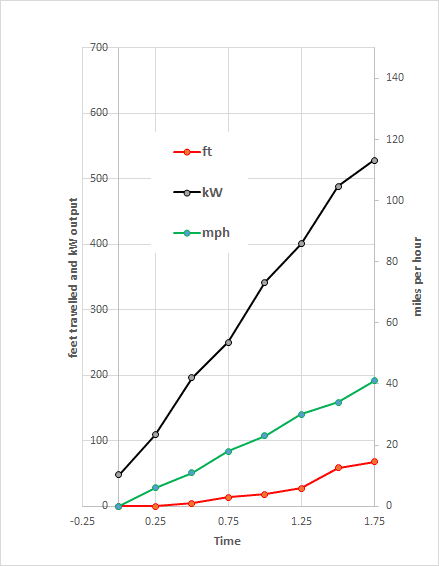
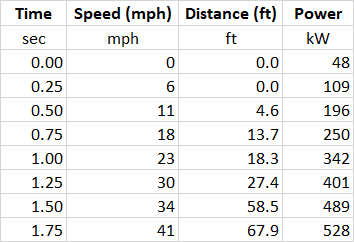
upload_2017-9-2_18-9-4.png


upload_2017-9-2_18-7-43.png


Time
Speed (mph) Distance (ft) Power
sec mph ft kW
0.00 0 0.0 48
0.25 6 0.0 109
0.50 11 4.6 196
0.75 18 13.7 250
1.00 23 18.3 342
1.25 30 27.4 401
1.50 34 58.5 489
1.75 41 67.9 528
 
Physics news on Phys.org
Do you know the equation relating torque and power? Can you relate speed to it using the physical properties of your device (which you have not provided...)?
 
The formula I know is Torque = Power / Angular Speed

which in this case for the second sample of 6 mph and 109 kW I believe to be

(109*1000)/((63360*6*9.73)/(60*86.9)*2*PI()/60) or 1467 Nm

where 63360 is inches per mile, 9.73 is the fixed gear ratio, 60 converts hours to minutes and 86.9 is the tire circumference in inches.

But I suspect that this 1467 Nm number overestimates the actual torque because of errors in recorded velocity. I suspect that the final entry of 41 mph and 528 kW which gives 1040 Nm is closer to the actual torque, but that the torque is actually constant for this range and the error in velocity can be worked around by instead using the change in power over time. But I don't know how to do that.
 
Last edited by a moderator:
For simple comparison, I think the same thought process can be followed as a block slides down a hill, - for block down hill, simple starting PE of mgh to final max KE 0.5mv^2 - comparing PE1 to max KE2 would result in finding the work friction did through the process. efficiency is just 100*KE2/PE1. If a mousetrap car travels along a flat surface, a starting PE of 0.5 k th^2 can be measured and maximum velocity of the car can also be measured. If energy efficiency is defined by...

Similar threads

  • · Replies 12 ·
Replies
12
Views
11K
  • · Replies 10 ·
Replies
10
Views
3K
  • · Replies 17 ·
Replies
17
Views
3K
Replies
25
Views
5K
  • · Replies 6 ·
Replies
6
Views
30K
Replies
8
Views
3K
  • · Replies 27 ·
Replies
27
Views
21K
  • · Replies 1 ·
Replies
1
Views
2K
  • · Replies 6 ·
Replies
6
Views
2K
Replies
4
Views
1K