Expanding second-order Runge-Kutta formula with series

3 replies · 2K views · last reply
jkthejetplane
Messages
29
Reaction score
4
Homework Statement
2nd order Runge Kutta problem
Relevant Equations
Second order Runge Kutta
So here's my homework question:
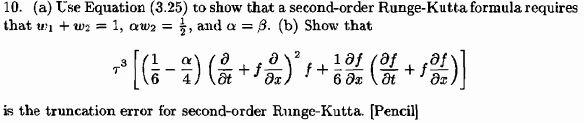
Printed homework problem 10 with part (a) and (b): show that a second-order Runge-Kutta formula gives truncation error tau cubed times the bracketed partial derivative expression of f.


This is the reference formula along with the Rung-Kutta form with the variables mentioned in the question
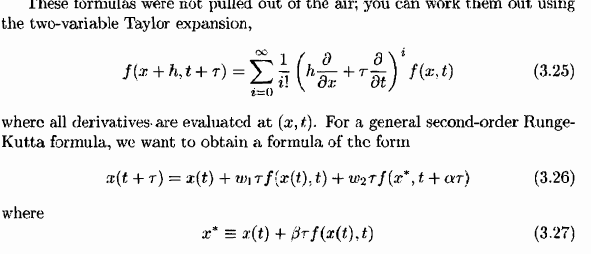
Printed textbook page showing the two-variable Taylor expansion f(x+h, t+τ) as a sum of (h d/dx + τ d/dt)^i f(x,t)/i!, followed by the second-order Runge-Kutta form x(t+τ) = x(t) + w1 τ f(x(t),t) + w2 τ f(x*, t+ατ) with x* defined as x(t) + βτ f(x(t),t).


Here is my attempt so far:
Handwritten homework solution on lined paper titled Homework #4, showing problem 3.9a: show that a second-order RK formula requires v1 + v2 = 1, a v2 = 1/2, and alpha = beta, with a Taylor series expansion of f(x+h, t+tau) and its third-order terms.


Problem is that i am unsure how to expand this to even get going. I tried referencing my text Math Methods by Boas which has a lot on series and expansion but I am kinda stumped. Even after i get it expanded I am not entirely sure where to go with it
Any help? This class is killing me haha

Thanks in advance
 
Attachments
  • Equation (3.25): f(x + h, t + τ) equals the sum from i = 0 to infinity of (1/i!) times (h ∂/∂x + τ ∂/∂t) to the power i, applied to f(x, t).
    1602726359451.png
    2.2 KB · Views: 221
  • Printed textbook page showing the two-variable Taylor expansion of f(x+h, t+tau) as a sum of derivative operators, equation 3.25, and the second-order Runge-Kutta form x(t+tau) with weights w1 and w2, equations 3.26 and 3.27.
    1602726436520.png
    11.5 KB · Views: 230
You need to expand [itex]x(t + \tau)[/itex] to third order in [itex]\tau[/itex], and compare that to what you get from expanding [tex] x(t + \tau) \approx x(t) + w_1 \tau f(x(t),t) + w_2 \tau f(x(t) + \beta \tau f(x(t),t), t + \alpha \tau)[/tex] to third order in [itex]\tau[/itex] (which means that [itex]f(x(t) + \beta \tau f(x(t),t), t + \alpha \tau)[/itex] only has to be expanded to second order, as it is already multiplied by [itex]\tau[/itex]).

Remember that by definition [tex]\frac{dx}{dt}(t) = f(x(t),t)[/tex] and that by the chain rule [tex] \frac{d^n}{dt^n}f(x(t),t) = \left(\frac{dx}{dt}\frac{\partial }{\partial x} + \frac{\partial }{\partial t}\right)^n f<br /> = \left(f\frac{\partial}{\partial x} + \frac{\partial}{\partial t}\right)^n f.[/tex]
 
  • Like
Likes   Reactions: scottdave and etotheipi
What does eq 3.25 have to do with it? and i have no idea how to expand either of those
 
[tex]\begin{align*}<br /> \left(f\frac{\partial}{\partial x} + \frac{\partial}{\partial t}\right)^2f &=<br /> \left(f\frac{\partial}{\partial x} + \frac{\partial}{\partial t}\right)\left(f\frac{\partial f}{\partial x} + \frac{\partial f}{\partial t}\right) \\<br /> & = f\frac{\partial}{\partial x}\left(f\frac{\partial f}{\partial x} + \frac{\partial f}{\partial t}\right) + \frac{\partial}{\partial t}\left(f\frac{\partial f}{\partial x} + \frac{\partial f}{\partial t}\right)<br /> \end{align*}[/tex] etc.