Experiments to distinguish 3-body and 2-body decays?

Click For Summary

Discussion Overview

The discussion revolves around the experimental methods to distinguish between two-body and three-body decays in particle physics, specifically focusing on the decays of pions and muons. Participants explore the implications of energy spectra and conservation laws in these decay processes.

Discussion Character

  • Exploratory
  • Technical explanation
  • Debate/contested
  • Mathematical reasoning

Main Points Raised

  • Some participants inquire about experiments that can differentiate between two-body and three-body decays, particularly in the context of pion and muon decays.
  • It is suggested that the energy spectrum of visible decay products can be measured, with two-body decays producing muons at the same energy and three-body decays resulting in a continuous energy spectrum.
  • One participant presents a mathematical framework for analyzing the energy of muons in the rest frame of the pion, noting that the energy of the muon is fixed under certain conditions.
  • Another participant discusses the implications of momentum conservation in three-body decays, indicating that the momenta of decay products can vary, leading to a continuous spectrum of energies.
  • There is a mention of how the difference in degrees of freedom between two-body and three-body decays affects the number of solutions available for momentum and energy conservation equations.

Areas of Agreement / Disagreement

Participants express differing views on the specifics of energy spectra in two-body versus three-body decays, and there is no consensus on the exact nature of the experiments currently being conducted to observe these decays.

Contextual Notes

Some mathematical steps and assumptions in the discussions remain unresolved, and the dependence on specific definitions of decay processes is noted.
unscientific
Messages
1,728
Reaction score
13
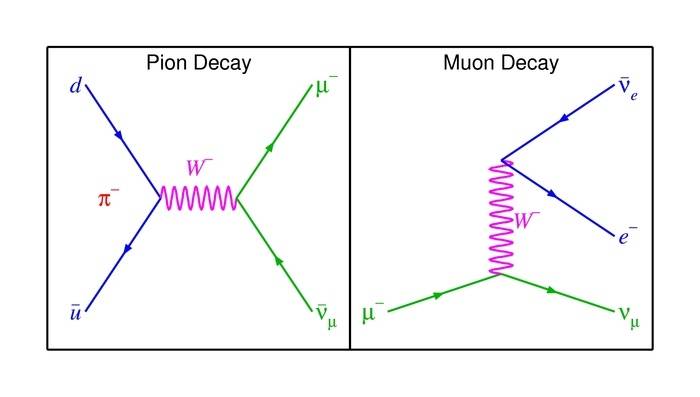
I was wondering are there any experiments to distinguish between 2 and 3-body decays? For example, consider decay of the muon and the pion:
7RsFo.jpg


The pion only emits 1 muon neutrino ("missing energy") and 1 muon. The muon however, emits 1 muon neutrino, 1 electron neutrino and 1 electron.

How is it established experimentally that the pion only emits 1 neutrino whereas the muon emits 2 neutrinos?
 
  • Like
Likes   Reactions: Buzz Bloom
Physics news on Phys.org
Well, there are experiments to see the neutrinos, but you can measure the energy spectrum of the visible decay product: a two.body decay produces all muons at the same energy (in the pion rest frame), in a three-body decay you get a continuous energy spectrum.
 
  • Like
Likes   Reactions: Buzz Bloom
In the rest frame of the pion the muon will carry an energy of E_\mu=\dfrac{m_\pi}{2}.
In the same result for the muon the electron will have to carry less energy...
 
mfb said:
there are experiments to see the neutrinos,
^ also that ^_^ however I don't know whether there are experiments actually going on with muon decays...
 
mfb said:
Well, there are experiments to see the neutrinos, but you can measure the energy spectrum of the visible decay product: a two.body decay produces all muons at the same energy (in the pion rest frame), in a three-body decay you get a continuous energy spectrum.

Why is it that in a 2 body decay all muons are produced at the same energy? Since ##E_{cm} = E_\nu + E_\mu##, shouldn't there be a spectrum as well?
 
In the rest frame of the pion you initially have a four-momentum:

P_{in} = \begin{pmatrix} m_\pi \\ \vec{0} \end{pmatrix}~~,~~P_{fin}= \begin{pmatrix} E_\mu + E_\nu \\ \vec{p}_\mu + \vec{p}_\nu \end{pmatrix}~~,~~ E_\nu = \sqrt{|p_\nu|^2 + m_\nu^2} \approx |p_\nu|

conservation of momentum tells you that:
\vec{p}_\nu = -\vec{p}_\mu \Rightarrow E_\nu = |\vec{p}_\mu|

So you have:
P_{fin}= \begin{pmatrix} E_\mu + |\vec{p}_\mu| \\ \vec{0} \end{pmatrix}

Take the square equality (I am not sure whether my equations are correct BUT by the fact that I already wrote that \vec{p}_\nu = - \vec{p}_\mu you should already get your answer- in particular they should be fixed numbers for the given decay since you can only have 1 variable):
E_\mu^2 + |p_\mu|^2 + 2 E_\mu |p_\mu| = m_\pi^2
2 |p_\mu|^2 + 2E_\mu |p_\mu| = m_\pi^2 - m_\mu^2
\sqrt{m_\mu^2 + |p_\mu|^2}= \dfrac{ m_\pi^2 - m_\mu^2}{2|p_\mu|}- |p_\mu|
m_\mu^2 + |p_\mu|^2 = \Big( \dfrac{ m_\pi^2 - m_\mu^2}{2|p_\mu|}\Big)^2+ |p_\mu|^2- (m_\pi^2 - m_\mu^2)
m_\mu^2 +(m_\pi^2 - m_\mu^2)= \dfrac{ (m_\pi^2 - m_\mu^2)^2}{4|p_\mu|^2}

|p_\mu|= \frac{1}{2} \sqrt{\dfrac{ (m_\pi^2 - m_\mu^2)^2}{m_\mu^2 +(m_\pi^2 - m_\mu^2)}}
which is a fixed number and so is the muon energy...
Forget my m_pi/2 that would be the case for equally massive produced particles.
 
Last edited:
  • Like
Likes   Reactions: Buzz Bloom and unscientific
In a 3 body decay 1 \rightarrow 2+3+4 the condition for momentum conservation in the rest frame of 1 would be:
\vec{p}_2= - \vec{p}_3 - \vec{p}_4
Which doesn't give a fixed number anymore , you can change 3 and 4 freely to keep the equality. In particular if I say that \vec{p}_3,\vec{p}_4 are such to give the equality right, then \vec{p}_3^\prime= \vec{p}_3 +\vec{a} and \vec{p}_4^\prime= \vec{p}_4 - \vec{a} can still keep the equality. This gives an ambiguity in the momenta and so the energies which results in a continuous spectrum.

That is a general fact difference between 2 and 3 body decays, and it was the reason why neutrinos were first demonstrated.
 
Last edited:
  • Like
Likes   Reactions: Buzz Bloom and unscientific
ChrisVer said:
That is a general fact difference between 2 and 3 body decays, and it was the reason why neutrinos were first demonstrated.
Good point.

Another way to see the difference:
2-body decay: let the x-direction be along the motion of one particle, the other will then move in negative x direction. You get two unknowns (the momenta of the two particle), and two conservation laws - energy and momentum. The result is a single solution.
3-body decay: suddenly you get 1+2+2 unknowns (you have to take the second dimension into account), and only 3 conservation laws (energy, and momentum in two dimensions). That leaves two degrees of freedom for the decay mechanism.
 
  • Like
Likes   Reactions: Buzz Bloom

Similar threads

  • · Replies 0 ·
Replies
0
Views
3K
  • · Replies 0 ·
Replies
0
Views
4K
Replies
2
Views
3K
  • · Replies 17 ·
Replies
17
Views
2K
  • · Replies 4 ·
Replies
4
Views
5K
  • · Replies 4 ·
Replies
4
Views
4K
  • · Replies 1 ·
Replies
1
Views
2K
  • · Replies 13 ·
Replies
13
Views
5K
Replies
13
Views
3K
  • · Replies 11 ·
Replies
11
Views
3K