Explain how condersor microphone operates

  • Thread starter Thread starter thisischris
  • Start date Start date
  • Tags Tags
    Explain
Click For Summary
SUMMARY

The condenser microphone operates by utilizing sound waves to cause a flexible front plate to vibrate, which alters the capacitance between two plates. When the plates move closer together, the capacitance increases, while moving them apart decreases it. This change in capacitance generates an alternating output signal that corresponds to the sound wave's amplitude. The relationship between the charge on the capacitor and the sound vibrations is defined by the formula Q = VC = VεA/s, demonstrating that the current produced is directly proportional to the speed of vibration, effectively mirroring the sound wave.

PREREQUISITES
  • Understanding of capacitor function and capacitance principles
  • Familiarity with sound wave mechanics and vibration theory
  • Knowledge of electrical current and voltage relationships
  • Basic grasp of differential calculus for analyzing charge variation
NEXT STEPS
  • Study the principles of capacitor charging and discharging in detail
  • Learn about the physics of sound waves and their interaction with electronic components
  • Explore the mathematical modeling of electrical signals in microphones
  • Investigate the design and operation of different types of microphones, including dynamic and ribbon microphones
USEFUL FOR

Audio engineers, electronics students, sound designers, and anyone interested in the technical workings of microphones and sound capture technology.

thisischris
Messages
26
Reaction score
1
The sound waves cause the felxible front plate to vibrate and change the capacitance. Moving the plates closer togther increases the capacitance. Moving the plates apart decreases the capacitance.

Explain how the sound wave produces an alternating output signal.
Heres a picture of the diagram:
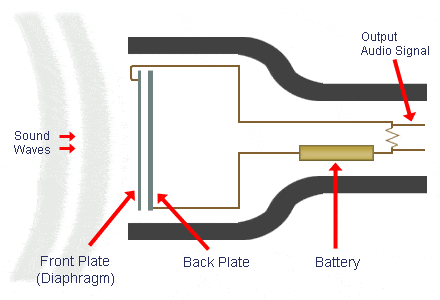
mic-condenser.gif


I have trouble understanding/predicting the behavior of an increased / decreased capacitance would have 'across the capacitor', specially with the fact that I'd assume it wouldn't perfectly match the audio wave due to 'charging/discharging' time.

Example of 'event'
'Charges until pd across capacitor equals pd across cell' , sound wave applied forces the capacitor closer, hence pd drops across capacitor, hence increase in pd across resistor?

Could anyone mention if the above is a suitable/correct explanation?
 
Physics news on Phys.org
thisischris said:
The sound waves cause the felxible front plate to vibrate and change the capacitance. Moving the plates closer togther increases the capacitance. Moving the plates apart decreases the capacitance.

Explain how the sound wave produces an alternating output signal.
I have trouble understanding/predicting the behavior of an increased / decreased capacitance would have 'across the capacitor', specially with the fact that I'd assume it wouldn't perfectly match the audio wave due to 'charging/discharging' time.

Example of 'event'
'Charges until pd across capacitor equals pd across cell' , sound wave applied forces the capacitor closer, hence pd drops across capacitor, hence increase in pd across resistor?

Could anyone mention if the above is a suitable/correct explanation?
Think of the capacitor consisting of two membranes/plates separated by a distance s to which a constant voltage V is applied. s is much greater than the amplitude, ds, of the sound vibrations. Using the formula for charge Q on the capacitor you can show that the charge will vary in time in a way that is proportional to the amplitude of the sound vibrations:

The charge, Q, on the plates depends on the separation s according to:

Q = VC = VεA/s

dQ = VεA(1/s - 1/(s-ds)) = VεAds/(s^2-sds) ≈ Kds since s^2>>sds

So: dQ/dt ≈ Kds/dt

Since ds/dt is the speed of vibration and dQ/dt is the current, you can see that the microphone will produce a current whose amplitude is directly proportional to the speed of vibration. The speed of vibration is simply the first derivative of the amplitude so it has identical shape as the sound wave. So the current is a perfect analog of the sound.

AM
 
The book claims the answer is that all the magnitudes are the same because "the gravitational force on the penguin is the same". I'm having trouble understanding this. I thought the buoyant force was equal to the weight of the fluid displaced. Weight depends on mass which depends on density. Therefore, due to the differing densities the buoyant force will be different in each case? Is this incorrect?

Similar threads

Replies
20
Views
2K
  • · Replies 4 ·
Replies
4
Views
4K
Replies
10
Views
5K
  • · Replies 4 ·
Replies
4
Views
2K
Replies
16
Views
3K
  • · Replies 2 ·
Replies
2
Views
3K
  • · Replies 9 ·
Replies
9
Views
11K
Replies
16
Views
4K
Replies
2
Views
5K
  • · Replies 1 ·
Replies
1
Views
17K