thisischris
- 26
- 1
The sound waves cause the felxible front plate to vibrate and change the capacitance. Moving the plates closer togther increases the capacitance. Moving the plates apart decreases the capacitance.
Explain how the sound wave produces an alternating output signal.
Heres a picture of the diagram:
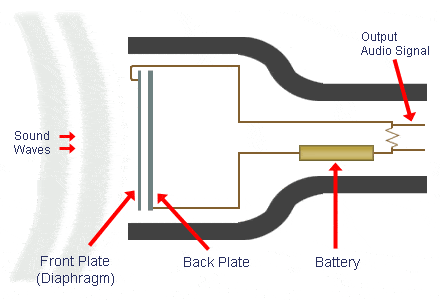
I have trouble understanding/predicting the behavior of an increased / decreased capacitance would have 'across the capacitor', specially with the fact that I'd assume it wouldn't perfectly match the audio wave due to 'charging/discharging' time.
Example of 'event'
'Charges until pd across capacitor equals pd across cell' , sound wave applied forces the capacitor closer, hence pd drops across capacitor, hence increase in pd across resistor?
Could anyone mention if the above is a suitable/correct explanation?
Explain how the sound wave produces an alternating output signal.
Heres a picture of the diagram:
I have trouble understanding/predicting the behavior of an increased / decreased capacitance would have 'across the capacitor', specially with the fact that I'd assume it wouldn't perfectly match the audio wave due to 'charging/discharging' time.
Example of 'event'
'Charges until pd across capacitor equals pd across cell' , sound wave applied forces the capacitor closer, hence pd drops across capacitor, hence increase in pd across resistor?
Could anyone mention if the above is a suitable/correct explanation?