SUMMARY
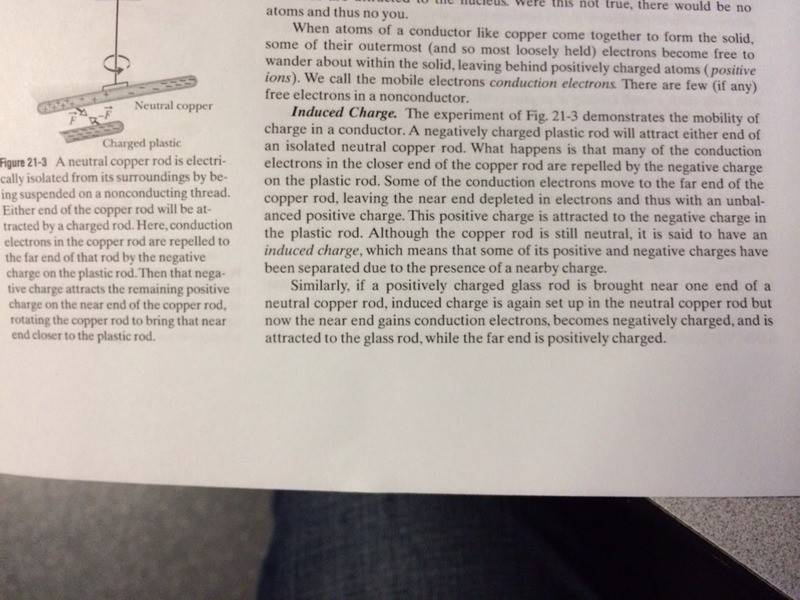
The discussion clarifies the interaction between positive and negative charges, specifically how they repel and attract each other. When a negatively charged plastic rod is brought near a copper rod, the free electrons in the copper are repelled, causing them to move to the far end of the copper rod. This movement results in the near end of the copper rod becoming positively charged, which is then attracted to the negatively charged plastic rod. The forces at play include the repulsion of electrons and the attraction of the positive charge created at the near end of the copper rod.
PREREQUISITES
- Understanding of basic electrostatics
- Familiarity with charge interactions (positive and negative)
- Knowledge of electron behavior in conductive materials
- Concept of electric fields and forces
NEXT STEPS
- Research the principles of electrostatics in depth
- Learn about electric fields and their effects on charged particles
- Study the behavior of conduction electrons in various materials
- Explore practical applications of charge interactions in electronics
USEFUL FOR
Students of physics, educators explaining electrostatics, and anyone interested in understanding the fundamental principles of electric charge interactions.