SUMMARY
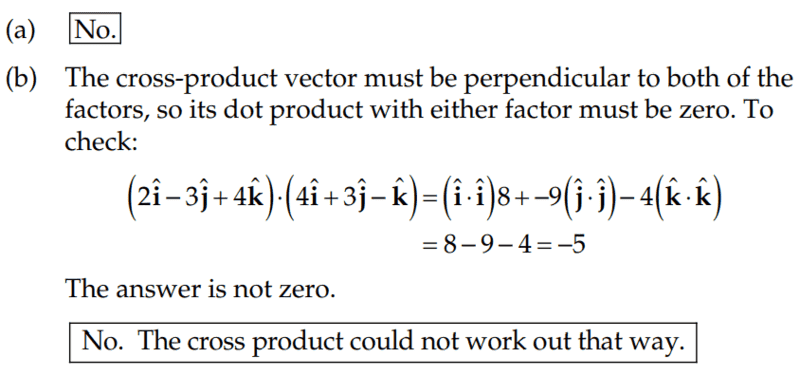
The discussion centers on the mathematical concepts of the cross product and dot product of vectors, specifically addressing the relationship between two vectors, B and C, derived from the cross product of A and B. It is established that the angle between B and C is 90 degrees, as the cross product results in a vector that is orthogonal to the plane formed by A and B. The conversation clarifies that the scalar product of two vectors is a single value, and for two vectors to be orthogonal, their dot product must equal zero. Non-orthogonal vectors do not have a specific term beyond "non-orthogonal."
PREREQUISITES
- Understanding of vector operations, specifically cross product and dot product.
- Familiarity with the geometric interpretation of vectors in a Cartesian coordinate system.
- Knowledge of trigonometric functions, particularly sine and cosine.
- Basic proficiency in LaTeX for typesetting mathematical expressions.
NEXT STEPS
- Study the properties of vector orthogonality and their implications in physics and engineering.
- Explore the applications of cross product in calculating torque and angular momentum.
- Learn about vector projections and their relationship to dot products.
- Investigate advanced vector calculus topics, such as gradient, divergence, and curl.
USEFUL FOR
Students of mathematics, physics, and engineering, as well as educators seeking to clarify vector operations and their applications in various fields.