Math Amateur
Gold Member
MHB
- 3,920
- 48
I am reading Anderson and Feil - A First Course in Abstract Algebra.
I am currently focused on Ch. 8: Integral Domains and Fields ...
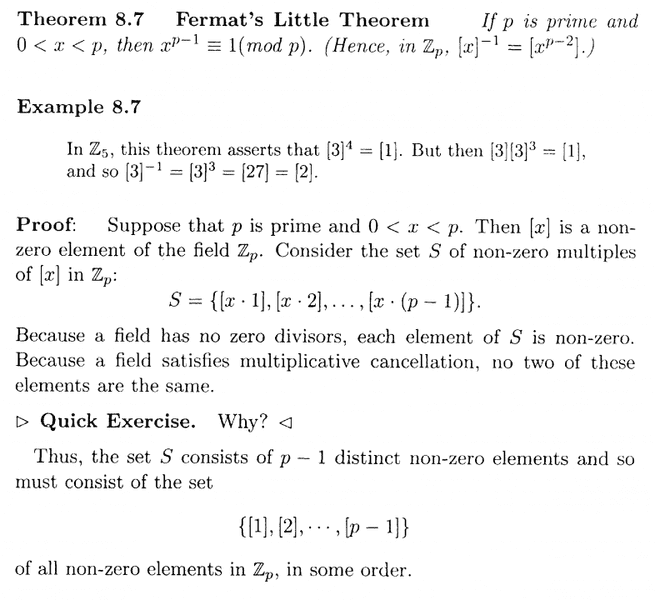
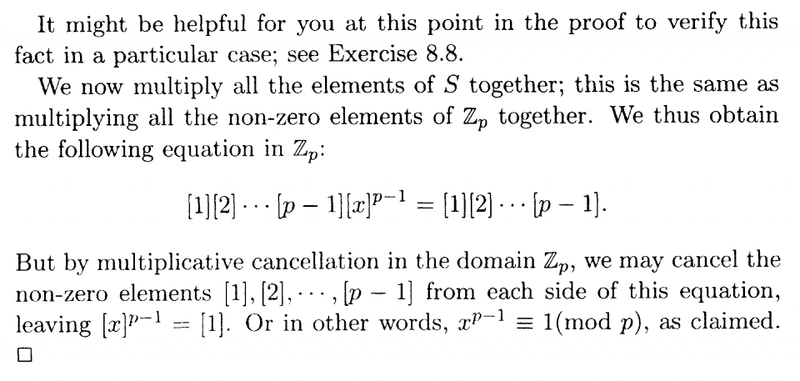
I need some help with an aspect of the proof of Theorem 8.7 (Fermat's Little Theorem) ...
Theorem 8.7 and its proof read as follows:
 My questions regarding the above are as follows:
Question 1
In the above text from Anderson and Feil we read the following:
" ... ... Because a field has no zero divisors, each element of ##S## is non-zero ... "Can someone please demonstrate exactly why this follows ... ?
Question 2
In the above text from Anderson and Feil we read the following:" ... ... Because a field satisfies multiplicative cancellation, no two of these elements are the same .. ... "Can someone please demonstrate exactly why it follows that no two of the elements of ##S## are the same .. ... "
Help will be appreciated ...
Peter*** EDIT ***
oh dear ... can see that the answer to Question 1 is obvious ... indeed it follows from the definition of zero divisor ... apologies ... brain not in gear ...
I am currently focused on Ch. 8: Integral Domains and Fields ...
I need some help with an aspect of the proof of Theorem 8.7 (Fermat's Little Theorem) ...
Theorem 8.7 and its proof read as follows:
Question 1
In the above text from Anderson and Feil we read the following:
" ... ... Because a field has no zero divisors, each element of ##S## is non-zero ... "Can someone please demonstrate exactly why this follows ... ?
Question 2
In the above text from Anderson and Feil we read the following:" ... ... Because a field satisfies multiplicative cancellation, no two of these elements are the same .. ... "Can someone please demonstrate exactly why it follows that no two of the elements of ##S## are the same .. ... "
Help will be appreciated ...
Peter*** EDIT ***
oh dear ... can see that the answer to Question 1 is obvious ... indeed it follows from the definition of zero divisor ... apologies ... brain not in gear ...
Attachments

