Fermat's Little Theorem proof: multiplicative cancellation in fields

  • Level: Undergrad 
  • Thread starter Math Amateur
  • Start date
  • Tags Tags
    Theorem
3 replies · 3K views · last reply
Math Amateur
Gold Member
MHB
Messages
3,920
Reaction score
48
I am reading Anderson and Feil - A First Course in Abstract Algebra.

I am currently focused on Ch. 8: Integral Domains and Fields ...

I need some help with an aspect of the proof of Theorem 8.7 (Fermat's Little Theorem) ...

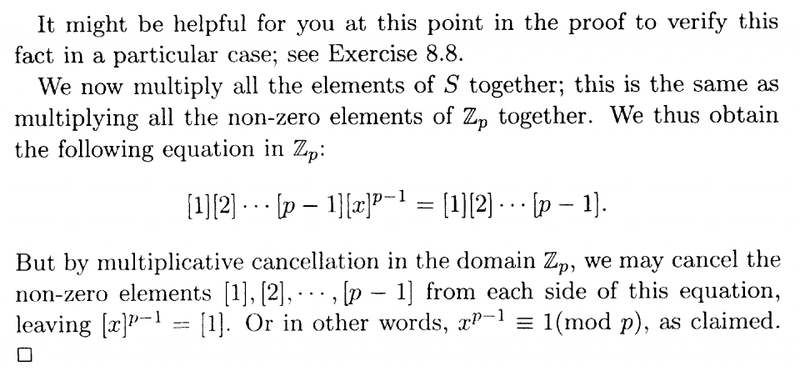
Theorem 8.7 and its proof read as follows:
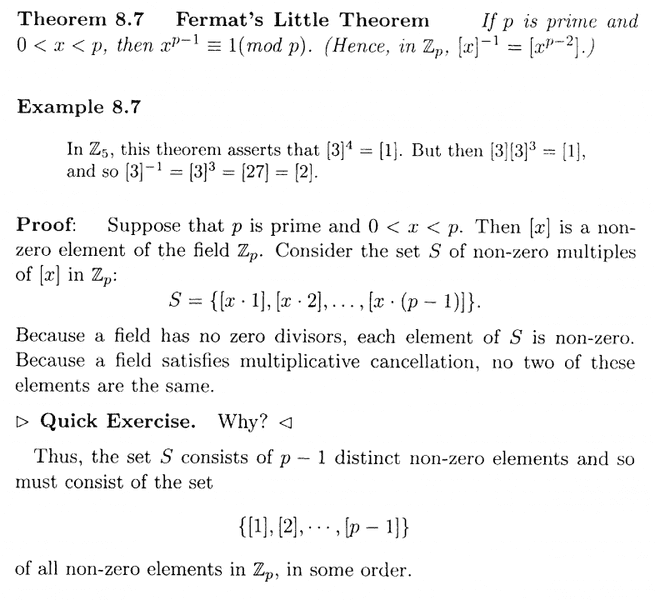
Textbook page showing Theorem 8.7 (Fermat's Little Theorem), Example 8.7 in Z_5, and the proof that the multiples [x*1], ..., [x*(p-1)] are distinct non-zero elements of Z_p.

Printed text from a textbook proof: the equation [1][2]...[p-1][x]^(p-1) = [1][2]...[p-1] in Z_p, followed by cancellation of the nonzero elements to get [x]^(p-1) = [1], i.e. x^(p-1) = 1 (mod p).
My questions regarding the above are as follows:
Question 1

In the above text from Anderson and Feil we read the following:

" ... ... Because a field has no zero divisors, each element of ##S## is non-zero ... "Can someone please demonstrate exactly why this follows ... ?

Question 2

In the above text from Anderson and Feil we read the following:" ... ... Because a field satisfies multiplicative cancellation, no two of these elements are the same .. ... "Can someone please demonstrate exactly why it follows that no two of the elements of ##S## are the same .. ... "
Help will be appreciated ...

Peter*** EDIT ***

oh dear ... can see that the answer to Question 1 is obvious ... indeed it follows from the definition of zero divisor ... apologies ... brain not in gear ...
 
Attachments
  • Textbook page showing Theorem 8.7 (Fermat's Little Theorem), Example 8.7 in Z5, and the proof that the nonzero multiples of [x] in Z_p are all distinct, with a Quick Exercise and the conclusion that they form all nonzero elements of Z_p.
    Anderson and Feil - 1 - Theorem 8.7 ... PART 1 ... ....png
    34.6 KB · Views: 4,113
  • Printed text from a textbook proof in Z_p: the product of all nonzero elements [1][2]...[p-1][x]^(p-1) equals [1][2]...[p-1], then cancellation gives [x]^(p-1) = [1], i.e. x^(p-1) ≡ 1 (mod p).
    Anderson and Feil - 2 - Theorem 8.7 ... PART 2 ... ....png
    35.3 KB · Views: 1,003
Math Amateur said:
Question 2
In the above text from Anderson and Feil we read the following:
" ... ... Because a field satisfies multiplicative cancellation, no two of these elements are the same .. ... "
Can someone please demonstrate exactly why it follows that no two of the elements of ##S## are the same .. ... "
It's also obvious. If we assumed ##[x\cdot n]=[x\cdot m]## then what would this mean? You can use all field operations and again the lack of zero divisors. In general, the question to be answered is: why do fields allow multiplicative cancellations? The reason doesn't require this special field, so you may as well prove: ##a\cdot m = b \cdot m \Longrightarrow a = b## for ##a,b \neq 0## of course.
 
  • Like
Likes   Reactions: Math Amateur
Thanks for the help fresh_42 ... grateful for your help ...

If ##[ x \cdot n ] = [ x \cdot m ]## then by cancellation in a field, we have n = m which cannot be the case for the members of the set S ...

Cancellation works in fields since every element of a field has an inverse ...

... so if ##a \cdot m = b \cdot m## then we can post-multiply by ##m^{-1}## and get ##a = b## ...

Hope that's right ...

Peter
 
Math Amateur said:
Thanks for the help fresh_42 ... grateful for your help ...

If ##[ x \cdot n ] = [ x \cdot m ]## then by cancellation in a field, we have n = m which cannot be the case for the members of the set S ...

Cancellation works in fields since every element of a field has an inverse ...

... so if ##a \cdot m = b \cdot m## then we can post-multiply by ##m^{-1}## and get ##a = b## ...

Hope that's right ...

Peter
Well, partially. You cannot rule out the case ##m=0## at prior and operate with ##m^{-1}##.

Therefore wait as long as you can with additional assumptions.

This is more of a general advice. Instead operate without (multiplicative) inverse elements.
 
  • Like
Likes   Reactions: Math Amateur