Discussion Overview
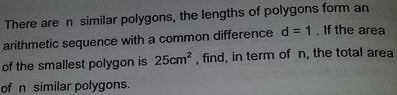
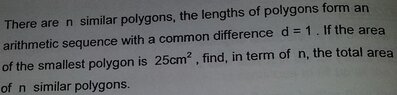
The discussion revolves around finding the total area of n similar polygons, specifically in terms of n. Participants explore various approaches to derive an expression for the area, considering different types of polygons and sequences of side lengths. The context includes geometric reasoning and mathematical summation techniques.
Discussion Character
- Exploratory
- Mathematical reasoning
- Debate/contested
Main Points Raised
- One participant expresses difficulty in solving the problem due to the lack of clarity on how to determine the length of the first polygon, resulting in an expression with two variables.
- Another participant proposes that the lengths of the polygons form an arithmetic sequence and provides a method to calculate the total area of squares based on their side lengths.
- A different participant assumes all polygons are regular and uses a specific formula for the area, leading to a complex summation that they believe does not yield the expected solution.
- Some participants question the wording of the problem, particularly the term "length," and suggest that it should specify "length of side" to avoid confusion.
- One participant acknowledges a misunderstanding of a previous reply and suggests that the approach taken may be applicable to a more general case beyond just squares.
- Another participant notes that the problem wording is poor and suggests that it should clarify the type of polygons being discussed.
Areas of Agreement / Disagreement
Participants express differing views on the interpretation of the problem and the methods used to derive the area. There is no consensus on a single approach or solution, and several competing models and interpretations remain unresolved.
Contextual Notes
Participants highlight limitations in the problem's wording, particularly regarding the definition of "length" and the assumption of regular versus irregular polygons. The discussion reflects uncertainty about the applicability of certain methods to different types of polygons.