Find Derivative: Solve G'(3) Problem

  • Context: MHB 
  • Thread starter Thread starter Teh
  • Start date Start date
  • Tags Tags
    Derivative
Click For Summary
SUMMARY

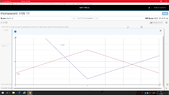
The discussion focuses on calculating the derivative G'(3) for the function G(x) defined as G(x) = 6f(x) - g(x). The derivative is expressed as G'(x) = 6f'(x) - g'(x), leading to G'(3) = 6f'(3) - g'(3). Participants determined that f'(3) = -3 and g'(3) = 1, resulting in G'(3) = 6(-3) - 1 = -19.

PREREQUISITES
  • Understanding of derivatives and their notation
  • Familiarity with the concept of rise over run in calculus
  • Knowledge of function notation and evaluation
  • Ability to interpret graphical representations of functions
NEXT STEPS
  • Study the concept of derivatives in calculus, focusing on the product and chain rules
  • Learn how to analyze graphs to determine slopes and derivatives
  • Explore the implications of derivative values in real-world applications
  • Investigate the relationship between a function and its derivative through graphical methods
USEFUL FOR

Students studying calculus, educators teaching derivative concepts, and anyone interested in understanding the application of derivatives in function analysis.

Teh
Messages
47
Reaction score
0
View attachment 6132

Does it want me to plug in G'(3) into the equation?
 

Attachments

  • mathhwk11(1).png
    mathhwk11(1).png
    39.5 KB · Views: 96
Physics news on Phys.org
We are told:

$$G(x)=6f(x)-g(x)$$

And so we know:

$$G'(x)=6f'(x)-g'(x)$$

which means:

$$G'(3)=6f'(3)-g'(3)$$

So, what you need to do is determine from the graph the values of $f'(3)$ and $g'(3)$, and plug them into the above...:D
 
MarkFL said:
We are told:

$$G(x)=6f(x)-g(x)$$

And so we know:

$$G'(x)=6f'(x)-g'(x)$$

which means:

$$G'(3)=6f'(3)-g'(3)$$

So, what you need to do is determine from the graph the values of $f'(3)$ and $g'(3)$, and plug them into the above...:D
will it be -26 when G'(3)
 
the said:
will it be -26 when G'(3)

What values do you get from the graph for $f'(3)$ and $g'(3)$?
 
MarkFL said:
What values do you get from the graph for $f'(3)$ and $g'(3)$?

you get f'(3) = 6 and g'(3) = 1
 
Around $x=3$, observe that for every increase of 1 unit in $x$, we find $f$ decreases by 3 units...thus $f'(3)=-3$, and I agree that $g'(3)=1$.
 
MarkFL said:
Around $x=3$, observe that for every increase of 1 unit in $x$, we find $f$ decreases by 3 units...thus $f'(3)=-3$, and I agree that $g'(3)=1$.

how did you get -3 from f'(3)?
 
the said:
how did you get -3 from f'(3)?

Rise over run...rise is -3 when run is 1...:D
 

Similar threads

Replies
5
Views
1K
  • · Replies 3 ·
Replies
3
Views
1K
  • · Replies 8 ·
Replies
8
Views
1K
  • · Replies 1 ·
Replies
1
Views
2K
  • · Replies 1 ·
Replies
1
Views
1K
  • · Replies 8 ·
Replies
8
Views
3K
  • · Replies 11 ·
Replies
11
Views
2K
  • · Replies 1 ·
Replies
1
Views
2K
  • · Replies 4 ·
Replies
4
Views
3K
  • · Replies 9 ·
Replies
9
Views
2K