Find f(x,y) s.t. z=f(x,y) defines a plane in R^3

  • Thread starter Thread starter gex
  • Start date Start date
  • Tags Tags
    Plane
Click For Summary
SUMMARY

The discussion centers on finding a function f(x,y) such that z = f(x,y) defines a plane in R^3. A user initially struggled with the approach but received guidance to set f(x,y) = ax + by + c, where a, b, and c are unknown constants. By applying the given conditions, the user successfully determined the values of a, b, and c, leading to a solution for the problem. This method effectively demonstrates how to represent a plane using a linear function in three-dimensional space.

PREREQUISITES
  • Understanding of linear functions and their representation in R^3
  • Familiarity with the concept of planes in three-dimensional geometry
  • Basic knowledge of algebraic manipulation and solving equations
  • Experience with determining constants in mathematical functions
NEXT STEPS
  • Study the properties of linear equations in three-dimensional space
  • Learn about the geometric interpretation of functions in R^3
  • Explore the concept of gradients and normal vectors related to planes
  • Investigate applications of linear functions in computer graphics and modeling
USEFUL FOR

Students and educators in mathematics, particularly those studying geometry and algebra, as well as professionals in fields requiring spatial analysis and modeling.

gex
Messages
36
Reaction score
2
The Question:
Question.JPG

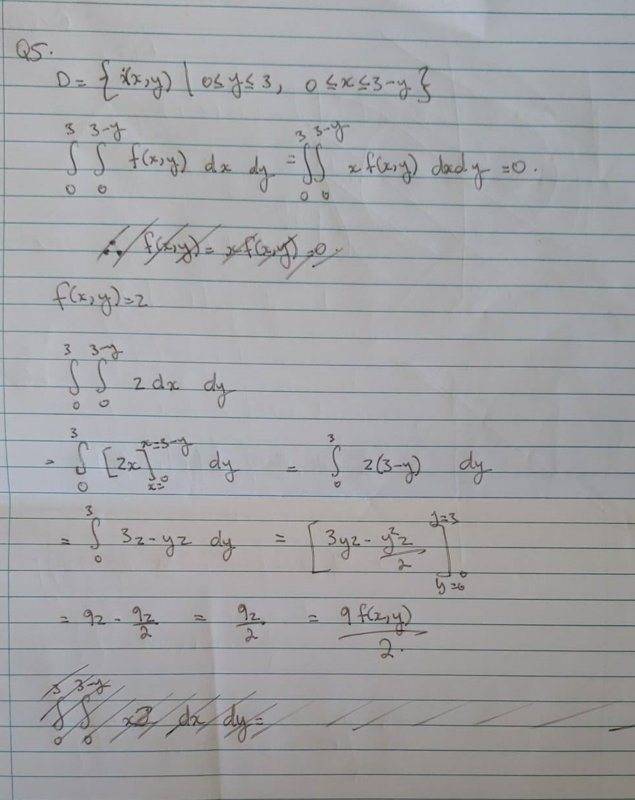
Attempt at a solution:
Sol attempt.jpg


I know for a fact that my attempt is fully wrong, but I am just grasping at straws here and have no clue how to approach this problem. Any help getting me to wrap my head around how to approach this is much appreciated. Thank you in advance.
 
Physics news on Phys.org
gex said:
The Question:
View attachment 240732
Attempt at a solution:
View attachment 240733

I know for a fact that my attempt is fully wrong, but I am just grasping at straws here and have no clue how to approach this problem. Any help getting me to wrap my head around how to approach this is much appreciated. Thank you in advance.

Try setting ##f(x,y) = ax + by + c## for some unknown constants ##a,b,c.## Using your given contitions you can eventually determine ##a,b## and ##c##.
 
Last edited:
  • Like
Likes   Reactions: gex
Ray Vickson said:
Try setting f(x,y)=ax+by+cf(x,y)=ax+by+cf(x,y) = ax + by + c for some unknown constants a,b,c.a,b,c.a,b,c. Using your given contitions you can eventually determine a,ca,ca,c and ccc.
Thank you so much Ray! I don't know how that didn't cross my mind. I successfully solved the problem now.
 

Similar threads

Replies
2
Views
2K
Replies
14
Views
4K
  • · Replies 14 ·
Replies
14
Views
2K
  • · Replies 6 ·
Replies
6
Views
2K
  • · Replies 2 ·
Replies
2
Views
2K
  • · Replies 3 ·
Replies
3
Views
2K
  • · Replies 15 ·
Replies
15
Views
3K
  • · Replies 3 ·
Replies
3
Views
2K
Replies
6
Views
2K
Replies
3
Views
1K