onelildustbunn
- 2
- 0
Hi guys! This is due tomorrow and I'm finally breaking down to ask for help in figuring it out.
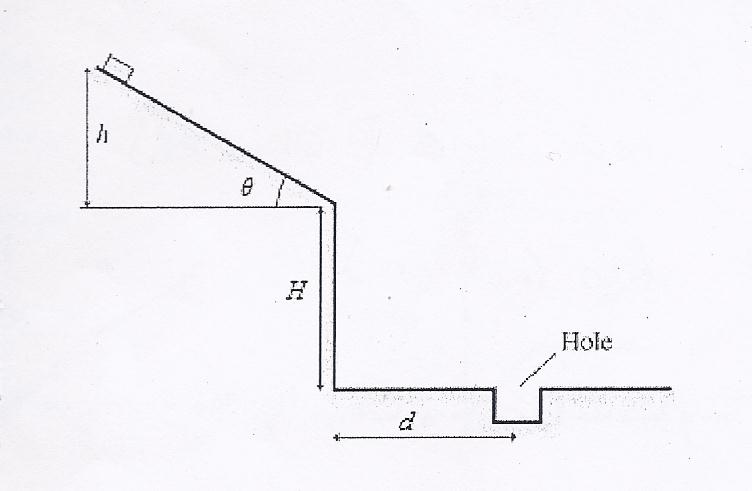
"A small block is placed at height h on a frictionless ramp, which is inclined by an angle θ from the horizontal. Upon release, the block slides down the ramp then falls a distance H to the floor. A small hole is located a distance D from the end of the ramp. Assume the block is released from rest when it is in the position shown in the diagram."
I'm on part D:
Now let H=1.0 m, d=1.0 m, and θ=30°. Find the height h.
Here's the diagram given for the problem:
Here is from part C (which definitely leads into part D):

The teacher hinted that we should consider the box on the ramp and the box in the air as two semi-separate parts of the problem, in the style that you find one and use it to find the other.
The kinematic equations:
Vf=Vi + aΔt
ΔS=ViΔt + 0.5a(Δt)2
Vf2= Vi2 +2aΔS
What I think needs to happen: I need to find out everything I can about the freefall portion first, especially V1 and V2. Then because I know V0 is 0 m/s (rest), and also that acceleration on the ramp is constant, I can find the distance traveled. Once I know the length of the ramp, simple trig can tell me its height.
My problems:
I haven't been given θ1 or θ2, which I need to calculate the velocities during freefall. How do I figure it out? Would I be wrong in thinking θ1=θ0, which I know is 30° (the ramp angle)?
Also, once I know everything about the freefall, how would I figure out the acceleration on the ramp? I don't know the object's mass so I can't use forces.
Any guidance appreciated! I'm not great with physics but I'm trying! )
)
Homework Statement
"A small block is placed at height h on a frictionless ramp, which is inclined by an angle θ from the horizontal. Upon release, the block slides down the ramp then falls a distance H to the floor. A small hole is located a distance D from the end of the ramp. Assume the block is released from rest when it is in the position shown in the diagram."
I'm on part D:
Now let H=1.0 m, d=1.0 m, and θ=30°. Find the height h.
Here's the diagram given for the problem:
Here is from part C (which definitely leads into part D):
The teacher hinted that we should consider the box on the ramp and the box in the air as two semi-separate parts of the problem, in the style that you find one and use it to find the other.
Homework Equations
The kinematic equations:
Vf=Vi + aΔt
ΔS=ViΔt + 0.5a(Δt)2
Vf2= Vi2 +2aΔS
The Attempt at a Solution
What I think needs to happen: I need to find out everything I can about the freefall portion first, especially V1 and V2. Then because I know V0 is 0 m/s (rest), and also that acceleration on the ramp is constant, I can find the distance traveled. Once I know the length of the ramp, simple trig can tell me its height.
My problems:
I haven't been given θ1 or θ2, which I need to calculate the velocities during freefall. How do I figure it out? Would I be wrong in thinking θ1=θ0, which I know is 30° (the ramp angle)?
Also, once I know everything about the freefall, how would I figure out the acceleration on the ramp? I don't know the object's mass so I can't use forces.
Any guidance appreciated! I'm not great with physics but I'm trying!
)