Find maximum of the function N(t) without Calculus

Join the discussion
Ask a follow-up here, or get your own question answered by working scientists, mathematicians and engineers — people, not an autocomplete.
Real named experts · corrections over time · the nuance an AI answer skips
14 replies · 2K views
Mathman2013
Messages
23
Reaction score
1
Homework Statement
Find maximum of N(t) without Calculus
Relevant Equations
N(t) = 1456*0.996^(t^2 - 48*t)
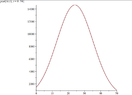
How would you go about finding maximum value for this function without Calculus? You can draw in it a CAS tool like Geogebra, NSpire or Maple. And use the maximise ability. But is possible to do it by hand? Pre-Calculus?
 
Physics news on Phys.org
BvU said:
PF guidelines ask you to post an attempt at solution before we can help.

When is something like this at a maximum ?

##\ ##
I have tried to say I take the internal function y=t^2-48*t and solve y =0, then t^2-48*t = 0, then I get t = 0 or t = 48, and it looks to be the function is symetrical, so if I divide by 48 by 2, I get t = 24, and N(24) = 14648.13868 which looks to be a maximum. But is there a better way?
 

Attachments

  • pg.png
    pg.png
    10.4 KB · Views: 203
caz said:
This is similar to maximizing 0.996^x. What does this say about x?
if x increases then N decreases?
 
caz said:
If you want to maximize N, what do you want x to do?
x to increase to. But why do I get the maximum point if solve the internal function as eqn: t^2-48*t=0 and divide one of the roots by two? Is it only do to symetry?
 
Mathman2013 said:
I have tried to say I take the internal function y=t^2-48*t and solve y =0, then t^2-48*t = 0, then I get t = 0 or t = 48, and it looks to be the function is symetrical, so if I divide by 48 by 2, I get t = 24, and N(24) = 14648.13868 which looks to be a maximum. But is there a better way?

I love the conditioned reaction to solve y = 0 and the ten digit accuracy of N(24), but unfortunately both are irrelevant here. The direct questions by @caz are more to the point.

If you want to maximize ##a^x## for a number ##a## between 0 and 1, what do you want for ##x## ? that it is zero, at a minimum, or at a maximum ?PS: @caz : in PF, we don't give the answer on a silver plate, but try to let the poster find his/her way towards the solution by him/herself using gentle nudges and inviting questions ...

##\ ##
 
Mathman2013 said:
x to increase to. But why do I get the maximum point if solve the internal function as eqn: t^2-48*t=0 and divide one of the roots by two? Is it only do to symetry?
Yes, if ##y=f(x)##, if it’s quadratic (something like ##f(x)=A x^2 + Bx + C## where ##A, B, C## are constants), then the point halfway between two zeros of ##f## will be either a maximum or a minimum.
 
Charles Link said:
I think the OP left off a minus sign for ## N(t) ##. Otherwise the function that he has will have a minimum and not a maximum. (His graph in post 3 is also incorrect otherwise).

No, the function is presented $$N(t)=1456 \cdot 0.996^{t^2-48 \cdot t}$$, where $$t \geq 0$$
 
  • Like
Likes   Reactions: BvU
My mistake. I didn't see the ^ in the OP. In any case ## t^2-48t=(t-24)^2-576 ##.
To do the arithmetic of ## .996^{-576} ## is the next problem. One possibility would be to use logarithms.
 
Last edited:
  • Like
Likes   Reactions: Mathman2013
For this equation, you indeed don't need calculus to know t that will maximize N(t). If you add a simple algebraic step, the answer will be shown more clearly.
 
  • Like
Likes   Reactions: Charles Link