Find net external work of a system w/ 2 objects w/ opposite forces

  • Thread starter Thread starter dcmf
  • Start date Start date
  • Tags Tags
    Net Work
Click For Summary
SUMMARY

The discussion centers on determining the net external work (Wext) of a two-object system experiencing opposite forces. Participants conclude that the work done on each object (Wa and Wb) is positive, leading to a net external work that is also positive, as the kinetic energy of the system increases. The distinction between total work done on the system and work done by the net force on the center of mass is emphasized, particularly in deformable systems. The consensus is that while the individual works are positive, the net work can be zero if considering the center of mass, but in this frictionless scenario, Wext is definitively positive.

PREREQUISITES
  • Understanding of Newton's laws of motion
  • Familiarity with the concepts of work and energy in physics
  • Knowledge of kinetic energy and its relation to work
  • Basic principles of deformable versus rigid systems
NEXT STEPS
  • Study the principles of work-energy theorem in classical mechanics
  • Learn about the differences between rigid and deformable bodies in physics
  • Explore the concept of center of mass and its implications in mechanics
  • Investigate the effects of external forces on system dynamics in frictionless environments
USEFUL FOR

Physics students, educators, and professionals interested in mechanics, particularly those focusing on work-energy concepts and system dynamics involving multiple objects.

dcmf
Messages
16
Reaction score
5
Homework Statement
Two equal mass blocks are initially at rest and sitting on a frictionless surface. A hand exerts a force of magnitude F on block A, which pushes it to the right by a distance d. Another hand exerts of force of the same magnitude F on block B, which pushes it to the left the same distance d. Consider the blocks A and B as the system. Is the sign of the net external work (Wext) done
by the hands on the system positive, negative, or is it zero?
Relevant Equations
W = Fdcosθ, K = 1/2mv^2, E1+W = E2
A diagram is also provided, which looks like this:
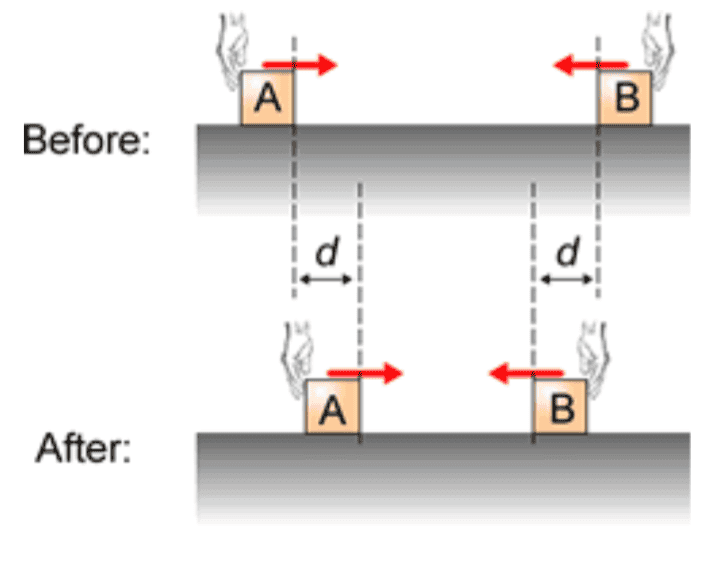
1709202114608.png

I'm not sure what is correct and after doing some digging online I still haven't been able to come to a consensus. I'm currently stuck between one of two possibilities: positive or zero. I'm pretty sure work on A (Wa) and work on B (Wb) are each positive values (force in same direction as displacement, right??). I also think I getting bogged down by the term "net external work (Wext)" since I'm not 100% sure what this indicates.

Why it might be positive:
If Wa and Wb are positive and Wext is the net external work, I feel like you should be able to just sum up Wa and Wb - making Wext a positive value. Work is a scalar quantity too so there shouldn't be issues with directions being associated with the signs.
Why it might be zero:
At the same time, intuitively it feels like if you consider system A+B, Wa and Wb would cancel each other out somehow because the forces and displacements are equal and opposite to each other. Also would energy equations be valid here (e.g. E1+W = E2) since you're moving the blocks from rest?
 
Physics news on Phys.org
It's an incomplete problem statement: either there are external forces that stop the blocks, or they are still moving at time 'After'.

Suppose the latter, then external work is positive and it has been converted to kinetic energy.


[edit] expanding/repeating:

dcmf said:
Why it might be zero:
At the same time, intuitively it feels like if you consider system A+B, Wa and Wb would cancel each other out somehow because the forces and displacements are equal and opposite to each other.
No, you have established both Wa and Wb to be positive. No canceling.

dcmf said:
Also would energy equations be valid here (e.g. E1+W = E2) since you're moving the blocks from rest?
If you mean E1 = kinetic energy of A + kinetic energy of B 'before', E2 = kinetic energy of A kinetic energy of B 'after' then yes,
E1+W = E2 (because there is no friction)
(but please, say what you mean explicitly so there is no confusion).

##\ ##
 
Last edited:
  • Like
Likes   Reactions: dcmf and Lnewqban
BvU said:
It's an incomplete problem statement: either there are external forces that stop the blocks, or they are still moving at time 'After'.

Suppose the latter, then external work is positive and it has been converted to kinetic energy.

##\ ##
I don't think that the problem statement is incomplete. One doesn't need the "after" picture to determine the sign of the work. While the work is being done on each of the two components of the system and the kinetic energy of each block is increasing, the kinetic energy of the system is increasing. Therefore, the work done on the two-component system is positive. That is sufficient to answer the question.

That said, I should point out that here we have a deformable system, i.e. a system that allows its components to change their relative position under the influence of external forces. When this is the case, the concept of "net work" may become ambiguous because, unless explicitly defined, it may mean two separate quantities.

The first is the sum total of all the works done on the components of the system, $$W_{\text{total}}=\sum_i \mathbf{F}_i\cdot \Delta \mathbf{x}_i=\sum_i\Delta K_i$$and the second is the work done by the net force on the center of mass system, $$W_{\text{net}}=\mathbf{F}_{\text{net}}\cdot\Delta\mathbf{x}_{\text{cm}}.$$The two are not the same when the system is deformable which is why I used different subscripts to distinguish them.

Here, ##W_{\text{total}}=2F\Delta x## where ##\Delta x## is the displacement of each mass whereas ##W_{\text{net}}=0.## One adds kinetic energy to the system but not to the center of mass which is and remains at rest while the forces are applied.
 
  • Like
  • Informative
Likes   Reactions: SammyS, jbriggs444, dcmf and 1 other person
I am in favor of the first interpretation -- in order to keep things simple for the OP.
I shudder at the thought of positive work and positive work on the system canceling 'somehow because..'

Work is done on the system, its internal energy increases and the system can do work when returning to its original state.

##\ ##
 
BvU said:
am in favor of the first interpretation -- in order to keep things simple for the OP.
I shudder at the thought of positive work and positive work on the system canceling 'somehow because..'
Most certainly, work is not a vector. What "cancels out" are the external forces. I think that the OP has not seen the distinction between rigid and deformable systems.

Note that OP is of two minds: the answer is "positive" but with a nagging intuitive doubt that something is also "zero". I am hopeful that the distinction between the kinetic energy of the system and the kinetic energy of the system's center of mass will sort things out for OP.
 
  • Like
Likes   Reactions: dcmf
BvU said:
It's an incomplete problem statement: either there are external forces that stop the blocks, or they are still moving at time 'After'.
The problem states "frictionless" and so the inference can be clearly drawn that the blocks remain in motion at t2. Not incomplete statement IMHO. Each force does positive work on system (A+B). Whether that work ends up as "Kinetic Energy" or internal energy in system (A+B) is not really relevant
 
  • Like
Likes   Reactions: dcmf
kuruman said:
Most certainly, work is not a vector. What "cancels out" are the external forces. I think that the OP has not seen the distinction between rigid and deformable systems.
I most definitely have not encountered rigid vs deformable systems yet. Your explanation makes a lot of sense though, thank you very much!
 
  • Like
Likes   Reactions: kuruman
kuruman said:
The two are not the same when the system is deformable which is why I used different subscripts to distinguish them.
Rotation also provides a case where the sum of the works done by the various forces at various points can differ from the work done by the net force on the center of mass.
 
  • Like
Likes   Reactions: hutchphd
jbriggs444 said:
Rotation also provides a case where the sum of the works done by the various forces at various points can differ from the work done by the net force on the center of mass.
Yes. The forces acting on this system form a couple except there is no lever arm.
 

Similar threads

Replies
9
Views
2K
Replies
30
Views
4K
  • · Replies 9 ·
Replies
9
Views
3K
Replies
2
Views
2K
  • · Replies 56 ·
2
Replies
56
Views
4K
Replies
17
Views
2K
Replies
1
Views
2K
  • · Replies 9 ·
Replies
9
Views
4K
Replies
12
Views
2K
  • · Replies 1 ·
Replies
1
Views
1K