theerenwithther
- 3
- 0
- Homework Statement
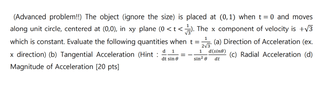
- The object (ignore the size) is placed at (0, 1) when t = 0 and moves
along unit circle, centered at (0,0), in xy plane (0 < t < 1/√3
). The x component of velocity is +√3 which is constant. Evaluate the following quantities when t = 1 /2√3. (a) Direction of Acceleration (ex. x direction) (b) Tangential Acceleration (c) Radial Acceleration (d)
Magnitude of Acceleration
- Relevant Equations
- N/A
Hello ,
First of all , I am still new to circular motion or any motions in general and still relatively learning so please bear with me.
1 . The direction of the tangential acceleration is parallel to the net velocity and that of radial of perpendicular to the velocity. So the direction of net acceleration would be inwards the circle (?) but it seems too vague. There may be other ways to phrase or even calculate it.
2/3/4 . In the next part , my approach was to find velocity from its x component by using v(x) = vsin(theta) and differentiating that v to eventually get the tangential acceleration and calculate the remaining two from it. But the concept seems thin in logical vision and in actual calculation , there is a derivative of sin(theta) respect to t in all values , which makes my final answers very unlikely. Any help would be greatly appreciated. I would be even more delighted if you take time to thoroughly explain the whole process.
Thank you in advance,
First of all , I am still new to circular motion or any motions in general and still relatively learning so please bear with me.
1 . The direction of the tangential acceleration is parallel to the net velocity and that of radial of perpendicular to the velocity. So the direction of net acceleration would be inwards the circle (?) but it seems too vague. There may be other ways to phrase or even calculate it.
2/3/4 . In the next part , my approach was to find velocity from its x component by using v(x) = vsin(theta) and differentiating that v to eventually get the tangential acceleration and calculate the remaining two from it. But the concept seems thin in logical vision and in actual calculation , there is a derivative of sin(theta) respect to t in all values , which makes my final answers very unlikely. Any help would be greatly appreciated. I would be even more delighted if you take time to thoroughly explain the whole process.
Thank you in advance,
Attachments
Last edited: