NicolaiTheDane
- 100
- 10
- TL;DR
- A theorem on local center manifolds in my textbook, seems to suggest that my center manifold is 2D, but as the system itself is 2D, this does not make sense to me. I need some help to understand how to apply the theorem, or understand why I cannot.
I have to find the center manifold of the following system
\begin{align}
\dot{x}_1&=x_2 \\
\dot{x}_2&=-\frac{1}{2}x_1^2
\end{align}
which has a critical point at ##x_0=\begin{bmatrix}0 & 0\end{bmatrix}##. Its linearization at that point is
\begin{align}
D\mathbf {f}(\mathbf {x_0}) = \begin{bmatrix}
0 & 1 \\
0 & 0
\end{bmatrix}
\end{align}
which obviously has the eigenvalue ##\lambda = 0##, with the eigenvector ##\mathbf{v}=\begin{bmatrix}1 & 0 \end{bmatrix}^T##. In the book (Differential Equations and Dynamical Systems 7. edition, by Perko) we are using in my introductory course on dynamical systems, we have the following theorem
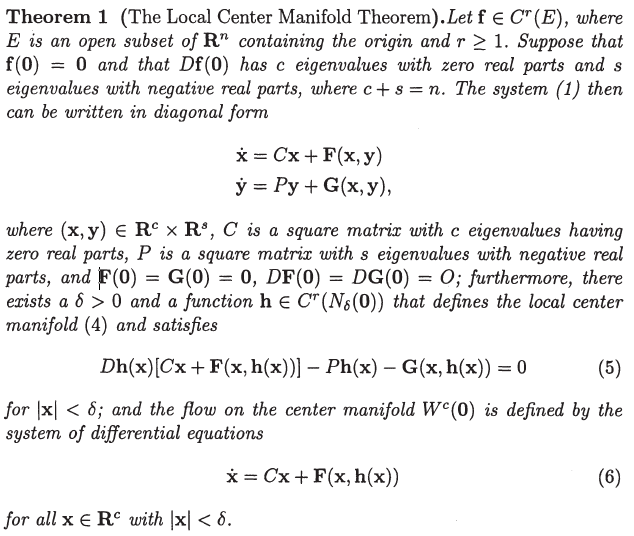
We are advised to use polynomial approximations to find ##h(x)##. However, since s = 0 (both eigenvalues are 0 exactly) I don't know how to utilize the theorem. With ##c = n## it would seem as though ##P## and ##G## has a dimensionality of 0, and ##C## is a 2 by 2 matrix with just zeros in it, effectively making ##\mathbf {F}=D\mathbf {f}##. Another big problem is that this means ##h## is 2D and not 1D as would seem intuitive (since the geometric multiplicty of ##\lambda=0## is 1), and that obviously does not make sense, as the system itself is 2D. Can someone perhaps see where I'm going wrong here? I suspect that the theorem simply doesn't work for this case, and that it is missing the condition that ##s \geq 1##, but its just a hunch.
It should be said that some guess work has lead me to a function
\begin{align}
\dot{x}_2 = h(x_1) = \sqrt{-\frac{1}{3}x_1^3 + c}
\end{align}
where ##c = 0## so as to make it fit with the critical point. This seems to visually to do exactly what I want it to
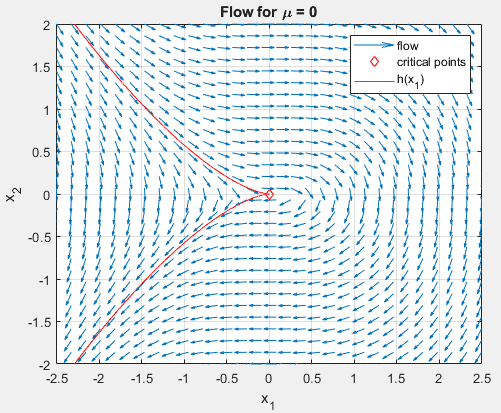
Not sure this helps, but I thought I'd add it.
\begin{align}
\dot{x}_1&=x_2 \\
\dot{x}_2&=-\frac{1}{2}x_1^2
\end{align}
which has a critical point at ##x_0=\begin{bmatrix}0 & 0\end{bmatrix}##. Its linearization at that point is
\begin{align}
D\mathbf {f}(\mathbf {x_0}) = \begin{bmatrix}
0 & 1 \\
0 & 0
\end{bmatrix}
\end{align}
which obviously has the eigenvalue ##\lambda = 0##, with the eigenvector ##\mathbf{v}=\begin{bmatrix}1 & 0 \end{bmatrix}^T##. In the book (Differential Equations and Dynamical Systems 7. edition, by Perko) we are using in my introductory course on dynamical systems, we have the following theorem
We are advised to use polynomial approximations to find ##h(x)##. However, since s = 0 (both eigenvalues are 0 exactly) I don't know how to utilize the theorem. With ##c = n## it would seem as though ##P## and ##G## has a dimensionality of 0, and ##C## is a 2 by 2 matrix with just zeros in it, effectively making ##\mathbf {F}=D\mathbf {f}##. Another big problem is that this means ##h## is 2D and not 1D as would seem intuitive (since the geometric multiplicty of ##\lambda=0## is 1), and that obviously does not make sense, as the system itself is 2D. Can someone perhaps see where I'm going wrong here? I suspect that the theorem simply doesn't work for this case, and that it is missing the condition that ##s \geq 1##, but its just a hunch.
It should be said that some guess work has lead me to a function
\begin{align}
\dot{x}_2 = h(x_1) = \sqrt{-\frac{1}{3}x_1^3 + c}
\end{align}
where ##c = 0## so as to make it fit with the critical point. This seems to visually to do exactly what I want it to
Not sure this helps, but I thought I'd add it.