rugerts
- 153
- 11
- Homework Statement
- Find the general solution of the given system of equations.
- Relevant Equations
- Finding eigenvalues: det(A-λI) = 0 ; Trace determinant plane eqn: λ^2 -Tλ + D
Finding eigenvectors: solve v(A-λI) = 0 (v and zero are vectors)
Hello,
I'm trying to find the general solution of this homog. system w/ constant coefficients. I can't even get past the first step, which is to find the eigenvalues. As far as I know, there are a few approaches:
1) solve det(A-λI) = 0
2) solve the trace determinant plane equation (which is practically the same as step 1). Then use quadratic formula. Here things get ugly pretty quickly.
See this calculation here, https://www.symbolab.com/solver/quadratic-equation-calculator/solve x^{2}-\left(1-i\right)x-i=0 , a substitution x=a+bi is made (which I didn't even know was at my disposal). When I solve without making this substitution, as you can see in my work below crossed by the red X, it appears as though my answer for eigenvalues is incorrect at least from what the book has.
I wonder if the answer I got and what the book has are equivalent?
3) Try to row reduce such that I get a zero for one entry and it simplifies things greatly. Here, https://www.slader.com/textbook/9780470458310-elementary-differential-equations-and-boundary-value-problems-10th-edition/405/problems/10/ , you can see this was done but I don't see what exact row operations they performed to get here, and it's unlikely I would have come up with the same. In fact, you can see in my work I did different row operations, and came upon a result. Is this result also equivalent to what the book has for its eigenvalues?
Note: The book lists the eigenvalues as 1 and -i.
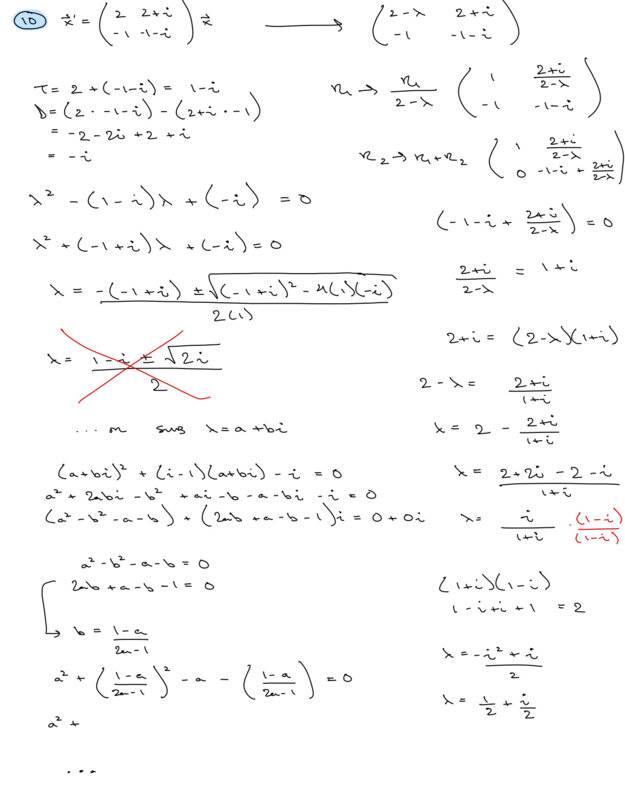
Here's my work:
I'm trying to find the general solution of this homog. system w/ constant coefficients. I can't even get past the first step, which is to find the eigenvalues. As far as I know, there are a few approaches:
1) solve det(A-λI) = 0
2) solve the trace determinant plane equation (which is practically the same as step 1). Then use quadratic formula. Here things get ugly pretty quickly.
See this calculation here, https://www.symbolab.com/solver/quadratic-equation-calculator/solve x^{2}-\left(1-i\right)x-i=0 , a substitution x=a+bi is made (which I didn't even know was at my disposal). When I solve without making this substitution, as you can see in my work below crossed by the red X, it appears as though my answer for eigenvalues is incorrect at least from what the book has.
I wonder if the answer I got and what the book has are equivalent?
3) Try to row reduce such that I get a zero for one entry and it simplifies things greatly. Here, https://www.slader.com/textbook/9780470458310-elementary-differential-equations-and-boundary-value-problems-10th-edition/405/problems/10/ , you can see this was done but I don't see what exact row operations they performed to get here, and it's unlikely I would have come up with the same. In fact, you can see in my work I did different row operations, and came upon a result. Is this result also equivalent to what the book has for its eigenvalues?
Note: The book lists the eigenvalues as 1 and -i.
Here's my work: