Find the mean and standard deviation of the heights of 13 boys

Click For Summary
SUMMARY

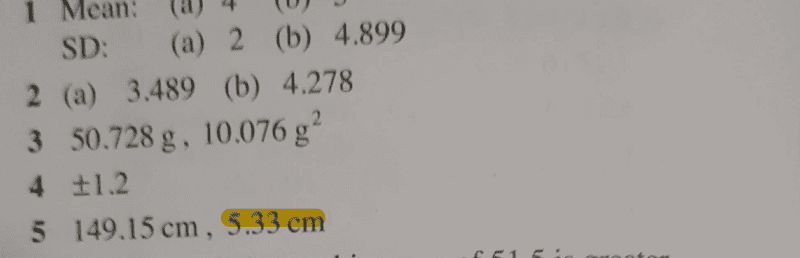
The forum discussion centers on calculating the mean and standard deviation of the heights of 13 boys, revealing discrepancies in the textbook solution. The correct mean is calculated as 149.15, while the variance is determined to be 28.49333333, leading to a standard deviation of 5.33. Participants clarify that the set of boys is treated as a population rather than a sample, which affects the formulas used for variance and standard deviation. Ultimately, the consensus is that the textbook solution is incorrect.

PREREQUISITES
  • Understanding of basic statistical concepts such as mean, variance, and standard deviation.
  • Familiarity with the formulas for calculating variance in a population versus a sample.
  • Knowledge of how to interpret population versus sample data in statistics.
  • Ability to perform calculations involving sums of squares and square roots.
NEXT STEPS
  • Review the formulas for variance and standard deviation in both population and sample contexts.
  • Practice calculating mean and standard deviation using different datasets.
  • Explore statistical software tools like R or Python's NumPy for statistical analysis.
  • Investigate the implications of sample size on statistical calculations and interpretations.
USEFUL FOR

This discussion is beneficial for students studying statistics, educators teaching statistical concepts, and anyone involved in data analysis who needs to understand the nuances of population versus sample data.

chwala
Gold Member
Messages
2,828
Reaction score
420
Homework Statement
see attached
Relevant Equations
statistics
Find the textbook problem here;

1641291258768.png


Find the textbook solution here:

1641291303879.png
Now, to my question, did the textbook guys make an error on the value of ##σ?##, see my working;

Mean (##13## boys)=##\dfrac{153.4+(148.8×12)}{13}=149.15##
We know that,
##29.16##=##\dfrac{\sum x^2}{12}##-##(148.8)^2##
##\sum x^2=266,047.2##
Now, it follows that, ##266,047.2+153.4^2=289,578.76##
Variance=##\dfrac{289,578.76}{13}##-##(149.15)^2##
Variance=##29.56673077##
Standard deviation=##\sqrt {29.56673077}=5.4375##
 
Last edited:
Physics news on Phys.org
It seems you forgot to include your work for the standard deviation
 
It is generally a bad idea to post before your post is ready and then continue editing it as people will not get notifications of your edits.

Regarding your work, you have used the wrong formula for the variance in a statistical sample where the mean is also estimated from the sample.
 
  • Like
Likes   Reactions: FactChecker
Ok let me check that...
 
I am unable to see what i have done wrong...i got it! let me post my working...hmmmm

Variance=##\dfrac{\sum (X-x)^2}{N-1}##
##5.4^2##=##\dfrac{\sum (X-x)^2}{11}##
##\sum (X-x)^2##=##320.76##
Therefore,
Variance=##\dfrac{320.76+(153.4-148.8)^2}{12}##
=##\dfrac{341.92}{12}##
=##28.49333333##
Standard deviation=##\sqrt {28.4933333}=5.33##

cheers orodruin...i will make sure to type all my working before posting, my apologies...there may be different approach to this of which i will appreciate...i guess i need more practice here...
 
Last edited:
What is N?
 
  • Like
Likes   Reactions: chwala
Orodruin said:
What is N?
hope you can see it mate:smile:
 
Just a question guys, to clear my doubt...the initial number of the boys i.e ##12##, is it considered as a sample population or population ?...is sample/population definition dependent on the question? or are we using the fact that data that is less than ##30## items is sample data...
Let me rephrase my question. Supposing the whole class had a total of ##12## boys only. Then is this population or sample data? I can see that the question indicates ' 12 boys in a class' implying population...
cheers
 
Last edited:
Orodruin said:
you have used the wrong formula for the variance in a statistical sample
I don’t understand. We are not estimating the mean and variance of a large population of boys from a sample of 12 or 13. In each case, the set of boys is the population. In particular, the mean is exactly known.
I'd say the given answer is wrong.
 
  • Like
Likes   Reactions: chwala
  • #10
haruspex said:
I don’t understand. We are not estimating the mean and variance of a large population of boys from a sample of 12 or 13. In each case, the set of boys is the population. In particular, the mean is exactly known.
I'd say the given answer is wrong.
Upon rereading the wording of the problem, I agree. It would have been different if the problem had asked for an estimate of the mean and standard deviation in the height of boys in the age group of the class.
 
  • #11
So this means the textbook solution is wrong and my initial solution in post ##1## right?
 
  • #12
chwala said:
So this means the textbook solution is wrong and my initial solution in post ##1## right?
Yes.
 
  • Like
Likes   Reactions: chwala
  • #13
haruspex said:
Yes.
Bingo! :cool:
 
  • #14
I was just looking at this problem again on my textbook...now i need to amend my textbook solution in Red so as not to fidget around trying to check where i went wrong in my working... i had to check my posts as the problem looked familiar. Hmmmm :oops:
 
  • Like
Likes   Reactions: THAUROS

Similar threads

  • · Replies 3 ·
Replies
3
Views
1K
  • · Replies 42 ·
2
Replies
42
Views
5K
  • · Replies 2 ·
Replies
2
Views
2K
  • · Replies 2 ·
Replies
2
Views
2K
  • · Replies 3 ·
Replies
3
Views
3K
Replies
4
Views
2K
  • · Replies 12 ·
Replies
12
Views
3K
  • · Replies 7 ·
Replies
7
Views
3K
  • · Replies 2 ·
Replies
2
Views
1K
  • · Replies 3 ·
Replies
3
Views
2K