Find the measure of angle BAC.

  • Context: MHB 
  • Thread starter Thread starter anemone
  • Start date Start date
  • Tags Tags
    Angle Measure
anemone
Gold Member
MHB
POTW Director
Messages
3,851
Reaction score
115
Hi members of the forum,

Problem:
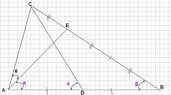
In triangle ABC, D is the midpoint of AB and E is the point of trisection of BC nearer to C. Given that $\displaystyle \angle ADC=\angle BAE$, find $\displaystyle\angle BAC$.

I have tried to solve it using only one approach, that is by assigning $\displaystyle\theta$ and $\displaystyle\beta$ to represent the angles of CAE and ABC respectively and applied the rules of Sine and Cosine appropriately but ended up with very messy equation with many unknown values.

View attachment 630

It's not that I didn't try it but now I feel like I've reached a plateau and I decided to ask for help at MHB.

If anyone could give me some hints, that would be great.

Thanks in advance.
 

Attachments

  • Find angle of BAC.JPG
    Find angle of BAC.JPG
    27.8 KB · Views: 114
Mathematics news on Phys.org
Re: Find the angle of BAC.

anemone said:
Hi members of the forum,

Problem:
In triangle ABC, D is the midpoint of AB and E is the point of trisection of BC nearer to C. Given that $\displaystyle \angle ADC=\angle BAE$, find $\displaystyle\angle BAC$.

I have tried to solve it using only one approach, that is by assigning $\displaystyle\theta$ and $\displaystyle\beta$ to represent the angles of CAE and ABC respectively and applied the rules of Sine and Cosine appropriately but ended up with very messy equation with many unknown values.

https://www.physicsforums.com/attachments/630

It's not that I didn't try it but now I feel like I've reached a plateau and I decided to ask for help at MHB.

If anyone could give me some hints, that would be great.

Thanks in advance.
Let the point of trisection of $BC$ nearer to $B$ be $F$. Draw a line passing through $D$ and parallel to $AE$. Argue that this line passes through $F$. This helps you show that $AE$ bisects $CD$. Its now not very hard to figure out that $\angle BAC$ is $90$.
 
Re: Find the angle of BAC.

caffeinemachine said:
Let the point of trisection of $BC$ nearer to $B$ be $F$. Draw a line passing through $D$ and parallel to $AE$. Argue that this line passes through $F$. This helps you show that $AE$ bisects $CD$. Its now not very hard to figure out that $\angle BAC$ is $90$.

I see it now...the trick is to draw another line parallel to AE that starts from the point D to touch the line of BC.

I will show my full solution here as a way to express my appreciation for your help and guidance...

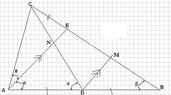
Join DM so that AE is parallel to DM.
View attachment 631

It follows that $\displaystyle \frac{BD}{DA}=\frac{BM}{ME}$, i.e.

$\displaystyle 1=\frac{BM}{ME}$

$\displaystyle BM=ME$ or $\displaystyle BM=ME=EC $.

It shows that M is the point of trisection of BC nearer to B.

Similarly, by applying the proportionality theorem again, we get

$\displaystyle \frac{CN}{ND}=\frac{CE}{EM}$

$\displaystyle \frac{CN}{ND}=1$

$\displaystyle CN=ND$

This gives us also the fact that $\displaystyle CN=AN$, and $\displaystyle \angle NAC=\angle NCA=\theta $

Last, by adding up all the angles of the triangle ADC and set them equal to $\displaystyle 180^\circ$, we obtain

$\displaystyle 2\theta +2\alpha=180^\circ$

$\displaystyle \theta +\alpha=90^\circ$

$\displaystyle \angle BAC=90^\circ$

Thanks a bunch, caffeinemachine!(Smile)
 

Attachments

  • Find angle of BAC 2.JPG
    Find angle of BAC 2.JPG
    20.3 KB · Views: 121
Re: Find the angle of BAC.

anemone said:
I see it now...the trick is to draw another line parallel to AE that starts from the point D to touch the line of BC.

I will show my full solution here as a way to express my appreciation for your help and guidance...

Join DM so that AE is parallel to DM.
https://www.physicsforums.com/attachments/631

It follows that $\displaystyle \frac{BD}{DA}=\frac{BM}{ME}$, i.e.

$\displaystyle 1=\frac{BM}{ME}$

$\displaystyle BM=ME$ or $\displaystyle BM=ME=EC $.

It shows that M is the point of trisection of BC nearer to B.

Similarly, by applying the proportionality theorem again, we get

$\displaystyle \frac{CN}{ND}=\frac{CE}{EM}$

$\displaystyle \frac{CN}{ND}=1$

$\displaystyle CN=ND$

This gives us also the fact that $\displaystyle CN=AN$, and $\displaystyle \angle NAC=\angle NCA=\theta $

Last, by adding up all the angles of the triangle ADC and set them equal to $\displaystyle 180^\circ$, we obtain

$\displaystyle 2\theta +2\alpha=180^\circ$

$\displaystyle \theta +\alpha=90^\circ$

$\displaystyle \angle BAC=90^\circ$

Thanks a bunch, caffeinemachine!(Smile)
That's great. (Yes)
 

Similar threads

Replies
1
Views
2K
  • · Replies 1 ·
Replies
1
Views
2K
  • · Replies 2 ·
Replies
2
Views
2K
  • · Replies 7 ·
Replies
7
Views
6K
  • · Replies 21 ·
Replies
21
Views
6K
  • · Replies 13 ·
Replies
13
Views
4K
  • · Replies 19 ·
Replies
19
Views
2K
  • · Replies 9 ·
Replies
9
Views
4K
Replies
14
Views
4K
  • · Replies 3 ·
Replies
3
Views
2K