Find the Moment about the ankle

Click For Summary

Homework Help Overview

The discussion revolves around calculating the moment about the ankle due to a force applied at the knee, with specific reference to the weight of the tibia and its dimensions. The subject area includes mechanics and statics, particularly focusing on forces and moments in a biological context.

Discussion Character

  • Exploratory, Assumption checking, Problem interpretation

Approaches and Questions Raised

  • Participants explore the relationship between the applied force at the knee and the angle of the tibia, questioning the relevance of the angle provided and whether the weight of the tibia should be considered in the moment calculation.

Discussion Status

There is an ongoing examination of the assumptions regarding the angle of the applied force and its implications for the moment about the ankle. Participants are questioning the clarity of the original problem statement and the role of the tibia's weight in the calculations.

Contextual Notes

Some participants note the lack of explicit information regarding the angle and the potential confusion arising from the diagram provided by the original poster. The discussion reflects uncertainty about the initial conditions and the setup of the problem.

jweica
Messages
5
Reaction score
1
New user has been reminded to use the Homework Help Template when starting schoolwork threads at the PF
Given that the tibia is 0.6kg and is 35 cm long. The force at the knee (Fk) is: (-200i + 346.41j)N
Find the moment about the ankle due to Fk

I found that: r: rx = (0.35cos60) and ry = (0.35sin60)

Using the sum of moments where: rxFy - ryFx = 0

[(0.35cos60)(346.41)] - [(0.35sin60)(-200)] = 0 k Nm

But I am wondering since the tibia weighs 0.6kg, wouldn't that be included in the question as a Fy component [(0.6)(9.81) = -5.886]?
Do I neglect the weight and only use the Fk?

((I attached a poorly drawn free body diagram))
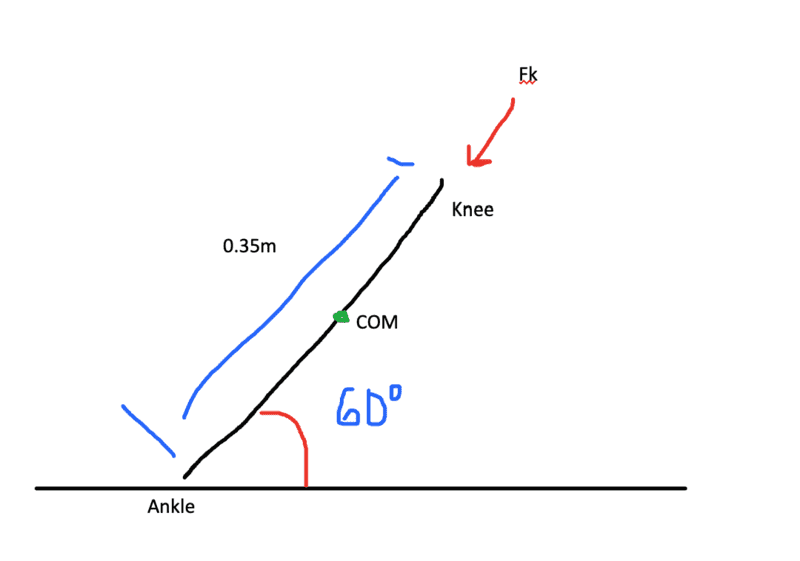
Screen Shot 2019-02-24 at 12.30.51 PM.png
 

Attachments

  • Screen Shot 2019-02-24 at 12.30.51 PM.png
    Screen Shot 2019-02-24 at 12.30.51 PM.png
    6.1 KB · Views: 494
Physics news on Phys.org
jweica said:
Given that the tibia is 0.6kg and is 35 cm long. The force at the knee (Fk) is: (-200i + 346.41j)N
Find the moment about the ankle due to Fk
I don't see anything there about 60 degrees. Where did that come from?
 
  • Like
Likes   Reactions: PhanthomJay
haruspex said:
I don't see anything there about 60 degrees. Where did that come from?

At a guess, it's from the dimensions of the force at the knee, where the angular force at the knee is broken into it's horizontal and vertical components of -200 and 346, which correspond to a 30/60/90 triangle having sides (2, 2##\sqrt (3)##, 4). It's unclear whether OP was given the angle and has already broken the forces into components, or was given the components and calculated the angle.
 
Friend of Kalina said:
At a guess, it's from the dimensions of the force at the knee, where the angular force at the knee is broken into it's horizontal and vertical components of -200 and 346, which correspond to a 30/60/90 triangle having sides (2, 2##\sqrt (3)##, 4). It's unclear whether OP was given the angle and has already broken the forces into components, or was given the components and calculated the angle.
Good point, but that means the 60 degrees is the angle of the applied force at the knee. The diagram shows it as the angle of the tibia. It seems unlikely to pose the question with the two at the same angle.
 
haruspex said:
Good point, but that means the 60 degrees is the angle of the applied force at the knee. The diagram shows it as the angle of the tibia. It seems unlikely to pose the question with the two at the same angle.

Given the diagram, I saw the problem as the force for someone turning with their leg at an angle to the ground and the foot/ankle pinned. The force is applied in line with the tibia (legs are don't bend laterally), with the leg at a 60 degree angle to the ground. Force in line with the leg along the tibia to the ankle is 400N, comprised of -200N horizontally and 346.41N vertically.

But you're right. Assuming that the components of Fk were given in the problem, if Fk is linearly along the tibia to the ankle, wouldn't that make it a radial force with zero torque? Nothing to solve, except the OP question of whether the tibia itself represents a moment. Much more likely that the tibia is vertical with the force Fk applied at the knee, in which case the tibia is vertical, provides no moment at the ankle, and can be disregarded. Although I'm not sure why you would then be concerned about the mass of the tibia, unless it was thrown into the problem as a red herring.

It would be nice to know if this was the original problem statement. It seems unlikely.
 

Similar threads

  • · Replies 4 ·
Replies
4
Views
6K
  • · Replies 13 ·
Replies
13
Views
4K
  • · Replies 2 ·
Replies
2
Views
4K
  • · Replies 13 ·
Replies
13
Views
3K
  • · Replies 4 ·
Replies
4
Views
4K
Replies
1
Views
14K