Find the Ratio of BG to FG in a Figure with Given Side Lengths

  • Context: High School 
  • Thread starter Thread starter anemone
  • Start date Start date
  • Tags Tags
    2016
Click For Summary
SUMMARY

The discussion focuses on calculating the ratio of segments BG to FG in a geometric figure with specified side lengths: AB=AF=15, FD=12, BD=18, BE=24, and CF=17. The problem is part of the Problem of the Week (POTW) series on the Math Help Boards. Participants are encouraged to engage with the problem and submit solutions, as previous problems have gone unanswered.

PREREQUISITES
  • Understanding of basic geometry concepts, including segment ratios.
  • Familiarity with geometric figures and their properties.
  • Ability to interpret and analyze mathematical problems presented in textual format.
  • Knowledge of problem-solving techniques in mathematics.
NEXT STEPS
  • Research methods for calculating ratios in geometric figures.
  • Explore geometric properties related to similar triangles.
  • Learn about the use of algebra in solving geometric problems.
  • Investigate previous Problem of the Week (POTW) solutions for additional context.
USEFUL FOR

Mathematics students, educators, and enthusiasts interested in geometry and problem-solving techniques will benefit from this discussion.

anemone
Gold Member
MHB
POTW Director
Messages
3,851
Reaction score
115
Here is this week's POTW:

-----

In the figure below, $AB=AF=15,\,FD=12,\,BD=18,\,BE=24$ and $CF=17$. Find $$\frac{BG}{FG}$$.

https://www.physicsforums.com/attachments/5959._xfImport

-----

Remember to read the http://www.mathhelpboards.com/showthread.php?772-Problem-of-the-Week-%28POTW%29-Procedure-and-Guidelines to find out how to http://www.mathhelpboards.com/forms.php?do=form&fid=2!
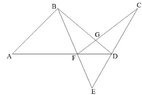
 

Attachments

  • potw 232.JPG
    potw 232.JPG
    8.1 KB · Views: 104
Physics news on Phys.org
No one answered last week problem. :(

You can see the proposed solution as follows:

By applying the Stewart's theorem on triangle $ABD$ and the line $BF$, we have:

$15^2\cdot 12+18^2 \cdot 15 =BF^2\cdot 27+15\cdot 12\cdot 27$

So $BF=10$ and so $EF=24-10=14$.

Again we use the Stewart's theorem on triangle $ABE$ and the line $AF$, we have:

$AE^2\cdot 10+15^2 \cdot 14 =15^2\cdot 24+14\cdot 10\cdot 24$

So $AE=\sqrt{561}$.

By Stewart's theorem on triangle $AED$ and the line $EF$, we have:

$ED^2\cdot 15+561 \cdot 12 =14^2\cdot 27+12\cdot 15\cdot 27$

So $ED=2\sqrt{57}$.

By Stewart's theorem on triangle $CFE$ and the line $FD$, we have:

$14^2\cdot CD+17^2 \cdot 2\sqrt{57} =12^2\cdot (CD+2\sqrt{57})+2\sqrt{57}\cdot 12\cdot CD \cdot (CD+2\sqrt{57})$

So $CD=\sqrt{57}$ and $CE=CD+DE=3\sqrt{57}$.

Note that $DG=18-BG$ and apply Menelaus' theorem to triangle $BED$ and the line through $C,\,G$ and $F$ to get $$3\cdot\frac{18-BG}{BG}\cdot \frac{10}{14}=1$$, so $$BG=\frac{135}{11}$$.

Similarly, $CG=17-FG$, so applying Menelaus's theorem to triangle $CFE$ and the line through $B,\,G$ and $D$ we get $$\frac{24}{10}\cdot \frac{FG}{17-FG}\cdot \frac{1}{2}=1$$ so $$FG=\frac{85}{11}$$.

Therefore $$\frac{BG}{FG}=\frac{27}{17}$$.
 

Similar threads

  • · Replies 1 ·
Replies
1
Views
2K
  • · Replies 1 ·
Replies
1
Views
2K
Replies
2
Views
2K
  • · Replies 1 ·
Replies
1
Views
2K
  • · Replies 1 ·
Replies
1
Views
1K
  • · Replies 1 ·
Replies
1
Views
2K
  • · Replies 1 ·
Replies
1
Views
2K
  • · Replies 1 ·
Replies
1
Views
1K
  • · Replies 1 ·
Replies
1
Views
1K
  • · Replies 1 ·
Replies
1
Views
2K