Find the supply voltage of a ladder circuit

Click For Summary
SUMMARY

The discussion focuses on calculating the supply voltage for a ladder circuit with a specified current of 7A and a resistance of 11Ω. Participants emphasize the importance of correctly identifying series and parallel resistor combinations to simplify the circuit. The final resistance calculation is crucial, as it directly influences the voltage calculation using Ohm's Law (V = IR). The consensus is that understanding the relationships between resistors and their configurations is essential for accurate analysis.

PREREQUISITES
  • Understanding of Ohm's Law (V = IR)
  • Knowledge of series and parallel resistor combinations
  • Familiarity with circuit analysis techniques such as KCL (Kirchhoff's Current Law) and KVL (Kirchhoff's Voltage Law)
  • Ability to redraw circuit diagrams for clarity
NEXT STEPS
  • Study series and parallel resistor combinations in depth
  • Learn how to apply KCL and KVL in circuit analysis
  • Practice redrawing complex circuits for easier analysis
  • Explore resources on ladder circuit configurations and their voltage calculations
USEFUL FOR

Electrical engineering students, circuit designers, and anyone involved in analyzing or troubleshooting electrical circuits will benefit from this discussion.

propvgvnda
Messages
22
Reaction score
0
Homework Statement
Below
Relevant Equations
How to analyze Electric Circuits
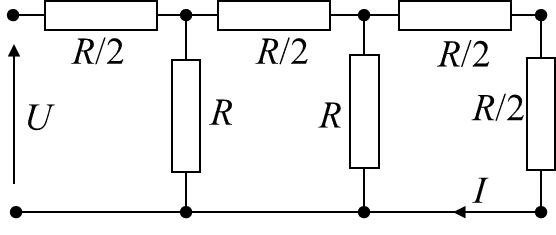
Find the supply voltage of a ladder circuit shown, so that I=7A. Assume R=11Ω. (The unit must be placed)
6.png


Hello, everyone. Please, help me with this. Could someone explain to me how to solve such tasks. I literally spent the whole day watching Khan Academy and trying to figure out how to solve these circuits, but still, I can't do a thing. I would also be very glad if someone shared a link to some article about this, I have to solve an awful lot of such tasks and I really need to learn how to deal with them. ASAP
 
Physics news on Phys.org
propvgvnda said:
Homework Statement:: Below
Relevant Equations:: How to analyze Electric Circuits

Find the supply voltage of a ladder circuit shown, so that I=7A. Assume R=11Ω. (The unit must be placed)View attachment 272627

Hello, everyone. Please, help me with this. Could someone explain to me how to solve such tasks. I literally spent the whole day watching Khan Academy and trying to figure out how to solve these circuits, but still, I can't do a thing. I would also be very glad if someone shared a link to some article about this, I have to solve an awful lot of such tasks and I really need to learn how to deal with them. ASAP
Welcome to PF.:smile:

In this problem you can just use a few combinations of series and parallel resistors to fold up the circuit from right-to-left. You will be left with only one resistor across the power supply, which will let you solve for the value of R to give the total input current of 7A.

So, are the right-most two resistors in series or in parallel? What is the resistance value that you get when you combine them? And then look to the next resistor to the left, and figure out how to combine that into the previous combination resistance. And so on, until you are left with just the one resistor.

Please show us your work, so we can see that you are proceeding correctly. Thanks.
 
  • Like
Likes   Reactions: propvgvnda
berkeman said:
Welcome to PF.:smile:

In this problem you can just use a few combinations of series and parallel resistors to fold up the circuit from right-to-left. You will be left with only one resistor across the power supply, which will let you solve for the value of R to give the total input current of 7A.

So, are the right-most two resistors in series or in parallel? What is the resistance value that you get when you combine them? And then look to the next resistor to the left, and figure out how to combine that into the previous combination resistance. And so on, until you are left with just the one resistor.

Please show us your work, so we can see that you are proceeding correctly. Thanks.

Okay, so my algorithm was: 1) Those 3 resistors in the top are in series, hence their overall resistance is 16.5 Ohms; 2) the Other 3 resistors are in parallel, (1/11) + (1/11) + (1/5.5) = 11/4 = 2.75; 3) I have 2 resistors in series left, therefore 16.5 + 2.75 = 19.25; 4) V = IR = 7 * 19.25 = 134.75V; Unfortunately, I know that this is wrong, because I failed this( Could you please correct my thoughts?
 
berkeman said:
, which will let you solve for the value of R to give the total input current of 7A.
Isn't I=7A the current through the bottom-right branch?

@propvgvnda, I believe you need to use series-parallel reduction technique along with KCL and KVL to find the equivalent resistance and total input current.
Based on these two, you can compute the input voltage U.
 
propvgvnda said:
Okay, so my algorithm was: 1) Those 3 resistors in the top are in series,
No.
propvgvnda said:
2) the Other 3 resistors are in parallel, (1/11) + (1/11) + (1/5.5) = 11/4 = 2.75
No.

You need to find the correct series and parallel combinations first.

What is the 'necessary' condition for two resistances to be in series?
What is the 'necessary' condition for two resistances to be in parallel?
 
cnh1995 said:
No.

No.

You need to find the correct series and parallel combinations first.

What is the 'necessary' condition for two resistances to be in series?
What is the 'necessary' condition for two resistances to be in parallel?
As far as I know: series resistances share the same current, and parallel resistances share the same voltage.
 
propvgvnda said:
As far as I know: series resistances share the same current, and parallel resistances share the same voltage.
Yes.
So based on these two facts, which resistors in your circuit diagram should be in series? Which resistances are in parallel?
 
cnh1995 said:
Yes.
So based on these two facts, which resistors in your circuit diagram should be in series? Which resistances are in parallel?
Yeah, I don't know. I don't understand how to identify what has which voltage and current.
 
cnh1995 said:
Isn't I=7A the current through the bottom-right branch?
Yes, the bottom branch is a short, so it is the same as the supply current. :wink:
 
  • #10
cnh1995 said:
Isn't I=7A the current through the bottom-right branch?
Actually, upon further review, the diagram is pretty ambiguous. You may be right, that they intend that 7A current to be the current flowing through the right-most resistor.
 
  • #11
Well guys, so do you know how this should be solved?
 
  • #12
propvgvnda said:
Well guys, so do you know how this should be solved?
1605467007525.png


Well, if I is the current through the right-most two resistors, that gives you the node voltage at the top of them. That voltage is across the next R to the left, which tells you what its current is. Just keep walking to the left using that technique to see what input voltage it takes to support all of those currents.
 
  • #13
Overlapping possibly or equivalent to whait others have said:
Label the nodes in the top row A, B, C, D, and in the bottom row E, F, G, H.
What is the total resistance between C and H?
Redraw The diagram with that as a single resistance between C and H, or, same thing, an additional resistance between C and G.
Now what is the total resistance between G and H?
Then condense the thing in the same fashion so that you get the total resistance between A and F (same thing as A-E).
You then have the total resistance of the circuit, you are given the voltage, so you can work out the total current.
The total current goes through AB, you can work out the voltage drop across that. Then work backwards, maybeYou don't have to work out the voltages and currents in every single branch, but don't worry about being maximally efficient, just get the result even if you have to get every single current and voltage - such refinements can come later, you may think of some as you go along.
Use R all through and only convert to a number at the end.
The current being asked is H → G according to the arrow on the diagram. Which is the same as...
Hope it will be evident or will become evident to you that that makes sense for how to do it
 
Last edited:
  • #14
propvgvnda said:
series resistances share the same current
Only if there are no other circuit connections between them.
The rightmost vertical and horizontal R/2 are in series, so can be collapsed into a single resistance, but between two adjacent R/2 resistors in the top line there are other connections, so more current may flow through one of these resistors than another.
Similarly, the rightmost R and the rightmost (vertical) R/2, though parallel, do not share the same voltage because of the rightmost R/2 in the top row.
 
  • #15
epenguin said:
Overlapping possibly or equivalent to whait others have said:
Label the nodes in the top row A, B, C, D, and in the bottom row E, F, G, H.
What is the total resistance between C and H?
Redraw The diagram with that as a single resistance between C and H, or, same thing, an additional resistance between C and G.
Now what is the total resistance between G and H?
Then condense the thing in the same fashion so that you get the total resistance between A and F (same thing as A-E).
You then have the total resistance of the circuit, you are given the voltage, so you can work out the total current.
The total current goes through AB, I can work out the voltage drop across that. Then work backwards, maybeYou don't have to work out the voltages and currents in every single branch, but don't worry about being maximally efficient, just get the result even if you have to get every single current and voltage - such refinements can come later, you may think of some as you go along.
Use R all through and only convert to a number at the end.
The current being asked is H → G according to the arrow on the diagram. Which is the same as...
Hope it will be evident or will become evident to you that that makes sense for how to do it

All I understood so far is that I should add two right corner resistors: R/2 + R/2 = 5.5 + 5.5 = 11 Ohms. I cannot understand what to do further?
 
  • #16
That (combination) resistor is then in parallel with the next (vertical) resistor yielding ______
This new combination is in series with the next horizontal resistor ... etc ,etc
You can do this forever, incidentally.
 
  • #17
I recommended essentially you just call (R/2 + R/2) call that R!
The next thing I recommended was redraw the diagram with this R in place of the two separate resistances you had before.
Hopefully you will then see what to do next.
 
  • Like
Likes   Reactions: Merlin3189 and hutchphd
  • #18
hutchphd said:
That (combination) resistor is then in parallel with the next (vertical) resistor yielding ______
This new combination is in series with the next horizontal resistor ... etc ,etc
You can do this forever, incidentally.

Hello. I was using your method and I got overall resistance of approximately 15 Ohms. Is that right?
 
  • #19
propvgvnda said:
. I was using your method and I got overall resistance of approximately 15 Ohms. Is that right?
No.
Please show your work so we can see what went wrong.
 
  • #20
cnh1995 said:
No.
Please show your work so we can see what went wrong.
IMG_20201117_193042.jpg
 
  • #21
As per your diagram, b+z= 11 ohm.
This 11 ohm is in parallel with c..and so on.

Keep reducing the circuit this way until you have only one resistor left.
 
  • #22
cnh1995 said:
As per your diagram, b+z= 11 ohm.
This 11 ohm is in parallel with c..and so on.

Keep reducing the circuit this way until you have only one resistor left.
...and then when I have bzc it's in series with y right? and so on?
 
  • #23
propvgvnda said:
...and then when I have bzc it's in series with y right? and so on?
Yes.
 
  • #24
I think there is a mistake in your second line where you are treating a series connection as a parallel one.That you have made it rather more difficult for yourself and us by introducing an extra notation when all resistances, currents and voltages can be sufficiently specified by the nodes A-F. Admittedly you could then have ambiguity between the resistance in a branch e.g. CG and the total or effective or equivalent resistance of the circuit between C and G which we might call simply (RCG)tot. This is in fact what you need to obtain in your second step, and I believe you would not have made the mistake you have if you had redrawn the diagram at that stage as recommended - you do not seem practised enough to do this in your head yet. And it would be simple for yourself and others if you kept R up to the point where you work out the total current (IAB = IEF).

If you redraw and label the equivalent resistances at this and the next stage you might then also just be able to conclude immediately and work backwards in your head to IHG (= ICDHG) because of the rather simple way the current is splitting at each junction.
 
Last edited:
  • #25
cnh1995 said:
As per your diagram, b+z= 11 ohm.
This 11 ohm is in parallel with c..and so on.

Keep reducing the circuit this way until you have only one resistor left.

Using this method, my final resistance is 11 Ohms.
 
  • #26
epenguin said:
I think there is a mistake in your second line where you are treating a series connection as a parallel one.That you have made it rather more difficult for yourself and us by introducing an extra notation when all resistances, currents and voltages can be sufficiently specified by the nodes A-F. Admittedly you could then have ambiguity between the resistance in a branch e.g. CG and the total or effective or equivalent resistance of the circuit between C and G which we might call simply (RCG)tot. This is in fact what you need to obtain in your second step, and I believe you would not have made the mistake you have if you had redrawn the diagram at that stage as recommended - you do not seem practised enough to do this in your head yet. And it would be simple for yourself and others if you kept R up to the point where you work out the total current (IAB = IEF).

If you redraw and label the equivalent resistances at this and the next stage you might then also just be able to conclude immediately and work backwards in your head to IHG (= ICDHG) because of the rather simple way the current is splitting at each junction.

I have only started learning analyzing EC, so I am pretty bad at it, and can't really digest so much information at once.
 
  • #27
Slow and steady wins the fray.
Notice that this input resistance is the same regardless of the number of units added to the left side. Pretty interesting.
So now figure the requested current by working "left to right" at each top junction.
 
  • #28
hutchphd said:
Slow and steady wins the fray.
Notice that this input resistance is the same regardless of the number of units added to the left side. Pretty interesting.
So now figure the requested current by working "left to right" at each top junction.

What do you mean? Do I need to find current in each resistor or node yes?
 
  • #29
You need to find the current in each successive upper (R/2) resister. The third one will be the requested current.
I don't know what current "at a node" means...currents flow through conductors and are confluent at nodes but are ill-defined there other than (what goes in) = (what comes out).
 
  • #30
propvgvnda said:
I have only started learning analyzing EC, so I am pretty bad at it, and can't really digest so much information at once.

Yes the total resistance of the circuit is just R, (=11Ω) , so looking you have calculated right. I didn't ask you to digest information, just to redraw a diagram with the equivalent resistance RCDH you found, well almost, by the calculation
RCD + RDHG = R/2 + R/2 = R .
If you had done that it would have been obvious you then had a pair of resistances in parallel whose equivalent resistance you can also calculate and then do another new diagram.Would then be evident you then have the same thing again. And it would now be evident that the voltage AF and the current at each node split in a very simple way and the answer to the problem would be immediately obvious.
 
Last edited:

Similar threads

  • · Replies 3 ·
Replies
3
Views
2K
  • · Replies 16 ·
Replies
16
Views
2K
Replies
3
Views
2K
  • · Replies 11 ·
Replies
11
Views
3K
  • · Replies 1 ·
Replies
1
Views
2K
Replies
3
Views
2K
  • · Replies 7 ·
Replies
7
Views
2K
  • · Replies 10 ·
Replies
10
Views
2K
  • · Replies 8 ·
Replies
8
Views
2K
  • · Replies 18 ·
Replies
18
Views
3K