Homework Help Overview
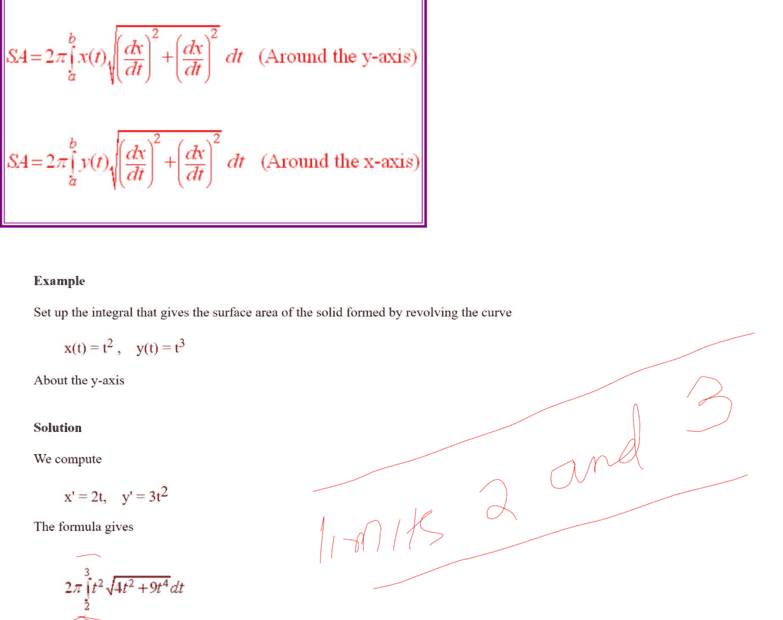
The discussion revolves around determining the surface area of a solid defined by a parametric curve, specifically the limits of integration and the completeness of the problem statement.
Discussion Character
- Exploratory, Assumption checking, Problem interpretation
Approaches and Questions Raised
- Participants question the determination of the limits of integration, noting that the problem statement lacks clarity regarding these limits. There is also a discussion about the correctness of the formula used for surface area and the implications of missing information.
Discussion Status
Participants are actively exploring the issues related to the problem statement and the formula for surface area. Some have pointed out potential errors and are suggesting that additional constraints may be necessary for a complete understanding.
Contextual Notes
There is mention of the problem statement being poorly written, with specific reference to missing limits of integration and the need for additional constraints. Participants are also discussing the accuracy of the formula presented in the context of the problem.