Find the transit time of the train

  • Thread starter Thread starter GLD223
  • Start date Start date
  • Tags Tags
    Homework
Join the discussion
Registration is free. Ask a follow-up in this thread, or start your own.
23 replies · 1K views
GLD223
Messages
14
Reaction score
7
Homework Statement
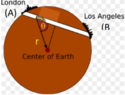
The train will use gravity to traverse from point A to B, in your answer, use the gravitational constant g and R - the radius of the earth in your answer. Assume the earth's mass is uniform
Relevant Equations
##L = T-V, KE(0) = 0, PE(0) = KE + PE##
I need to find the transit time of the train, from what I see online it should be independent of points A and B and should be roughly 42 minutes.
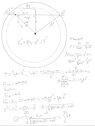
I started by looking at the energies and derived an ODE for the speed of the train to find the transit time but it seems to be wrong.
Also, I might need to use the Lagrangian since we learned it in the last lesson.
##M_earth := M##
##\rho = M/4/3 * \pi * R^3##
##M(r) = r^3/R^3 * M##
##T = 1/2 * m *(dx/dt)^2##
##U(0) = -mgR##
##U(r) = -mg/R *r^2##
 

Attachments
  • 2024-01-27 07.50.24.jpg
    2024-01-27 07.50.24.jpg
    24.5 KB · Views: 97
  • gravity_train.png
    gravity_train.png
    12.7 KB · Views: 107
Last edited:
Reply
  • Informative
Likes   Reactions: Delta2
Physics news on Phys.org
Generating a differential should work. You should rotate the diagram of the Earth so that the line AB is horizontal. It's seems silly not to do that. Try finding the equation of motion for the horizontal motion.

Perhaps using the Lagrangian is a shortcut.
 
Delta2 said:
Wikipedia has a quite good treatment on this, both explaining why the transit time is independent of the end points and finding the formula for the time, but wiki does it in the Newtonian formalism , that is with force and acceleration concepts and not with Lagrangian.

https://en.wikipedia.org/wiki/Gravity_train
That's just looking at a solution, rather than trying to work it out for yourself.
 
Reply
  • Like
Likes   Reactions: Delta2
PeroK said:
That's just looking at a solution, rather than trying to work it out for yourself.
Ehm, yes that's right but still you know how wiki explanations are sometimes, they mention step A and step H and they require for you to fill in the steps B,C,D,E,F,G, so the OP might need to work through wiki solution so he will fully understand it and fill in the in between steps by himself.
 
GLD223 said:
Homework Statement: The train will use gravity to traverse from point A to B, in your answer, use the gravitational constant g and R - the radius of the earth in your answer. Assume the earth's mass is uniform
Relevant Equations: ##L = T-V, KE(0) = 0, PE(0) = KE + PE##

I need to find the transit time of the train, from what I see online it should be independent of points A and B and should be roughly 42 minutes.
I started by looking at the energies and derived an ODE for the speed of the train to find the transit time but it seems to be wrong.
Also, I might need to use the Lagrangian since we learned it in the last lesson.
##M_earth := M##
##\rho = M/4/3 * \pi * R^3##
##M(r) = r^3/R^3 * M##
##T = 1/2 * m *(dx/dt)^2##
##U(0) = -mgR##
##U(r) = -mg/R *r^2##
The Lagrangian approach works quite well. But, you must be careful calculating the GPE inside a solid sphere. Your expression for ##U(r)## is not correct.
 
Reply
  • Informative
  • Like
Likes   Reactions: SammyS and Delta2
PeroK said:
The Lagrangian approach works quite well. But, you must be careful calculating the GPE inside a solid sphere. Your expression for ##U(r)## is not correct.
my expression for U is ##-mgr^2/R## that is what I meant (to multiply by r squared and not divide by r squared)
 
PeroK said:
That's not correct.
why not? The gravitational potential energy is given by ##-GMm/r## and ##M(r) = (r^3/R^3) * M##.
Plugging this in and using ##GM/R^2 = g## I get ##(-mg*r^2)/R## which also makes sense if you plug in r=R (you get ##-mgR##)
 
GLD223 said:
why not? The gravitational potential energy is given by ##-GMm/r## and ##M(r) = (r^3/R^3) * M##.
Plugging this in and using ##GM/R^2 = g## I get ##(-mg*r^2)/R## which also makes sense if you plug in r=R (you get ##-mgR##)
Please calculate the gravitational force, as a function of ##r##, based on your potential.
 
Oh I think it needs to be ##U(r) = -mgr^2 / 2R##
Because the force is ##G*M(r)*m/r^2 = mgr/R## and integrating this with a minus sign gives ##-mgr^2 / 2R## but I still get a wrong solution
 
Last edited:
PeroK said:
Please calculate the gravitational force, as a function of ##r##, based on your potential.
##F = -d/dr(-mgr^2/R) = 2mgr/R##
 
GLD223 said:
Oh I think it needs to be ##U(r) = -mgr^2 / 2R##
Because the force is ##G*M(r)*m/r^2 = mgr/R## and integrating this with a minus sign gives ##-mgr^2 / 2R## but I still get a wrong solution
The sign is wrong. The force has a negative sign in the first place.
 
PeroK said:
The sign is wrong. The force has a negative sign in the first place.
So ##F = -G*M(r)*m/r^2##?
 
I start by deriving the potential given the aforementioned force ##F=-G*M(r)*m/r^2 = -mgr/R => U(r) = mgr^2/2R##
Now there is no kinetic energy at time 0 so the total energy at time zero is ##E(0) = U(r=R) = mgR/2##
From conservation of energy:
##mgR/2 = m*v^2/2 + mgr^2/2R##
now I can use the Pythagoras theorem to show that ##r^2 = r_0^2 + (D/2 - x)^2## problem is I don't have an easy way to express r_0 (I can use trigonometry but it gets messy) and after I figure out an expression for r using x I can generate an ODE for dx/dt (v) and find the transit time. How can I continue from here? I'm stuck
 
GLD223 said:
I start by deriving the potential given the aforementioned force ##F=-G*M(r)*m/r^2 = -mgr/R => U(r) = mgr^2/2R##
Now there is no kinetic energy at time 0 so the total energy at time zero is ##E(0) = U(r=R) = mgR/2##
From conservation of energy:
##mgR/2 = m*v^2/2 + mgr^2/2R##
now I can use the Pythagoras theorem to show that ##r^2 = r_0^2 + (D/2 - x)^2## problem is I don't have an easy way to express r_0 (I can use trigonometry but it gets messy) and after I figure out an expression for r using x I can generate an ODE for dx/dt (v) and find the transit time. How can I continue from here? I'm stuck
I thought you were going for the Lagrangian approach?

In any case, you could try looking for the equation of motion for the horizontal displacement. The trig is fairly straightforward.
 
Reply
  • Like
Likes   Reactions: GLD223
update: using trigonometry worked but it is kinda dirty (sin of arccos) but it gave me the correct expression
 
PeroK said:
I thought you were going for the Lagrangian approach?
Yes I wanted to do it using conservation of energy first and now I'll do it using the Lagrangian approach
 
Reply
  • Like
Likes   Reactions: PeroK
is there a nicer way to express r^2 using x? because I get ##r^2 = r_0^2 + (D/2 - x)^2## and ##r_0 = R*sin(arccos(D/(2*R)))##
 
GLD223 said:
is there a nicer way to express r^2 using x? because I get ##r^2 = r_0^2 + (D/2 - x)^2## and ##r_0 = R*sin(arccos(D/(2*R)))##
I asked the question too quickly but it doesn't matter since r_0 is still a constant and thus "disappears" in the E.L. equation