MHB Can I Solve for c by Replacing b with a Value Greater Than 0?

  • Thread starter Thread starter mathland
  • Start date Start date
  • Tags Tags
    Value
Click For Summary
SUMMARY

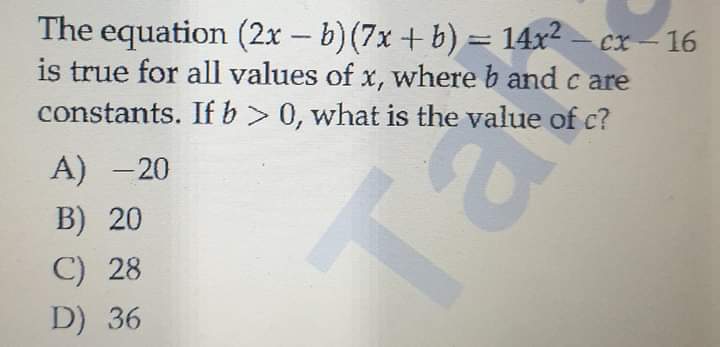
The discussion revolves around solving for the variable c in the equation derived from the expression (2x - b)(7x + b) = 14x^2 - cx - 16. The analysis reveals two solutions for b: 4 and -4, leading to corresponding values for c of 20 and -20, respectively. The calculations confirm that substituting these values into the expanded equation yields consistent results, validating the solutions. The conversation also highlights the importance of correctly equating terms from both sides of the equation.

PREREQUISITES
  • Understanding of polynomial expansion and factorization
  • Familiarity with algebraic equations and variable manipulation
  • Knowledge of solving quadratic equations
  • Basic skills in equating coefficients from algebraic expressions
NEXT STEPS
  • Study polynomial factorization techniques in algebra
  • Learn about solving quadratic equations using the quadratic formula
  • Explore the concept of equating coefficients in algebraic expressions
  • Investigate the implications of variable substitution in algebraic equations
USEFUL FOR

Students, educators, and anyone interested in mastering algebraic equations, particularly those focusing on polynomial expressions and variable relationships.

mathland
Messages
33
Reaction score
0
I replace b with any value greater than 0 and then solve for c. Right?
FB_IMG_1612321193999.jpg
 
Mathematics news on Phys.org
What do you get when you expand the LHS and equate the resulting terms with the corresponding terms in the RHS of the given equation
 
Greg said:
What do you get when you expand the LHS and equate the resulting terms with the corresponding terms in the RHS of the given equation

Ok. I will do as you suggested and be back.
 
It's been 7 months now! Are you still working on it?

For those who were wondering, there are two solutions.
(2x- b)(7x+ b)= 14x^2+ 2bx- 7bx- b^2= 14x^3- 5bx- b^2. That is to be equal to 14x^2- cx- 16.

So we must have -5b= -c and -b^2= -16. b^2= 16 so b= 4 or b= -4.
If b= 4, -5b= -20= -c so c= 20.
If b= -4, -5b= 20= -c so c= -20.

Check:
(2x- 4)(7x+ 4)= 14x^2+ 8x- 28x- 16= 14x^2- 20x- 16.
(2x+ 4)(7x- 4)= 14x^2- 8x+ 28x- 16= 14x^2+ 20x- 16.
 
Beer soaked comment follows.
Country Boy said:
It's been 7 months now! Are you still working on it?
...
He's been banned permanently.
 
I'll bet I could drink that cask of wine in less than 20 days!
 

Similar threads

Replies
5
Views
2K
  • · Replies 12 ·
Replies
12
Views
4K
  • · Replies 5 ·
Replies
5
Views
1K
  • · Replies 1 ·
Replies
1
Views
1K
  • · Replies 2 ·
Replies
2
Views
1K
  • · Replies 1 ·
Replies
1
Views
890
Replies
4
Views
1K
  • · Replies 2 ·
Replies
2
Views
2K
  • · Replies 1 ·
Replies
1
Views
1K
  • · Replies 10 ·
Replies
10
Views
1K