Undergrad Find your ideal quantum interpretation

Click For Summary
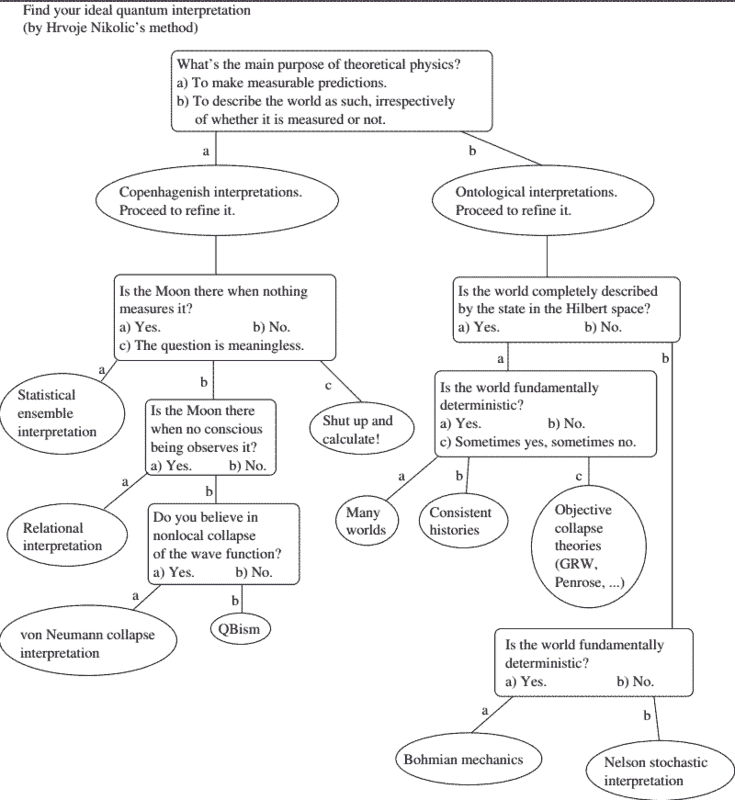
The discussion revolves around finding a quantum mechanics (QM) interpretation that aligns with individual personalities, emphasizing intuitive choices over deep analysis. Participants express dissatisfaction with the decision tree provided, noting that it only includes popular interpretations, which they find deficient. Various interpretations such as Bohmian mechanics, statistical ensemble, and QBism are debated, with some users sharing their personal outcomes and preferences. The conversation highlights the complexity and ongoing debates within quantum interpretations, particularly regarding determinism and the nature of reality when unobserved. Overall, the thread illustrates the subjective nature of interpreting quantum mechanics and the diverse perspectives that exist within the community.
Demystifier
Science Advisor
Insights Author
Messages
14,608
Reaction score
7,219
Find the interpretation of QM that best suits your personality. You don't need to think much about quantum interpretations to decide which one is the best for you. Just choose one of the offered answers to a couple of questions on the graph. You don't need to think much about the offered answers, just choose the one that feels right intuitively, in your guts.

find_you_ideal_quantum_interpretation_3.png
 

Attachments

  • ideal_interp.pdf
    ideal_interp.pdf
    11.5 KB · Views: 470
  • find_you_ideal_quantum_interpretation_3.png
    find_you_ideal_quantum_interpretation_3.png
    40.4 KB · Views: 1,233
Last edited:
  • Like
Likes Hypercube, bhobba, julcab12 and 3 others
Physics news on Phys.org
Demystifier said:
Find the interpretation of QM that best suits your personality. You don't need to think much about quantum interpretations to decide which one is the best for you. Just choose one of the offered answers to a couple of questions. You don't need to think much about the offered answers, just choose the one that feels right intuitively, in your guts.
You decision tree is not good: I ended up with Bohmian mechanics, though I find this a very poor interpretation. My thermal interpretation is far better! (The state is not in Hilbert space but a density operator operating on it.)
 
Last edited:
  • Like
Likes bhobba, vanhees71 and dextercioby
Well, I couldn't put all the existing interpretations to the graph, so I put only the most popular ones.

If you had to choose one from the graph, which one would that be?
 
Demystifier said:
Well, I couldn't put all the existing interpretations to the graph, so I put only the most popular ones.

If you had to choose one from the graph, which one would that be?
Neither; they are all heavily deficient, though in different ways. That's why the interpretation problem is still unsettled.

How did you decide on popularity?
 
A. Neumaier said:
How did you decide on popularity?
By experience (which I have a lot on this matter, but I may be biased).
 
Demystifier said:
By experience (which I have a lot on this matter, but I may be biased).
Please add to your figure your subjective probabilities of popularity of each case (nonnegative, sum to 1, as you had stipulated)! For example, I wonder why GRW/Penrose is in...
 
Demystifier said:
Find the interpretation of QM that best suits your personality.
Wow, it worked for me :smile:. I ended up at the statistical ensemble interpretation, which I do feel closest to. But nevertheless I'm trying to keep my mind open regarding interpretations.
 
  • Like
Likes Demystifier
I am in a superposition of the statistical ensemble interpretation and the Nelson stochastic interpretation. I think the choices in the first box are both equally important. I wanted to end up in Bohmian mechanics but I don't think the world is deterministic due to some intrinsic randomness that we will never be able to know. I would like to think a photon "really" goes via one path or another in an interferometer, the energy of a photon is "localized" and remains so until it is annihilated.

Thanks.
 
  • Like
Likes Demystifier
Find the interpretation of QM that best suits your personality :

if I'm interested in epistemological questions: Qbims
On the other hand, if I'm interested in physics issues: "shut up and calculated",but not for the reason of the decision tree. Just for the interest of understanding the modeling of a physical phenomenon through the language of mathematics.

Now, is "shut up and calculated" an interpretation of Quantum Mechanics !?

I would have put "Is the Moon there when conscious being observe it ?" before 'Is the Moon there when nothing measure it ?" because for us human beings “Lived experience is where we start from and where all must link back to, like a guiding thread”. Accepting the fact that there is something rather than nothing, this does not mean that this something would be such as our consciences present it to us (e.g the Moon).

/Patrick
 
  • #10
Ewww, I got 'shut up and calculate'. That is FAR from the interpretation I adhere to.
 
  • #11
Shut Up And Calculate is in the very center:smile: because the Moon question can be made meaningless only by means of a very meaningful philosophy!
 
  • #12
Consistent Histories is usually presented as a Copenhagen style interpretation, explicitly so in the books of Griffiths and Omnès. Also in both it and QBism the Moon is there when nobody looks.

I'd say at the Moon question QBism, Statistical Ensemble, Consistent Histories and Neo-Copenhagen views (e.g. Bub, Healey, Brukner) all branch off from Relational. You'd then need a set of precise questions to separate them.

I think the first one to ask would be:
"Do Probability 1 events represent a sure occurrence?" or something similar like "Given a set of experimental conditions is there a single rational probability assignment?" or even more briefly "Are you a Subjective Bayesian?". That would separate QBism from the others, with QBism being a "No" answer.

EDIT: I actually think "Are experimental outcomes objective facts?" is a better selector for QBism

After that a similar question asking whether you hold a Frequentist view of probability will pull out the Statistical Ensemble view.

Finally "Can Classical Mechanics be derived from QM?" with "No" giving Neo-Copenhagen and "Yes" giving Consistent Histories.

I'm still holding out for my "I wish I could shut up and calculate" interpretation swinging the hearts of the physics community.:smile:
 
Last edited:
  • #13
If you follow along the path of clean QM formalism. I would say you would likely end up with Many World on face value. Simply because it is simple. The ontology is simple: all that exists is the wavefunction. The dynamics are simple: the wavefunction obeys unitary evolution according to the Schrödinger equation. Measurement problem is simple: decoherence selects a basis, and the relative state gives you definiteness; both of these are natural quantum processes and don't have to be added in. The derivation of the Born rule for probability is -- well maybe not simple -- but it is elegant: proceeding in analogy to classical Savage decision theory. It is an entirely local theory. It generalizes straightforwardly to quantum field theories... Ok I get it. But my personal bias led me to Relational bec of my GR mentality-- Mirages and Gravitational Effect produces illusions.
 
  • #14
julcab12 said:
Measurement problem is simple: decoherence selects a basis, and the relative state gives you definiteness; both of these are natural quantum processes and don't have to be added in. The derivation of the Born rule for probability is -- well maybe not simple -- but it is elegant: proceeding in analogy to classical Savage decision theory. It is an entirely local theory
It really isn't that simple, Wallace's proof is a bit odd defining rationality as almost equivalent to thinking you live in a single world and having a bunch of strange, almost self-contradictory hypotheses about the set of "Quantum Actions" such as irreversibility. This is ignoring the issue that even if it all panned out it's circular. He assumes a branching structure for the proof to work, but branching requires decoherence which requires the Born rule which his proof is attempting to demonstrate, so it's quite circular.

Also as for the "locality" of Many-Worlds, I've never seen a convincing demonstration of this. Even Many-Worlds advocates don't agree on this. Wallace says it is nonlocal, Deutsch says it is local, but like many I don't accept Deutsch's "proof" of this. @Demystifier uses a phrase "alocal" which seems closer to what Many-Worlds is like.
 
  • Like
Likes bhobba and Demystifier
  • #15
Well, I ended in two steps at the statistical ensemble interpretation. That's not a big surprise ;-)).
 
  • Like
Likes PeroK, bhobba and Demystifier
  • #16
DarMM said:
It really isn't that simple, Wallace's proof is a bit odd defining rationality as almost equivalent to thinking you live in a single world and having a bunch of strange, almost self-contradictory hypotheses about the set of "Quantum Actions" such as irreversibility. This is ignoring the issue that even if it all panned out it's circular. He assumes a branching structure for the proof to work, but branching requires decoherence which requires the Born rule which his proof is attempting to demonstrate, so it's quite circular.

That's the reason i say face value, Outside of what is known--Ignoring any philosophical implication(For now). I shouldn't have said "end up". Its the nearest conjecture applying our known contemporary mathematics or dear within the standard formalism of quantum mechanics.
 
  • #17
DarMM said:
Also in both it and QBism the Moon is there when nobody looks.
It depends on which QBist do you ask. Mermin is a QBist that says that the Moon is not there when nobody looks. Fuchs sometimes says that it is and sometimes (especially when defends locality) that it isn't.
 
  • #18
Demystifier said:
It depends on which QBist do you ask. Mermin is a QBist that says that the Moon is not there when nobody looks. Fuchs sometimes says that it is and sometimes (especially when defends locality) that it isn't.
Do you have a link? As that seems different from what Fuchs says in most of what I've read.

As far as I've seen Fuchs says there is an Moon when nobody looks, it just isn't fully mathematically comprehensible (like all things in his view).
 
  • #19
StevieTNZ said:
Ewww, I got 'shut up and calculate'. That is FAR from the interpretation I adhere to.
So what's the interpretation you adhere to?
 
  • #20
DarMM said:
Consistent Histories is usually presented as a Copenhagen style interpretation
Perhaps, but it is more ontological than any other Copenhagen style interpretation.
 
  • #22
Demystifier said:
Perhaps, but it is more ontological than any other Copenhagen style interpretation.
Genuinely I don't see it as too different from Bub, Haag, Brukner and Healey in how much ontology it gives, at least from Griffith's and Omnès's books. Omnès for example says Quantum Mechanics doesn't directly model the world as it is, he also describes it as simply an extended form of Copenhagen. I think the real difference between it and other Neo-Copenhagen views is that it supposes Classical Mechanics can be derived from QM rather than that it is more ontological.
 
  • #23
DennisN said:
Wow, it worked for me :smile:. I ended up at the statistical ensemble interpretation, which I do feel closest to. But nevertheless I'm trying to keep my mind open regarding interpretations.
I tried the ontological branch too, but interestingly I found it very hard to answer the questions;

Is the world completely described by the state in the Hilbert space?
Here I would probably say "no", since I feel answering "yes" would feel a bit like hubris :smile:.

Is the world fundamentally deterministic?
This question I find very hard to answer. Very hard. Because on the one hand the physical world very much appear to follow the rules of causes and effects, but on the other hand we are still stuck with this randomness in QM. But if I really force myself to answer, I'll probably answer "yes", which would make me end up at Bohmian mechanics.
 
  • #24
Demystifier said:
It depends on which QBist do you ask. Mermin is a QBist that says that the Moon is not there when nobody looks. Fuchs sometimes says that it is and sometimes (especially when defends locality) that it isn't.
I guess to handle that you need to draw a quantum picture, with an irreducible uncertainty about which interpretation belongs where!
 
  • Like
Likes bhobba, Demystifier and DarMM
  • #25
Demystifier said:
https://www.quantamagazine.org/quantum-bayesianism-explained-by-its-founder-20150604/

"My fellow QBists and I instead think that what Bell’s theorem really indicates is that the outcomes of measurements are experiences, not revelations of something that’s already there."
I don't think that's saying there's no external world or that things aren't there when not observed, it's just the standard "measurement creates measurement outcomes" you have in Copenhagen views like Haag's, i.e. the measurement results don't follow predictably from something prior they're a creation of the measurement or Peres's "Unperformed experiments have no results".

I think this paper is fairly clear on laying out that there is an external world out there in QBism:
https://arxiv.org/abs/1601.04360

It's just that world has non-deteministic interactions, i.e. some interactions between the Moon and my equipment are purely associated with that interaction event and not determined prior to it.
 
  • #26
DarMM said:
I don't think that's saying there's no external world or that things aren't there when not observed
I think they are saying that such things (which are there when not observed) are not physical. Assuming that the Moon is physical, it follows that the Moon is not there when not observed.
 
  • #27
Demystifier said:
I think they are saying that such things (which are there when not observed) are not physical. Assuming that the Moon is physical, it follows that the Moon is not there when not observed.
So in their interpretation, the Moon is physical when observed, and nonphysical otherwise?
 
  • #28
Demystifier said:
I think they are saying that such things (which are there when not observed) are not physical. Assuming that the Moon is physical, it follows that the Moon is not there when not observed.
I guess all I can say is from reading their papers I disagree, Fuchs explicitly says that the view is not instrumentalist, i.e. he disagrees that only that which is observed is real, see this talk:

See around 16:20 for comments on external reality and around 30:10 for a clearer statement of the view of measurements. They simply think that interactions provoke events and values that are entirely "new" and don't follow directly from the previous state of objects, not that nothing exists outside measurement or is unphysical.

This video is a clear rejection of instrumentalism by Fuchs:


My own issue with QBism is I don't think that if one is Copenhagenist1 that one is compelled to a perspectival view as of yet, i.e. that measurement outcomes aren't objective. This is actually in light of the thread with you and @atyy on the Frauchiger-Renner paper.

1Copenhagenist meaning QM is not representational of nature, it only discusses measurement outcome statistics or similar.
 
  • Like
Likes julcab12 and Spinnor
  • #29
A. Neumaier said:
So in their interpretation, the Moon is physical when observed, and nonphysical otherwise?
As I above I would say no. From my reading of their papers the Moon is always physical, just that the results of certain interactions with the Moon don't follow from the preceding state of the world.
 
  • #30
Demystifier said:
It depends on which QBist do you ask. Mermin is a QBist that says that the Moon is not there when nobody looks. Fuchs sometimes says that it is and sometimes (especially when defends locality) that it isn't.
It's utter nonsense. Already the conservation laws prevent the moon from vanishing when nobody looks at it. This is really superfluous philosophical gibberish!
 
  • Like
Likes N88, Mentz114 and bhobba

Similar threads

  • · Replies 4 ·
Replies
4
Views
3K
  • · Replies 292 ·
10
Replies
292
Views
13K
  • · Replies 5 ·
Replies
5
Views
2K
  • · Replies 14 ·
Replies
14
Views
3K
  • · Replies 7 ·
Replies
7
Views
5K
  • · Replies 376 ·
13
Replies
376
Views
23K
  • · Replies 179 ·
6
Replies
179
Views
15K
  • · Replies 25 ·
Replies
25
Views
5K
  • · Replies 6 ·
Replies
6
Views
2K
  • · Replies 26 ·
Replies
26
Views
5K