Finding acceleration from position formula

Join the discussion
Ask a follow-up here, or get your own question answered by working scientists, mathematicians and engineers — people, not an autocomplete.
Real named experts · corrections over time · the nuance an AI answer skips
4 replies · 2K views
guyvsdcsniper
Messages
264
Reaction score
37
Homework Statement
A particle moves with constant velocity v along the curve r = k(1+cosθ) (a cardioid), where
k is a constant. Find the acceleration of the particle (a), a· rˆ, |a|, and θ˙.
Relevant Equations
a = dV/dt
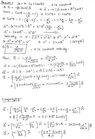
I am trying to follow the solution to the following problem, both linked in the attachment.

When trying to find the acceleration, a, that should be taking the derivative of r, the position formula twice. When doing so I get v = -ksinθ and a = -kcosθ. The attached work shows v being -(ksinθ)θ' which also leads to them getting a different answer for acceleration. Am i approaching this problem the wrong way?
 

Attachments

  • Screen Shot 2022-01-11 at 2.30.33 PM.png
    Screen Shot 2022-01-11 at 2.30.33 PM.png
    7.3 KB · Views: 161
  • r+costheta.jpeg
    r+costheta.jpeg
    40.5 KB · Views: 151
Physics news on Phys.org
quittingthecult said:
Homework Statement:: A particle moves with constant velocity v along the curve r = k(1+cosθ) (a cardioid), where
k is a constant. Find the acceleration of the particle (a), a· rˆ, |a|, and θ˙.
Relevant Equations:: a = dV/dt

I am trying to follow the solution to the following problem, both linked in the attachment.

When trying to find the acceleration, a, that should be taking the derivative of r, the position formula twice. When doing so I get v = -ksinθ and a = -kcosθ. The attached work shows v being -(ksinθ)θ' which also leads to them getting a different answer for acceleration. Am i approaching this problem the wrong way?
To find the velocity and acceleration you need to differentiate twice with respect to time. You appear to have differentiated wrt ##\theta##. Using the chain rule, you must then multiply by the derivative of that wrt time.
 
Reply
  • Like
Likes   Reactions: Charles Link
Maybe a bit pedantic but….

The velocity (a vector) can’t be constant because its direction is constantly changing.

The question and the model answer should refer to the speed (not the velocity) as being constant.
 
Reply
  • Like
Likes   Reactions: robphy, sysprog, SammyS and 1 other person
haruspex said:
To find the velocity and acceleration you need to differentiate twice with respect to time. You appear to have differentiated wrt ##\theta##. Using the chain rule, you must then multiply by the derivative of that wrt time.
Since I am differentiating with respect to time, this becomes implicit differentiation?