Finding compound interest formula

  • Thread starter Thread starter member 731016
  • Start date Start date
  • Tags Tags
    Formula Interest
Click For Summary
SUMMARY

The compound interest formula for continuously compounded interest is defined as A = P0ert, where A is the amount, P0 is the principal, r is the interest rate, and t is time in years. A participant in the discussion incorrectly proposed A(t) = 500 × 6.5t as the formula, leading to confusion regarding the base of the exponent. The correct understanding is that the base e is used for continuous compounding, as established in financial mathematics. Resources such as Khan Academy provide further clarification on this topic.

PREREQUISITES
  • Understanding of the compound interest formula
  • Familiarity with the mathematical constant e
  • Basic knowledge of exponential functions
  • Concept of continuous compounding in finance
NEXT STEPS
  • Study the derivation of the formula A = P0ert for continuous compounding
  • Explore Khan Academy's resources on continuously compounding interest
  • Learn about the differences between discrete and continuous compounding
  • Investigate real-world applications of continuous compounding in finance
USEFUL FOR

Students studying finance, educators teaching compound interest, and anyone interested in understanding the mathematics of continuous compounding.
member 731016
Homework Statement
please see below
Relevant Equations
please see below
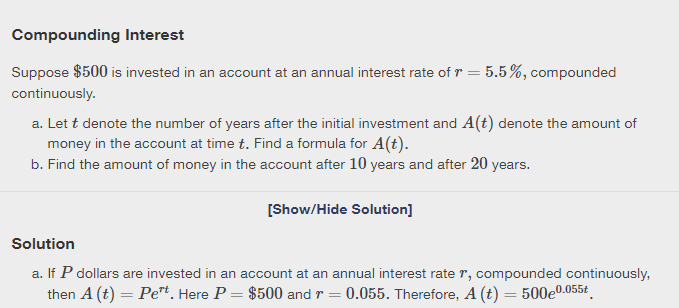
For this part (a),
1686806444867.png

I got ##A(t) = 500 \times 6.5^t## where t is in years. Does someone please know whhy their function is to base e? Is it because the money is compounded continuously?

Many thanks!
 
Physics news on Phys.org
ChiralSuperfields said:
Homework Statement: please see below
Relevant Equations: please see below

For this part (a),
View attachment 327892
I got ##A(t) = 500 \times 6.5^t## where t is in years. Does someone please know whhy their function is to base e? Is it because the money is compounded continuously?
Yes, and because the formula for interest compounded continuously is defined as ##A = P_0e^{rt}##. Most textbooks that discuss compound interest and in particular, interest compounded continuously, will develop this formula.

I don't know how you came up with 6.5 as the base. Was it as simple as adding 1 and 5.5? That's wrong for several reasons.
 
Last edited:
  • Like
Likes member 731016

Similar threads

  • · Replies 29 ·
Replies
29
Views
4K
  • · Replies 8 ·
Replies
8
Views
3K
  • · Replies 4 ·
Replies
4
Views
3K
  • · Replies 11 ·
Replies
11
Views
3K
Replies
14
Views
7K
  • · Replies 2 ·
Replies
2
Views
2K
  • · Replies 11 ·
Replies
11
Views
2K
  • · Replies 7 ·
Replies
7
Views
5K
  • · Replies 15 ·
Replies
15
Views
3K
  • · Replies 2 ·
Replies
2
Views
3K