Finding conjunctive normal form for ((A → (B → C)) & (A → B) & A) ↔ C

  • Context:
  • Thread starter Thread starter ion88
  • Start date Start date
  • Tags Tags
    Formula
Join the discussion
Registration is free. Ask a follow-up in this thread, or start your own.
4 replies · 2K views
ion88
Messages
2
Reaction score
0
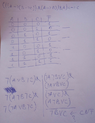
Hello I'm new here. Can someone please help me with the conjunctive normal form for this formula ?
(((A -> (B -> C)) & (A -> B)) & A) <-> C
I don't know if i did this right or not. If not what should i do ?
oT5LC58
 
Physics news on Phys.org

Attachments

  • mhb_inline_0001.png
    mhb_inline_0001.png
    85.4 KB · Views: 135
ion88 said:
Hello I'm new here. Can someone please help me with the conjunctive normal form for this formula ?
(((A -> (B -> C)) & (A -> B)) & A) <-> C
I don't know if i did this right or not. If not what should i do ?
Hello ion88.

This is the truth table you need to fill in:

$$\begin{array}{|c|c|c|c|c|c|c|c|}\hline A & B & C & B\to C & A\to(B\to C) & A\to B & (A\to(B\to C))\,\&\,(A\to B) & ((A\to(B\to C))\,\&\,(A\to B))\,\&\,A \\ \hline 0 & 0 & 0 \\ \hline 0 & 0 & 1 \\ \hline 0 & 1 & 0 \\ \hline 0 & 1 & 1 \\ \hline 1 & 0 & 0 \\ \hline 1 & 0 & 1 \\ \hline 1 & 1 & 0 \\ \hline 1 & 1 & 1 \\ \hline \end{array}$$

When you have done, compare the last column with the $C$ column.
 
Olinguito said:
Hello ion88.

This is the truth table you need to fill in:

$$\begin{array}{|c|c|c|c|c|c|c|c|}\hline A & B & C & B\to C & A\to(B\to C) & A\to B & (A\to(B\to C))\,\&\,(A\to B) & ((A\to(B\to C))\,\&\,(A\to B))\,\&\,A \\ \hline 0 & 0 & 0 \\ \hline 0 & 0 & 1 \\ \hline 0 & 1 & 0 \\ \hline 0 & 1 & 1 \\ \hline 1 & 0 & 0 \\ \hline 1 & 0 & 1 \\ \hline 1 & 1 & 0 \\ \hline 1 & 1 & 1 \\ \hline \end{array}$$

When you have done, compare the last column with the $C$ column.


Sory but I don't even know what programming language is that
 
ion88 said:
Sory but I don't even know what programming language is that

Hi ion88, welcome to MHB! (Wave)

No worries.
I believe you've already correctly filled in the table, which is what MarkFL uploaded for you.

I'm afraid it also means that the conjunctive normal form that you had found (¬B ∨ C), is not correct.
We can verify by checking (¬B ∨ C) against your truth table, and see that it does not match. (Worried)

The easiest way to convert your truth table to conjunctive form, is through a so called Karnaugh Map.
It looks like this:
\begin{tikzpicture}
%preamble \usepackage{karnaugh-map}
\node {
\begin{karnaugh-map}[4][2][1][AB][C]
\minterms{0,1,2,3,7}
\maxterms{4,5,6}
\implicant{0}{2}
\implicant{3}{7}
\end{karnaugh-map}
};
\end{tikzpicture}
From this Karnaugh Map, we can deduce that the corresponding disjunctive expression is:
(A & B) ∨ ¬C​
That is, the green rectangle corresponds to (A & B), and the red rectangle corresponds to ¬C.
The resulting expression is true if we are in the green rectangle OR in the red rectangle.

We can convert it to conjunctive normal form by using the distributivity of boolean expressions:
(A & B) ∨ ¬C = (A ∨ ¬C) & (B ∨ ¬C)​
(Thinking)