What Is the Correct Expression for the Emitted Field?

Click For Summary
SUMMARY

The discussion centers on determining the correct expression for the emitted field in the context of calculating its Fourier transform. The emitted field is described by the equation f(t) = C e^{-t/2\tau}, where C is a constant and \tau is the decay time constant. Participants emphasize the need to calculate the Fourier transform to derive the frequency spectrum of the radiated power and subsequently the density of states (DOS). The confusion primarily arises from the correct identification of the constant C and its relationship to the expected output, which involves terms like (E - \hbar \omega_{21})^2.

PREREQUISITES
  • Understanding of Fourier transforms in the context of electromagnetic fields.
  • Familiarity with decay functions, specifically e^{-t/\tau}.
  • Knowledge of the density of states (DOS) in quantum mechanics.
  • Basic concepts of radiated power and its frequency spectrum.
NEXT STEPS
  • Research the derivation of the Fourier transform of exponential decay functions.
  • Study the relationship between the emitted field and the density of states in quantum systems.
  • Learn about the significance of the constant C in the context of emitted fields.
  • Explore examples of calculating the Fourier transform for similar physical systems.
USEFUL FOR

Physicists, electrical engineers, and students studying quantum mechanics or electromagnetic theory who are looking to deepen their understanding of emitted fields and their transformations.

MaestroBach
Messages
53
Reaction score
4
Homework Statement
Find the frequency spectrum of the radiated power in spontaneous emission and use it to find the DOS.
Relevant Equations
Desired result below
All I'm reallly confused on this problem is what the expression for the emitted field is. As long as I've got that, I'm good to go, but I just don't know what to use. I've tried looking for an expression for the emitted field but I've had no luck. Would appreciate any ideas or someone telling me I'm missing something obvious.

(I'm told to find the Fourier transform of the field and go from there, which is why I'm trying to find the expression for the field)
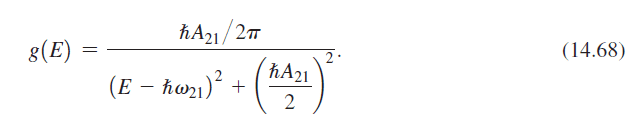
Eq. 14.68.png
 
  • Like
Likes   Reactions: Delta2
Physics news on Phys.org
You have to give some more context.

Are you starting from the Einstein coefficients?
 
DrClaude said:
You have to give some more context.

Are you starting from the Einstein coefficients?

No, I'm being told to start by taking the Fourier transform of the emitted field, and as far as I'm understanding, I won't even be using the einstein coefficients.

I'm being told to calculate the Fourier transform of the emitted field to find the frequency spectrum of the radiated power, and then use that to find the DOS.

I just have absolutely no idea what the emitted field expression is, other than that it decays with the form ##e^{-t/\tau}## (Sorry I should have included that info in the original post, but now it seems like I can't even edit it).
 
MaestroBach said:
No, I'm being told to start by taking the Fourier transform of the emitted field, and as far as I'm understanding, I won't even be using the einstein coefficients.
Then I don't know what ##A_{21}## is.

MaestroBach said:
I'm being told to calculate the Fourier transform of the emitted field to find the frequency spectrum of the radiated power, and then use that to find the DOS.

I just have absolutely no idea what the emitted field expression is, other than that it decays with the form ##e^{-t/\tau}## (Sorry I should have included that info in the original post, but now it seems like I can't even edit it).
Do you have the full text of the question?
 
DrClaude said:
Then I don't know what ##A_{21}## is.Do you have the full text of the question?

Yeah, it is:
14.5.png


where eq 14.68 is what I have in the original post.
 
So the problem tells you that the field is ##\propto e^{-t/2 \tau}##, i.e., ##f(t) = C e^{-t/2 \tau}##, with C a constant. That is your starting point.
 
DrClaude said:
So the problem tells you that the field is ##\propto e^{-t/2 \tau}##, i.e., ##f(t) = C e^{-t/2 \tau}##, with C a constant. That is your starting point.
Fair enough. For some reason I thought there would be another term that also has some other kind of dependence, along with ##f(t) = C e^{-t/2 \tau}##. How in the world do I go about finding C though?
 
So I've gone and tried ##f(t) = Ce^{\frac{-t}{2\tau}}##, but that does not give me the correct answer. It actually comes close, but I get ##E^2## instead of ##(E - \hbar \omega_{21})^2## like my answer is supposed to be (correct answer in OP), which makes me suspect my electric field expression is still incorrect. If anyone has any insight I'd appreciate it.
 

Similar threads

Replies
1
Views
1K
  • · Replies 5 ·
Replies
5
Views
2K
  • · Replies 2 ·
Replies
2
Views
2K
  • · Replies 0 ·
Replies
0
Views
1K
  • · Replies 6 ·
Replies
6
Views
2K
Replies
9
Views
2K
  • · Replies 1 ·
Replies
1
Views
2K
  • · Replies 12 ·
Replies
12
Views
2K
  • · Replies 73 ·
3
Replies
73
Views
6K
  • · Replies 2 ·
Replies
2
Views
2K