rcyn12
- 1
- 0
A slab made of unknown material is connected to a power supply as shown in the figure. There is a uniform magnetic field of 0.7 tesla pointing upward throughout this region (perpendicular to the horizontal slab). Two voltmeters are connected to the slab and read steady voltages as shown. (Remember that a voltmeter reads a positive number if its positive lead is connected to the higher potential location.) The connections across the slab are carefully placed directly across from each other. The distance w = 0.16 m. Assume that there is only one kind of mobile charges in this material, but we don't know whether they are positive or negative.
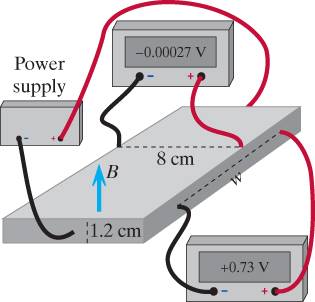
In the steady state, the current moves straight along the bar, so the net sideways force on a moving charge must be zero. Use this fact to determine the drift speed
 of the mobile charges.
.0048 m/s (correct)
(c) Knowing the drift speed, determine the mobility u of the mobile charges. (Note that there are two contributions to the electric field in the bar. Think about which one drives the current.)
1.42 (m/s)/(volts/m) (incorrect)
(d) The current running through the slab was measured to be 0.3 ampere. If each mobile charge is singly charged ( |q| = e), how many mobile charges are there in 1 m3 of this material?
4.069e23 carriers/m^3 (correct)
(e) What is the resistance in ohms of a 0.16 m length of this slab?
2.43 ohms (correct)
I've tried:
E=dV/h -> u=v/(dV/h) based off Drude model with dV=.00027, h=.08, v=.0048
Not sure why this wouldn't work.
In the steady state, the current moves straight along the bar, so the net sideways force on a moving charge must be zero. Use this fact to determine the drift speed
.0048 m/s (correct)
(c) Knowing the drift speed, determine the mobility u of the mobile charges. (Note that there are two contributions to the electric field in the bar. Think about which one drives the current.)
1.42 (m/s)/(volts/m) (incorrect)
(d) The current running through the slab was measured to be 0.3 ampere. If each mobile charge is singly charged ( |q| = e), how many mobile charges are there in 1 m3 of this material?
4.069e23 carriers/m^3 (correct)
(e) What is the resistance in ohms of a 0.16 m length of this slab?
2.43 ohms (correct)
I've tried:
E=dV/h -> u=v/(dV/h) based off Drude model with dV=.00027, h=.08, v=.0048
Not sure why this wouldn't work.