Finding Real and Imaginary Parts of the complex wave number

Click For Summary
SUMMARY

The discussion centers on the derivation of the real and imaginary parts of the complex wave number as presented in Griffiths' "Introduction to Electrodynamics," specifically in the fourth edition, page 413, section 9.4.1. The real part, denoted as k+, corresponds to k, while the imaginary part, denoted as k-, corresponds to κ (kappa). The inquiry focuses on the rationale behind Griffiths' choice of the positive root when calculating k+, emphasizing that selecting the negative root would yield an imaginary value, which is not suitable for this context.

PREREQUISITES
  • Understanding of complex numbers and their properties
  • Familiarity with electromagnetic wave theory
  • Knowledge of polynomial equations and their roots
  • Experience with Griffiths' "Introduction to Electrodynamics" (4th edition)
NEXT STEPS
  • Review the derivation of complex wave numbers in Griffiths' "Introduction to Electrodynamics"
  • Study the implications of real versus imaginary components in wave propagation
  • Explore polynomial equations and their roots in mathematical physics
  • Investigate the physical significance of the complex wave number in conductors
USEFUL FOR

Students of electromagnetism, physicists, and educators seeking a deeper understanding of complex wave numbers and their applications in electromagnetic theory.

sams
Gold Member
Messages
84
Reaction score
2
In Griffiths fourth edition, page 413, section 9.4.1. Electromagnetic Waves in Conductors, the complex wave number is given according to equation (9.124).
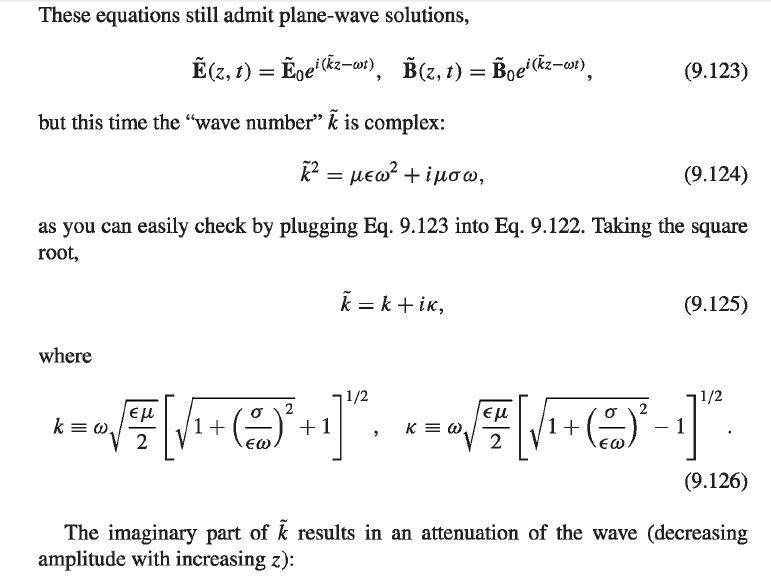
Capture.JPG


Calculating the real and imaginary parts of the complex wave number as in equation (9.125) lead to equations (9.126). I have done the derivation by myself and I present it here as follows:
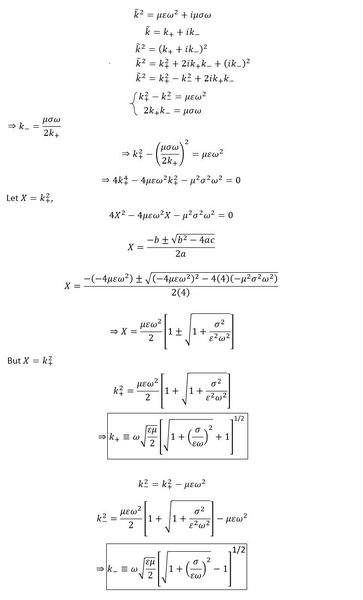
Complete Derivation.jpg


Where,
k+ is the real part of the complex wave number = k in Griffiths.
k- is the imaginary part of the complex wave number = κ (kappa) in Griffiths.

My question here is mathematical rather than physical, why did Griffiths took the positive sign of the first root of X (since X here has two roots when evaluating the polynomial of 2nd degree) when finding the real part k+ of the complex wave number?

Any help is deeply appreciated! Many Thanks!
 

Attachments

  • Capture.JPG
    Capture.JPG
    40.3 KB · Views: 8,229
  • Complete Derivation.jpg
    Complete Derivation.jpg
    15.7 KB · Views: 2,405
Physics news on Phys.org
The positive sign must be taken for k to be real. Taking the negative sign would result in a negative value and hence k would be imaginary since the square root of a negative number is imaginary.
 
  • Like
Likes   Reactions: sams

Similar threads

  • · Replies 6 ·
Replies
6
Views
1K
  • · Replies 1 ·
Replies
1
Views
2K
  • · Replies 2 ·
Replies
2
Views
2K
  • · Replies 20 ·
Replies
20
Views
3K
  • · Replies 5 ·
Replies
5
Views
2K
  • · Replies 1 ·
Replies
1
Views
1K
  • · Replies 4 ·
Replies
4
Views
2K
  • · Replies 0 ·
Replies
0
Views
2K
  • · Replies 7 ·
Replies
7
Views
2K
  • · Replies 7 ·
Replies
7
Views
3K