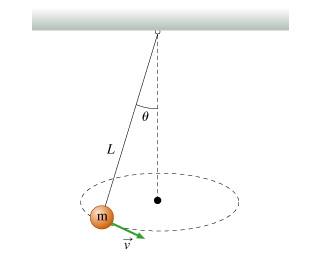
Finding tangential speed to maintain an angle theta

  • Thread starter Thread starter Linus Pauling
  • Start date Start date
  • Tags Tags
    Angle Speed Theta
Click For Summary
To maintain a horizontal circular motion with a string at an angle theta from the vertical, the required tangential speed, v, can be derived using the equations T = mg/cos(theta), r = Lsin(theta), and a_c = v^2/r. The inward radial force is identified as mgtan(theta), which is crucial for determining the necessary speed. To find the time for one complete revolution, the circumference of the circle, given by 2πLsin(theta), is divided by the constant speed v. The kinematic equation needed for this calculation relates distance, speed, and time, allowing for the determination of the period of revolution. Understanding these relationships is essential for solving the problem effectively.
Linus Pauling
Messages
187
Reaction score
0
1.
MLD_cm_6.jpg


What tangential speed, v, must the bob have so that it moves in a horizontal circle with the string always making an angle theta from the vertical?
Express your answer in terms of some or all of the variables m, L, and theta, as well as the acceleration due to gravity g.


2. I figured out the following:

T = mg/cos(theta)
r = Lsin(theta)
a_c = v^2/Lsin(theta)


3. see above

I next had to get the horizontal (inward radial) force, which is mgtan(theta). How was that force obtained? Also, how do I use this information to answer the question?
 
Physics news on Phys.org
Second part of question: How long does it take the bob to make one full revolution (one complete trip around the circle)?

I know that the speed is constant = sqrt[Lgsin(theta)tan(theta), and I also know the distance is the circumference of the circle = 2*pi*Lsin(theta). I know I have to use kinematics but which equation?
 
Thread 'Correct statement about size of wire to produce larger extension'
The answer is (B) but I don't really understand why. Based on formula of Young Modulus: $$x=\frac{FL}{AE}$$ The second wire made of the same material so it means they have same Young Modulus. Larger extension means larger value of ##x## so to get larger value of ##x## we can increase ##F## and ##L## and decrease ##A## I am not sure whether there is change in ##F## for first and second wire so I will just assume ##F## does not change. It leaves (B) and (C) as possible options so why is (C)...

Similar threads

Replies
2
Views
1K
Replies
1
Views
1K
  • · Replies 20 ·
Replies
20
Views
2K
  • · Replies 9 ·
Replies
9
Views
820
Replies
55
Views
5K
  • · Replies 6 ·
Replies
6
Views
1K
  • · Replies 2 ·
Replies
2
Views
1K
  • · Replies 6 ·
Replies
6
Views
2K
  • · Replies 18 ·
Replies
18
Views
2K
  • · Replies 21 ·
Replies
21
Views
3K