Finding Tension of a string tied to a wall

Click For Summary
The discussion focuses on calculating the tension in a string tied to a wall, involving two blocks with different masses. The user initially calculated the tension as zero for Block A and 8.82 for Block B, but sought clarification on the static equilibrium conditions. It was emphasized that the forces acting on the blocks can be resolved using trigonometric functions without needing to consider the weight of Block A for calculating the tension in the string. The advice suggests focusing solely on the forces at the rope join to find the tension related to Block B and the wall. The conversation highlights the importance of understanding static equilibrium in solving the problem effectively.
DERC511
Messages
2
Reaction score
0
In the figure we see two blocks connected by a string and tied to a wall, with θ = 33°. The mass of the lower block is m = 0.9 kg; the mass of the upper block is 4.0 kg. Find the tension in the string that is tied to the wall.
-I have the forces of Block A as Tension, Normal Force, and Gravity (mg). From my calculations I have that Tension equals 0 (which I don't think is correct) and the Normal Force being equal to 39.2.
- For Block B I have the forces as Tension and Gravity, which gives me the Tension being equal to 8.82
- Finally,I separated the tension of the rope on the wall to the x and y components with X: Tcos33 and Y: Tsin33
- We can assume this is all in static equilibrium. Any advice on mistakes or how to proceed with this problem is much appreciated!
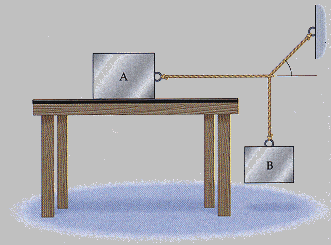
4-23.gif
 
Physics news on Phys.org
Look at the just the rope join.

There are three forces acting, let's call them TA to the left, TB downward, and TW to the right, Θ degrees above horizontal.

Using ∑Fx = ∑Fy = 0 you can find TW from theta and T B using trig, you don't need to know anything about TA.
 
  • Like
Likes DERC511
billy_joule said:
Look at the just the rope join.

There are three forces acting, let's call them TA to the left, TB downward, and TW to the right, Θ degrees above horizontal.

Using ∑Fx = ∑Fy = 0 you can find TW from theta and T B using trig, you don't need to know anything about TA.
Thank you for the reply. So you're saying that I can't calculate TB By equating the Weight of the block to it?
 
DERC511 said:
Thank you for the reply. So you're saying that I can't calculate TB By equating the Weight of the block to it?

If it's in static equilibrium then the weight of block A has no effect on TA and is only given to confuse or challenge you, or maybe it's required for a later question.
 
The book claims the answer is that all the magnitudes are the same because "the gravitational force on the penguin is the same". I'm having trouble understanding this. I thought the buoyant force was equal to the weight of the fluid displaced. Weight depends on mass which depends on density. Therefore, due to the differing densities the buoyant force will be different in each case? Is this incorrect?

Similar threads

Replies
21
Views
852
Replies
2
Views
1K
Replies
2
Views
1K
Replies
16
Views
3K
  • · Replies 8 ·
Replies
8
Views
2K
  • · Replies 7 ·
Replies
7
Views
2K
  • · Replies 2 ·
Replies
2
Views
1K
Replies
4
Views
798
  • · Replies 9 ·
Replies
9
Views
7K
  • · Replies 3 ·
Replies
3
Views
2K