Finding the activity of a carbon 14 sample

  • Thread starter Thread starter Bolter
  • Start date Start date
  • Tags Tags
    Activity Carbon
Click For Summary
SUMMARY

The forum discussion focuses on calculating the activity of a carbon-14 sample, specifically addressing the number of C-14 atoms in a 1g sample. Participants clarify the use of carbon-12's molar mass, noting that using 14 as an approximation is acceptable due to the abundance of carbon-12. The conversation emphasizes the importance of precision in calculations, particularly when determining the activity reduction over time, with one user updating their findings based on previous calculations. The final activity is stated to reduce to 3 disintegrations per minute based on an initial activity of 11.835 disintegrations per minute.

PREREQUISITES
  • Understanding of carbon-14 dating principles
  • Knowledge of molar mass calculations
  • Familiarity with radioactive decay and activity measurement
  • Basic algebra for weighted averages
NEXT STEPS
  • Research the principles of carbon-14 dating and its applications
  • Learn about radioactive decay constants and their calculations
  • Explore the concept of weighted averages in chemistry
  • Investigate the use of disintegration rates in radiometric dating
USEFUL FOR

Students in chemistry or geology, researchers in radiocarbon dating, and anyone involved in environmental science or archaeology who seeks to understand carbon-14 activity calculations.

Bolter
Messages
262
Reaction score
31
Homework Statement
See full question below
Relevant Equations
A = Lambda*N
Hi there

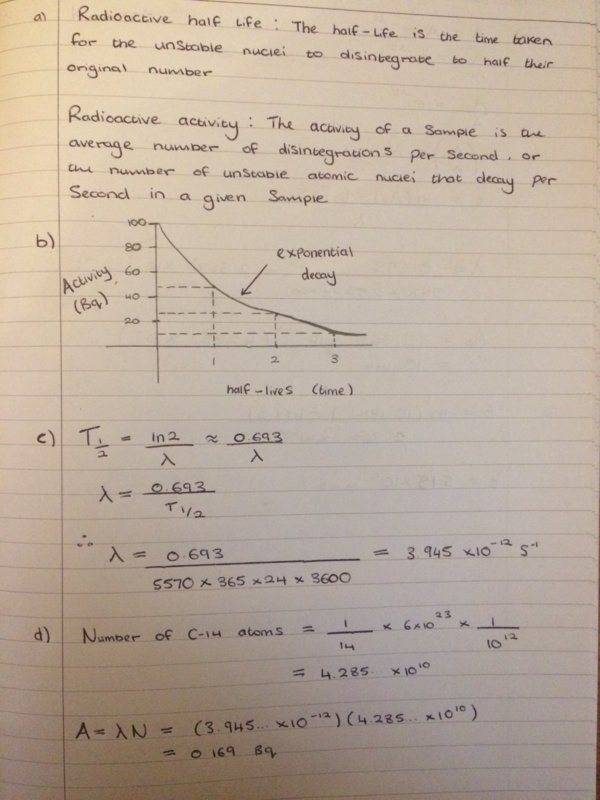
So I have had a go at this question but I'm not confident that I have done the last 2 parts of this question right?
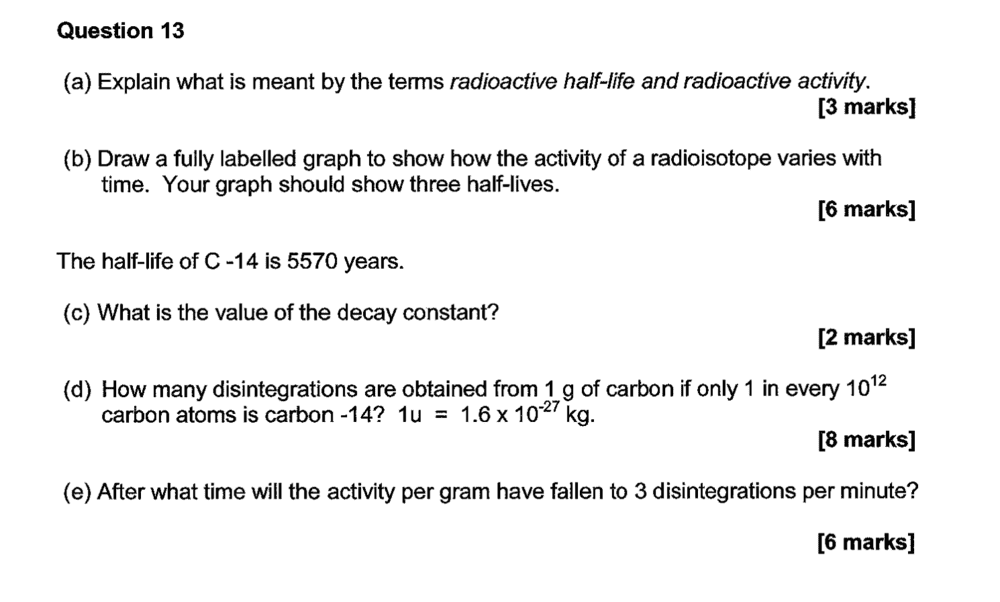
Screenshot 2020-04-20 at 19.09.53.png


IMG_4644.jpg

IMG_4645.jpg


Can anyone please see if this is what you do to get the values?

Any help would be appreciated! Thanks
 
Physics news on Phys.org
Think again about how you calculate the number of C14 atoms in the 1g.
 
  • Like
Likes   Reactions: etotheipi
haruspex said:
Think again about how you calculate the number of C14 atoms in the 1g.

Is this what I should get instead?

IMG_4653.jpg

I don't know why I was using 14 as the molar mass of carbon-12
 
Bolter said:
I don't know why I was using 14 as the molar mass of carbon-12

That appears to be a good enough approximation considering the huge excess of carbon-12, good enough for the precision of my calculator, anyway!

If the proportions were less extreme, you'd need to perhaps consider using a weighted mean or else an algebraic expression of some sort for the relative masses.
 
  • Like
Likes   Reactions: Bolter
etotheipi said:
That appears to be a good enough approximation considering the huge excess of carbon-12, good enough for the precision of my calculator, anyway!

If the proportions were less extreme, you'd need to perhaps consider using a weighted mean or else an algebraic expression of some sort for the relative masses.

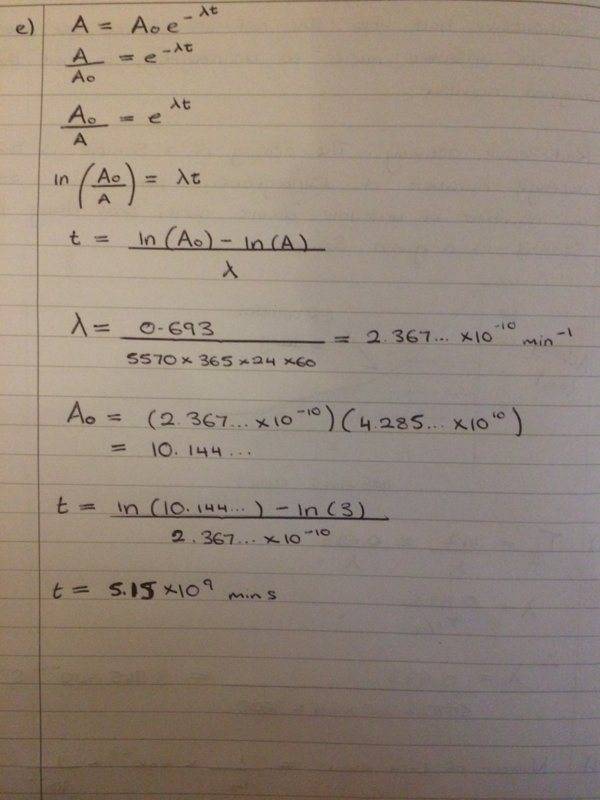
Thanks I understand, and notably this means my answer will be affected for part e) as part e) relies on part d)

I changed it now and found the time that the activity will reduce to 3 disintegrations per min assuming 11.835... is the initial activity in disintegrations per min

IMG_4658.JPG
 

Similar threads

  • · Replies 11 ·
Replies
11
Views
5K
  • · Replies 2 ·
Replies
2
Views
2K
  • · Replies 8 ·
Replies
8
Views
3K
  • · Replies 17 ·
Replies
17
Views
2K
  • · Replies 20 ·
Replies
20
Views
2K
  • · Replies 2 ·
Replies
2
Views
1K
  • · Replies 9 ·
Replies
9
Views
4K
  • · Replies 9 ·
Replies
9
Views
5K
  • · Replies 1 ·
Replies
1
Views
1K
  • · Replies 2 ·
Replies
2
Views
2K