Finding the center of an n-gon (circle) based on angle and side-length

  • Context: Undergrad 
  • Thread starter Thread starter STENDEC
  • Start date Start date
  • Tags Tags
    Angle Center Circle
Join the discussion
Ask a follow-up here, or get your own question answered by working scientists, mathematicians and engineers — people, not an autocomplete.
Real named experts · corrections over time · the nuance an AI answer skips
3 replies · 3K views
STENDEC
Messages
21
Reaction score
0
I hope this is self-evident to someone, I'm struggling.

I have a program that draws circles (n-gons really) of various sizes, but by translating-rotating-translating-rotating-..., not by x=sin/y=cos. That works as intended, but my wish is to offset the circle so that its center is (0,0) in the coordinate system. For that i need its center. Currently the circle itself originates from- and hence touches the (0,0) coordinates, so its center is somewhere above, in the y-axis.
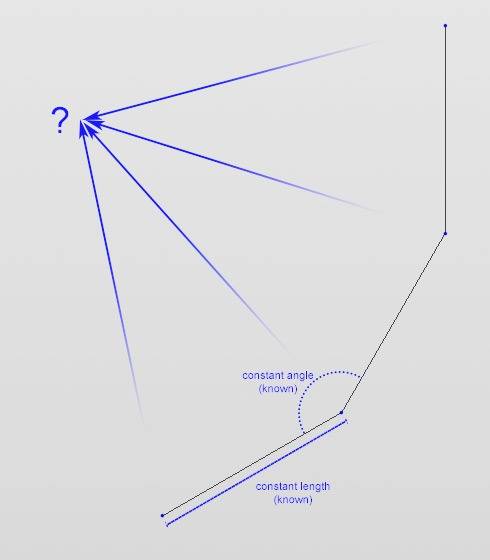
dsrd0.jpg


Position of ? is sought after. A wider angle would result in ? rising for instance.

I found lots of tutorials on how to do it on paper using dividers and i also considered that it's a isosceles triangle, but it seems all textbook examples assume that one of the symmetric sides is already known.
 
Mathematics news on Phys.org
you could use similar triangles and some trig to get the radius along the y-axis.

Notice you can extend a perpendicular bisector from the first n-gon side which intersects the y-axis

so that 1/2 the n-gon side is the short edge the perpendicular creates the right angle and the y-axis is the hypotenuse.

This triangle is similar to the one formed by the n-gon edge and the x-axis.

So I get something like:

radius along y-axis = (1/2 n-gon side) / sin theta
 
Last edited:
jedishrfu said:
you could use similar triangles and some trig to get the radius along the y-axis.
Yes, you're right. After some more reading and pondering i came to this solution:

[itex]\alpha =[/itex] angle in degrees
[itex]s =[/itex] segment length

To get the inner angle between the sides, we subtract from a half-circle. We then divide by two, to get the inner angle of the isosceles triangle:
[itex]\beta = (180 - \alpha) \div 2[/itex]

degrees to radians:
[itex]\phi = \beta\times\frac\pi{180}[/itex]

Distance to center point can then be gotten from [itex]s\div 2 * tan(\phi)[/itex].

Edit: Just saw you extended your reply, oh well :)
 
STENDEC said:
Yes, you're right. After some more reading and pondering i came to this solution:

[itex]\alpha =[/itex] angle in degrees
[itex]s =[/itex] segment length

To get the inner angle between the sides, we subtract from a half-circle. We then divide by two, to get the inner angle of the isosceles triangle:
[itex]\beta = (180 - \alpha) \div 2[/itex]

degrees to radians:
[itex]\phi = \beta\times\frac\pi{180}[/itex]

Distance to center point can then be gotten from [itex]s\div 2 * tan(\phi)[/itex].

Edit: Just saw you extended your reply, oh well :)

Glad you figured it out.