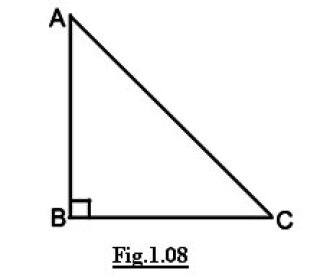
Ahh programming, I thought it might have been that.
If you instead know the gradient of AB or BC as opposed to the angle BAC, then your formula is
[tex]B=(x,y)=\frac{m}{1+m^2}\left( \frac{x_1}{m}+mx_0+y_1-y_0 \ \textbf{,} \ x_1-x_0+my_1+\frac{y_0}{m} \right)[/tex]
Where [itex]A=(x_0,y_0)[/itex] and [itex]C=(x_1,y_1)[/itex]
The gradient of AB = m and BC = -1/m (avoiding m being 0 or undefined).
But in order to use the angles of the triangle to determine the gradient, you need to know the orientation of the triangle with respect to the XY axis including the internal angles of the triangle. This takes a lot of work, and depending on how you want to go about it, you can either use a rotation matrix to change your coordinates such that the triangle is upright as in your picture, or you can use trigonometry.
Gil's idea works too but still takes a hefty amount of algebra to compute the formula.
You can find B by finding the intersection of the 2 circles each centred on A and C respectively, each with the correct distance
(1) - [tex](x-x_0)^2+(y-y_0)^2=d_0^2[/tex]
where [itex]d_0=|AC|\cos\theta[/itex] and |AC| is the length of AC, [itex]\theta[/itex] is the angle BAC.
(2) - [tex](x-x_1)^2+(y-y_1)^2=d_1^2[/tex]
where [itex]d_1=|AC|\sin\theta[/itex]If you then subtract equation (2) from (1), expand, simplify and rearrange, you get
[tex]y=-\frac{x_0-x_1}{y_0-y_1}x+\frac{x_0^2-x_1^2}{2(y_0-y_1)}+\frac{y_0+y_1}{2}-\frac{d_0^2-d_1^2}{2(y_0-y_1)}[/tex]
which if you notice is a linear equation of the form y=mx+b. This line goes right through the two points of intersection of the circles.
So now if you plugged this linear equation into (1) say, and simplified, you'd have a quadratic in x which can be solved and would then give you the two x coordinates where those two circles intersect.