Finding the Equation of a Circle Given the Diameter Coordinates

  • Context: MHB 
  • Thread starter Thread starter mathdad
  • Start date Start date
  • Tags Tags
    Circle
Click For Summary
SUMMARY

The equation of a circle can be determined using the endpoints of its diameter, specifically points P(1, -3) and Q(-5, -5). The center of the circle is calculated as the midpoint, resulting in coordinates (-2, -4). The radius is derived as half the distance between the two points, yielding a radius of √10. Consequently, the standard form of the circle's equation is (x + 2)² + (y + 4)² = 10.

PREREQUISITES
  • Understanding of coordinate geometry
  • Knowledge of the distance formula
  • Ability to calculate midpoints
  • Familiarity with the standard form of a circle's equation
NEXT STEPS
  • Study the distance formula in detail
  • Learn about the properties of circles in coordinate geometry
  • Explore graphing circles using graphing software like Desmos
  • Investigate transformations of circle equations
USEFUL FOR

Students, educators, and anyone interested in mastering the concepts of circles in coordinate geometry, particularly those preparing for exams or teaching mathematics.

mathdad
Messages
1,280
Reaction score
0
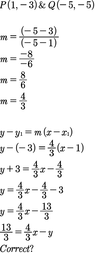
Determine the equation of the circle in standard form, given the coordinate of the diameter PQ.

P(1, -3) and Q(-5, -5)

View attachment 7471
 

Attachments

  • MathMagic171103_3.png
    MathMagic171103_3.png
    13.2 KB · Views: 129
Last edited by a moderator:
Mathematics news on Phys.org
You are asked to find the equation of a circle with diameter $\overline{PQ}$. To do that, find the distance between $P$ and $Q$ and divide that result by 2 - that will give you the radius of the circle. To find the center, find the midpoint of $\overline{PQ}$ - that's the $x$ and $y$ coordinates of the center. Does that make sense?

Standard form is $(x-h)^2+(y-k)^2=r^2$, where $h,k$ are the $x$ and $y$ coordinates of the circle's center and $r$ is the radius.
 
Seriously? You were asked to find the equation of the circle having those two points as endpoints of a diameter. Instead, you found the equation of the line though those points!

The two points you are given are (1, -3) and (-5, -5). The midpoint of that segment is ((1-(-5))/2, ((-3-(-5))/2)= (3, 1). That is the center of the circle. The radius of the circle is the distance from either (1, -3) or (-5, -5) to (3, 1) or, equivalently, half the distance from (1, -3) to (-5, -5), \sqrt{(1- (-5))^2+ (-3-(-5))^2}= \sqrt{40}= 2\sqrt{10}.
 
We want an equation in the form (x - h)^2 + (y - k)^2 = r^2.

Yes?
 
r = 2•sqrt{10}

Midpoint = (3,1)

(x - h)^2 + (y - k)^2 = r^2.

Let h = 3

Let k = 1

(x - 3)^2 + (y - 1)^2 = [2•sqrt{10}]^2

(x- 3)^2 + (y - 1)^2 = 4•10

(x - 3)^2 + (y - 1)^2 = 40
 
RTCNTC said:
r = 2•sqrt{10}

Midpoint = (3,1)

(x - h)^2 + (y - k)^2 = r^2.

Let h = 3

Let k = 1

(x - 3)^2 + (y - 1)^2 = [2•sqrt{10}]^2

(x- 3)^2 + (y - 1)^2 = 4•10

(x - 3)^2 + (y - 1)^2 = 40

try again ...

$(x+2)^2+(y+4)^2=10$
 
skeeter said:
try again ...

$(x+2)^2+(y+4)^2=10$

Are you saying that the midpoint is not (3, 1)?

Are you saying that r does not equal 2•sqrt{10}?
 
RTCNTC said:
Are you saying that the midpoint is not (3, 1)?

Are you saying that r does not equal 2•sqrt{10}?

that’s what my equation says ...

center $(-2,-4)$, radius $r = \sqrt{10}$

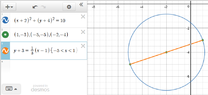
recommend you graph your equation and mine using the desmos app to verify ...
 
RTCNTC said:
Determine the equation of the circle in standard form, given the coordinate of the diameter PQ.

P(1, -3) and Q(-5, -5)

Center of the circle is the midpoint of $\overline{PQ}$:

$$(h,k)=\left(\frac{(1)+(-5)}{2},\frac{(-3)+(-5)}{2}\right)=(-2,-4)$$

Radius of the circle is 1/2 of the diameter (the length of $\overline{PQ}$ or the distance from $P$ to $Q$):

$$r=\frac{1}{2}\sqrt{((1)-(-5))^2+((-3)-(-5))^2}=\frac{1}{2}\sqrt{6^2+2^2}=\frac{1}{2}\sqrt{40}=\sqrt{10}$$

Thus, the equation of the circle is:

$$(x-(-2))^2+(y-(-4))^2=(\sqrt{10})^2$$

or:

$$(x+2)^2+(y+4)^2=10$$

View attachment 7486
 

Attachments

  • rtcntc_circle_3.png
    rtcntc_circle_3.png
    14.1 KB · Views: 114
  • #10
MarkFL said:
Center of the circle is the midpoint of $\overline{PQ}$:

$$(h,k)=\left(\frac{(1)+(-5)}{2},\frac{(-3)+(-5)}{2}\right)=(-2,-4)$$

Radius of the circle is 1/2 of the diameter (the length of $\overline{PQ}$ or the distance from $P$ to $Q$):

$$r=\frac{1}{2}\sqrt{((1)-(-5))^2+((-3)-(-5))^2}=\frac{1}{2}\sqrt{6^2+2^2}=\frac{1}{2}\sqrt{40}=\sqrt{10}$$

Thus, the equation of the circle is:

$$(x-(-2))^2+(y-(-4))^2=(\sqrt{10})^2$$

or:

$$(x+2)^2+(y+4)^2=10$$

Great job as always.
 

Similar threads

Replies
8
Views
2K
  • · Replies 2 ·
Replies
2
Views
1K
  • · Replies 3 ·
Replies
3
Views
2K
  • · Replies 3 ·
Replies
3
Views
1K
  • · Replies 2 ·
Replies
2
Views
2K
  • · Replies 2 ·
Replies
2
Views
2K
  • · Replies 8 ·
Replies
8
Views
2K
  • · Replies 4 ·
Replies
4
Views
2K
Replies
6
Views
2K
Replies
6
Views
1K