Finding the Force Applied by a Support on a Falling Chain

Click For Summary
SUMMARY

The discussion focuses on calculating the force exerted by a support on a falling chain with length L and mass density σ kg/m. Participants emphasize that the support must counteract both the weight of the fallen chain and the force required to stop the falling portion. The key equation derived involves the center of mass of the chain and its acceleration, leading to the conclusion that the net external force can be expressed as m(d²y/dt²) = W + F, where W is the weight and F is the force from the support.

PREREQUISITES
  • Understanding of Newton's laws of motion
  • Familiarity with concepts of mass density and center of mass
  • Basic knowledge of calculus, specifically derivatives and integrals
  • Experience with kinematic equations, particularly those involving gravitational acceleration
NEXT STEPS
  • Study the principles of conservation of momentum in falling bodies
  • Learn about the dynamics of systems with variable mass, such as falling chains
  • Explore advanced kinematic equations and their applications in physics
  • Investigate the concept of impulse and its relation to momentum changes
USEFUL FOR

Physics students, mechanical engineers, and anyone interested in dynamics and the behavior of falling objects will benefit from this discussion.

LCSphysicist
Messages
644
Reaction score
162
Homework Statement
All below
Relevant Equations
All below
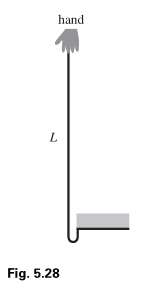
A chain with length L and mass density σ kg/m is held in the position
shown in Fig. 5.28, with one end attached to a support. Assume that
only a negligible length of the chain starts out below the support. The
chain is released. Find the force that the support applies to the chain, as
a function of time.
1591647596927.png
I am trying hard to see how the things work here. Try by conservation of energy is, to me, wrong.
I think the support's force need to stop the falling part and yet bear the weight of the fallen part.
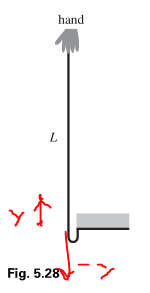
To show my vision:
1591647746281.png
this elementar mass at y fall actually twice y to come to rest.
It falls y in gt²2

So N = W + F = σyg + σv². But this seems wrong.
 
Physics news on Phys.org
An idea; in a time ##t##, the chain falls down a distance ##\frac{1}{2}gt^2##. The two loops at the bottom each have a height of ##\frac{1}{4}gt^2##.

If you can work out the centre of mass ##\bar{y}## of the whole chain in terms of ##t##, then you can set ##m\frac{d^2 \bar{y}}{dt^2}## equal to the net external force on the whole chain :wink:.
 
Last edited by a moderator:
  • Like
Likes LCSphysicist and haruspex
@etotheipi's approach is neat.
A more elementary way is to consider time t and a further interval dt. In dt, an element mass dm (you can express dm in terms of g, t, dt, and ##\sigma##) comes to a halt from speed gt. What change of momentum does that represent?
 
  • Like
Likes LCSphysicist and etotheipi

Similar threads

Replies
7
Views
3K
  • · Replies 12 ·
Replies
12
Views
3K
  • · Replies 9 ·
Replies
9
Views
2K
  • · Replies 2 ·
Replies
2
Views
3K
  • · Replies 11 ·
Replies
11
Views
3K
  • · Replies 2 ·
Replies
2
Views
4K
  • · Replies 6 ·
Replies
6
Views
2K
Replies
28
Views
6K
  • · Replies 4 ·
Replies
4
Views
2K
  • · Replies 1 ·
Replies
1
Views
6K