Finding the minimum and maximum distances using Lagrange Multipliers

3 replies · 4K views · last reply
theBEAST
Messages
361
Reaction score
0

Homework Statement


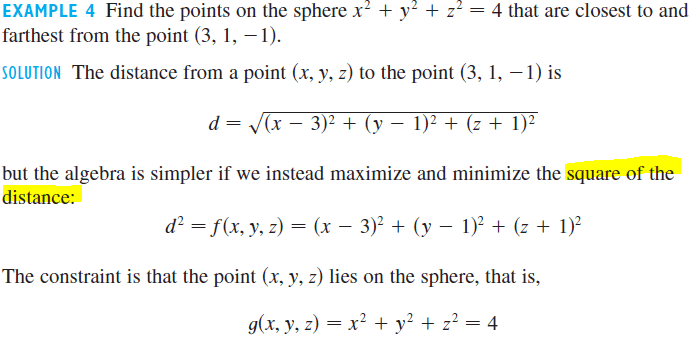
Textbook page showing Example 4: finding points on the sphere x^2 + y^2 + z^2 = 4 closest to and farthest from (3, 1, -1), with the distance formula d = sqrt((x - 3)^2 + (y - 1)^2 + (z + 1)^2) and the squared distance f(x, y, z) = (x - 3)^2 + (y - 1)^2 + (z + 1)^2 and constraint g(x, y, z) = x^2 + y^2 + z^2 = 4.


What I don't understand is why you can maximize the distances squared - d2. Isn't d2 different from d? I don't see how they can get you the same value.
 
Attachments
  • Textbook page: Example 4 finds points on the sphere x² + y² + z² = 4 nearest and farthest from (3, 1, −1); distance formula d and highlighted squared distance d² = f(x, y, z) = (x − 3)² + (y − 1)² + (z + 1)², with constraint g(x, y, z) = x² + y² + z² = 4.
    Capture.PNG
    16.3 KB · Views: 890
Last edited:
theBEAST said:

Homework Statement


Textbook page showing Example 4: find points on the sphere x^2 + y^2 + z^2 = 4 closest to and farthest from (3, 1, -1), with the distance formula d = sqrt((x - 3)^2 + (y - 1)^2 + (z + 1)^2), squared distance f(x, y, z), and constraint g(x, y, z) = x^2 + y^2 + z^2 = 4.


What I don't understand is why you can maximize the distances squared - d2. Isn't d2 different from d? I don't see how they can get you the same value.

They don't have the same values (unless they happen to be 0 or 1), but they are maximized or minimized at the same points (x,y,z). Think about it: how could it be otherwise?

RGV
 
Last edited:
Letting distance be "D", so we can distinguish it from the differential, "d", [itex]d(D^2)/dt= 2D (dD/dt)= 0[/itex]. If D itself is not 0, [itex]d(D^2)/dt[/itex] will be 0 if and only if [itex]dD/dt[/itex] is 0.
 
Ray Vickson said:
They don't have the same values (unless they happen to be 0 or 1), but they are maximized or minimized at the same points (x,y,z). Think about it: how could it be otherwise?

RGV

As HallsofIvy has pointed out, the stationary points are the same in both problems. However, if the original f can take both negative and positive values, a min in the squared problem can be a saddle point in the original problem (eg: f(x) = x^3 has a saddle point at x = 0 but g(x) = f(x)^2 = x^6 has a global minimum at x = 0) and a min in the original problem can be a max in the squared problem, etc. None of these issues arise if the original f is >= 0, as it is in the distance problem you cite.

RGV