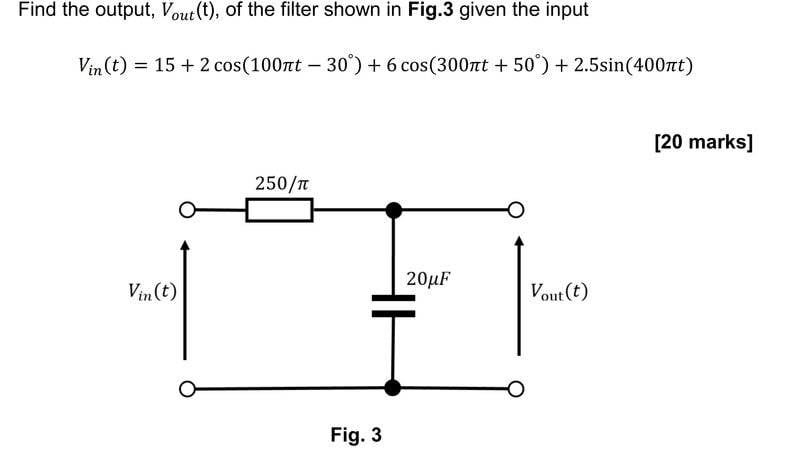
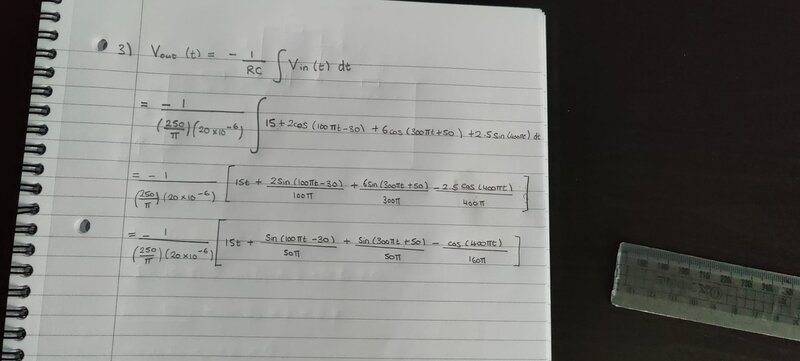
Homework Help Overview
The discussion revolves around analyzing the output voltage of a filter circuit, specifically focusing on the behavior of an integrator and the implications of input signals, including DC and AC components. Participants are exploring the dynamics of a first-order differential equation in the context of circuit analysis.
Discussion Character
- Exploratory, Conceptual clarification, Assumption checking
Approaches and Questions Raised
- Participants are attempting to evaluate the integral related to the circuit's output and questioning the appropriateness of treating the circuit as an integrator given the input conditions. There are discussions about the implications of a constant input voltage and the behavior of the output over time.
Discussion Status
There is an active exploration of different interpretations of the circuit's behavior, with some participants suggesting that the circuit cannot be treated as a true integrator under certain conditions. Guidance has been offered regarding the need to consider initial conditions and the limitations of approximations in the analysis.
Contextual Notes
Participants note the lack of initial conditions in the problem statement and express concerns about the terminology used, such as "filter," which may lead to confusion regarding the expected analysis. There is also mention of the circuit's response to both DC and AC inputs and the implications for the output voltage behavior.