Finding the position vector for translated frame of reference

Click For Summary
SUMMARY

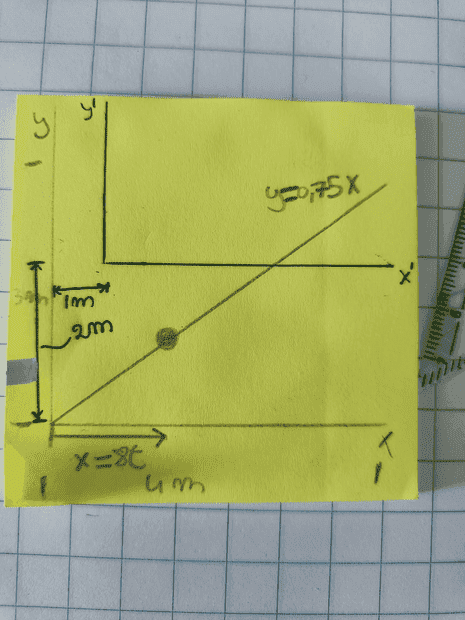
The discussion centers on finding the position vector for a translated frame of reference, specifically the vector ##\vec r = (8t - 1) \hat i + (6t - 2) \hat j##. The user seeks clarification on the reasoning behind the signs in the vector components, particularly at t = 0, where the position is set to -1i -2j. The conversation also touches on the relationship between vectors ##\vec R##, ##\vec r##, and ##\vec r\:'## in the context of relative frames of reference, emphasizing the need for an inertial frame for valid calculations.

PREREQUISITES
  • Understanding of vector notation and operations in physics
  • Familiarity with the concept of translated frames of reference
  • Knowledge of inertial frames and their properties
  • Basic principles of relative motion in classical mechanics
NEXT STEPS
  • Study the derivation of position vectors in translated frames of reference
  • Learn about the mathematical representation of relative motion
  • Explore the implications of inertial frames in classical mechanics
  • Investigate vector transformations and their applications in physics
USEFUL FOR

This discussion is beneficial for physics students, educators, and anyone involved in mechanics, particularly those focusing on vector analysis and relative motion in different frames of reference.

simphys
Messages
327
Reaction score
46
Homework Statement
Please refer to the picture, I don't really have a question problem.
I was posed the question on how I would model what the position would be when the frame of reference is translated as shown on the picture.
Relevant Equations
##\vec r = 8t \hat i + 6t \hat j## for the y-x reference framse.
what would be the y'-x' ##\vec r## vector be?

I think it is
##\vec r = (8t - 1) \hat i + (6t - 2) \hat j## (not sure whether it is correct or not.)
I thought about it as at t = 0 the position needs to be -1i -2j so that is why I took the signs in the y'-x' frame position vector as a - instead of + signs for 1 and 2.

Is it ok to reason like this or do I need to derive it from somewhere else? I am not very acquianted with translation of the axes that's why I am asking.
Thanks in advance.
1658132327542.png
 
  • Like
Likes   Reactions: Delta2
Physics news on Phys.org
What is the origin of x' y' system as measured in the x y system?
 
  • Like
Likes   Reactions: simphys
drmalawi said:
What is the origin of x' y' system as measured in the x y system?
in points (1,2) = (x,y)
 
1658133200085.png

can you find a relation for the vectors ## \vec R##, ##\vec r## and ##\vec r\:'##?
 
  • Like
  • Love
Likes   Reactions: Delta2 and simphys
drmalawi said:
What is the origin of x' y' system as measured in the x y system?
oh wait, isn't this actually the 'relative frames of references' that are used to describe relative motion?
than it becomes r_x/p = r_x'/x + r_p/x' (where the condition was that it should be an inertial frame aka cst velocity or at rest for it to be valid)
 
  • Like
Likes   Reactions: malawi_glenn
drmalawi said:
View attachment 304325
can you find a relation for the vectors ## \vec R##, ##\vec r## and ##\vec r\:'##?
yep exactly my post #5 no?
 
simphys said:
aka cst
?
 
  • Like
Likes   Reactions: simphys
drmalawi said:
?
constant, apologies.
 
  • #10
simphys said:
constant, apologies.
np glhf
 
  • Like
  • Love
Likes   Reactions: simphys and Delta2

Similar threads

Replies
23
Views
2K
  • · Replies 3 ·
Replies
3
Views
2K
  • · Replies 16 ·
Replies
16
Views
2K
  • · Replies 4 ·
Replies
4
Views
1K
  • · Replies 3 ·
Replies
3
Views
2K
Replies
34
Views
2K
Replies
27
Views
1K
Replies
9
Views
2K
Replies
5
Views
1K
Replies
2
Views
2K