Finding the quantum number using Morse Potential

Click For Summary
SUMMARY

The discussion centers on calculating the quantum number using the Morse Potential and its relation to harmonic oscillators. The user initially miscalculated the Taylor series expansion of the Morse Potential, resulting in an incorrect factor of 1/2. After corrections, the user derived the energy expression as En=(n+1/2)ℏ√(Aα²/μ), where μ is the reduced mass. The conversation emphasizes the importance of correctly identifying the spring constant k for the Morse potential and understanding the relationship between classical and quantum mechanics.

PREREQUISITES
  • Understanding of Morse Potential and its mathematical representation
  • Familiarity with Taylor Series expansions in physics
  • Knowledge of quantum mechanics, specifically energy quantization in harmonic oscillators
  • Concept of reduced mass in two-body systems
NEXT STEPS
  • Study the derivation of the Morse Potential and its applications in quantum mechanics
  • Learn about the Taylor Series and its role in approximating potential energy functions
  • Explore the concept of reduced mass and its significance in quantum systems
  • Investigate the relationship between classical and quantum harmonic oscillators
USEFUL FOR

Students and professionals in physics, particularly those focusing on quantum mechanics, molecular physics, and anyone working with potential energy calculations in diatomic systems.

guyvsdcsniper
Messages
264
Reaction score
37
Homework Statement
Using your result from the previous part, and what you know about harmonic oscillators, find an expression for the allowed energies as a function of the quantum number n. Not that since we have two atoms, the mass that shows up in your calculations should be the reduced mass μ=1/(1/m1+1/m2)
Relevant Equations
U=1/2kx^2
Morse Potential
Taylor Series
E=(n+1/2)hbarw
This problem had me take the taylor series of the Morse Potential,

Screen Shot 2022-03-11 at 7.23.08 PM.png


until I got the first non zero term.

My result was U(x)=Aα2(x-x0)2.

I know to find the quantum number I can use En=(n+1/2)ℏω and I know I can relate that to the potential energy of a harmonic oscillator, 1/2kx2. So if this taylor series is similar to the PE of a H.O. I can just substitute that.

The problem is my taylor series is off by a factor of 1/2, so it doesn't resemble the PE of a Harmonic Oscillator.

Can anyone help me see where I am going wrong.

EDIT:

I rechecked my work and I think I was incorrect. Forgot the the 1/2! for my first taylor expansion. My apologies for anyone who viewed this already. I have edited my post.
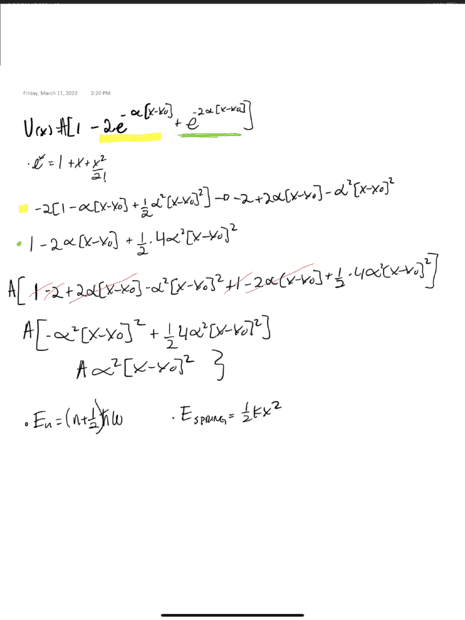
IMG_9BC3A2B2B391-1.png
 
Last edited:
Physics news on Phys.org
quittingthecult said:
Homework Statement:: Using your result from the previous part, and what you know about harmonic oscillators, find an expression for the allowed energies as a function of the quantum number n. Not that since we have two atoms, the mass that shows up in your calculations should be the reduced mass μ=1/(1/m1+1/m2)
Relevant Equations:: U=1/2kx^2
Morse Potential
Taylor Series
E=(n+1/2)hbarw

I know to find the quantum number I can use En=(n+1/2)ℏω and I know I can relate that to the potential energy of a harmonic oscillator, 1/2kx2. So if this taylor series is similar to the PE of a H.O. I can just substitute that.

The problem is my taylor series is off by a factor of 1/2, so it doesn't resemble the PE of a Harmonic Oscillator.
First check your algebra.
I don't understand the 1/2 discussion...you just redefine the constant. But there is a much bigger problem.
Your use of the correspondence to the Quantum oscillator is a good idea done badly. The value of the classical potential energy is essentially not related to the energy of the quantum eigenstrates. What does remain the same is the identification of ##\omega## from the respective equations. So what is the value of ##\omega##?
 
hutchphd said:
First check your algebra.
I don't understand the 1/2 discussion...you just redefine the constant. But there is a much bigger problem.
Your use of the correspondence to the Quantum oscillator is a good idea done badly. The value of the classical potential energy is essentially not related to the energy of the quantum eigenstrates. What does remain the same is the identification of ##\omega## from the respective equations. So what is the value of ##\omega##?
ω=##\sqrt{k/m}##.

BUt my Quantum Oscillator doesn't have ω in it, so how can I relate that to En?

I guess I had this approach because I did a problem very similar in class this week, where we were given m,k,and x for a spring and we were asked if we should worry about the quantum effects. So we set spring potential equal to the En=(n+1/2)ℏω
 
quittingthecult said:
BUt my Quantum Oscillator doesn't have ω in it, so how can I relate that to En?
You need to to identify the "spring constant" k for the Morse potential near its bottom. This has nothing to do with QM or ħ.
Once you have that you then know ##\omega=\sqrt {\frac k m}##
 
hutchphd said:
You need to to identify the "spring constant" k for the Morse potential near its bottom. This has nothing to do with QM or ħ.
Once you have that you then know ##\omega=\sqrt {\frac k m}##
I THINK I get what you are trying to say, so here is my attempt at identifying k.

Does this seem correct?
Screen Shot 2022-03-13 at 12.18.30 AM.png
 
Looks good (I didn't check the Algebra). Remember that it is the "reduced mass" that appears in both the quantum and classical problem when written in the center of mass frame so I should have written ##~~\omega=\sqrt {\frac k {\mu}}##.
 
  • Like
Likes   Reactions: guyvsdcsniper
hutchphd said:
Looks good (I didn't check the Algebra). Remember that it is the "reduced mass" that appears in both the quantum and classical problem when written in the center of mass frame so I should have written ##~~\omega=\sqrt {\frac k {\mu}}##.
So I ended up getting En=(n+1/2)ℏ##\sqrt{Aα^2/μ}##

Does that seem correct?
 
I think that is what the problem is looking for. This is a little bit tricky depending upon how you define the zero of energy for the system. Also the Morse potential can be solved...but that is not introductory physics on any planet. You should (always) check that your result has the units of energy (I think it does)
 
  • Like
Likes   Reactions: jim mcnamara
hutchphd said:
I think that is what the problem is looking for. This is a little bit tricky depending upon how you define the zero of energy for the system. Also the Morse potential can be solved...but that is not introductory physics on any planet. You should (always) check that your result has the units of energy (I think it does)
I think that does make sense as well. But then I run into a problem for the next question which states

"Calculate the wavelength of a photon emitted from diatomic hydrogen as it transitions from the third excited
state to the ground state. For this molecule, A = 4.787 eV and = 5:396 10^-11 m.""

Well if En= (n+##\frac{1}{2}##)ℏω, and from the third state to ground state (0), I should get En=ℏω

And I know E = ##\frac{hc}{λ}## I can solve for lambda and get λ=##\frac{hc}{ℏω}## .

I think that makes sense, but I don't have a value for the masses when I express omega in terms of k and μ. Mass should play a factor right? My teacher relies on us approximating values at times, so I might need to do that, but from your perspective, does this seem like the right approach?
 
  • #10
Diatomic hydrogen !
mH=1amu
And how do you get 3-0=1? (n=3 and n=0)
 
  • #11
hutchphd said:
Diatomic hydrogen !
mH=1amu
And how do you get 3-0=1? (n=3 and n=0)
Crap I totally looked that over in the question. Sorry. Your right, It is diatomic hydrogen.

Well just looking at the (n+##\frac{1}{2}##) part of the En= (n+##\frac{1}{2}##)ℏω,

if n = 3 then I get ##\frac{3}{2}## and at ground state, n=0, so i get -##\frac{1}{2}## which adding together gets me 1.
 
  • #12
quittingthecult said:
Crap I totally looked that over in the question. Sorry. Your right, It is diatomic hydrogen.

Well just looking at the (n+##\frac{1}{2}##) part of the En= (n+##\frac{1}{2}##)ℏω,

if n = 3 then I get ##\frac{3}{2}## and at ground state, n=0, so i get -##\frac{1}{2}## which adding together gets me 1.
EDIT: at n=0 i get 1/2, but the difference between states gives me 1.
 
  • #13
1)Attach brain.
2)plug n=3 into equation :headbang::smile:
 
  • #14
hutchphd said:
1)Attach brain.
2)plug n=3 into equation :headbang::smile:
:oops:. Let's act like I never wrote my last post.
 
  • Like
Likes   Reactions: hutchphd
  • #15
There is an art to slowing down... and then checking once more via the back door. Trust me, I am not a fastidious thinker.
 
  • Like
Likes   Reactions: guyvsdcsniper

Similar threads

Replies
2
Views
957
  • · Replies 2 ·
Replies
2
Views
1K
  • · Replies 2 ·
Replies
2
Views
2K
  • · Replies 4 ·
Replies
4
Views
3K
Replies
3
Views
816
  • · Replies 1 ·
Replies
1
Views
1K
Replies
5
Views
1K
Replies
10
Views
3K
  • · Replies 3 ·
Replies
3
Views
1K
Replies
1
Views
2K