Finding the Range of the given function

  • Thread starter Thread starter Kaushik
  • Start date Start date
  • Tags Tags
    function range
Click For Summary
SUMMARY

The function f(x) = 6^x + 3^x + 6^{-x} + 3^{-x} + 2 has a confirmed minimum value of 6. This conclusion is derived from the application of the Arithmetic Mean-Geometric Mean (AM-GM) inequality, which indicates that g(x) = 6^x + 3^x + 6^{-x} + 3^{-x} achieves a minimum of 4, leading to f(x) being greater than or equal to 6. The confusion arises from the initial misapplication of AM-GM without considering the constant term, which resulted in a lower bound of 5 * 2^{1/5}, a less accurate estimate.

PREREQUISITES
  • Understanding of the Arithmetic Mean-Geometric Mean (AM-GM) inequality
  • Familiarity with exponential functions and their properties
  • Basic knowledge of function graphing and minimum value determination
  • Experience with mathematical proofs and inequalities
NEXT STEPS
  • Study the properties of exponential functions and their behavior at limits
  • Explore advanced applications of the AM-GM inequality in optimization problems
  • Learn about graphing techniques for analyzing function behavior
  • Investigate other inequalities and their implications in calculus
USEFUL FOR

Mathematicians, students studying calculus, and anyone interested in optimization techniques and inequalities in mathematical analysis.

Kaushik
Messages
282
Reaction score
17
Homework Statement
Find the range of ##f(x) = 6^x + 3^x + 6^{-x} + 3^{-x} + 2##
Relevant Equations
AM >= GM
##f(x) = 6^x + 3^x + 6^{-x} + 3^{-x} + 2##

But, ## AM >= GM##

So,

##f(x) >= 5 * 2 ^ {\frac{1}{5}}##

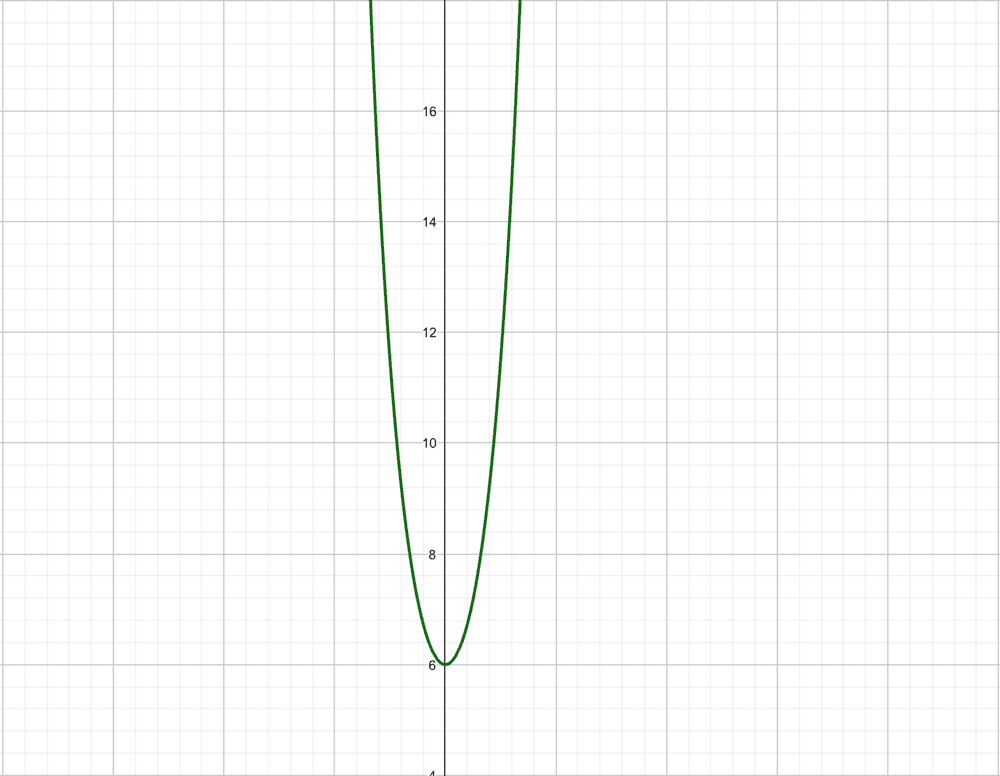
But this is not the case. According to the graph, it is ## f(x) >= 6##.
?hash=1b7894284589b0f79085f4f37f7a56da.png


If I do the same thing without considering the constant '2' then I am getting the answer.

let ##g(x) = 6^x + 3^x + 6^{-x} + 3^{-x} ## and ##f(x) = g(x) + 2##

Using ##AM>=GM##,

##g(x) >= 4##

Hence, ##f(x) >= 6##

Why is this the case? Why is the latter approach working but no the former?
 

Attachments

  • Screen Shot 2020-03-18 at 1.02.59 AM.png
    Screen Shot 2020-03-18 at 1.02.59 AM.png
    16.5 KB · Views: 281
Physics news on Phys.org
Kaushik said:
Homework Statement:: Find the range of ##f(x) = 6^x + 3^x + 6^{-x} + 3^{-x} + 2##
Relevant Equations:: AM >= GM

##f(x) = 6^x + 3^x + 6^{-x} + 3^{-x} + 2##
Kaushik said:
But, ## AM >= GM##
So,
##f(x) >= 5 * 2 ^ {\frac{1}{5}}##
I don't see what AM >= GM has to do with this problem, or how the inequality you show is related to this problem. Certainly ##f(x) \ge 5 \cdot 2^{1/5}##, but that's a very rough lower bound.
Kaushik said:
But this is not the case. According to the graph, it is ## f(x) >= 6##.

View attachment 258864

If I do the same thing without considering the constant '2' then I am getting the answer.

let ##g(x) = 6^x + 3^x + 6^{-x} + 3^{-x} ## and ##f(x) = g(x) + 2##

Using ##AM>=GM##,

##g(x) >= 4##

Hence, ##f(x) >= 6##

Why is this the case? Why is the latter approach working but no the former?
##6^x + 6^{-x}## has a minimum value of 2 for x = 0. Likewise, ##3^x + 3^{-x}## also has a minimum value of 2 at x = 0. Add these pairs together + 2, and you get a minimum value of 6.
 
  • Like
Likes   Reactions: nomadreid, Kaushik and SammyS

Similar threads

  • · Replies 3 ·
Replies
3
Views
2K
  • · Replies 11 ·
Replies
11
Views
3K
  • · Replies 15 ·
Replies
15
Views
2K
  • · Replies 8 ·
Replies
8
Views
2K
  • · Replies 5 ·
Replies
5
Views
2K
  • · Replies 23 ·
Replies
23
Views
2K
  • · Replies 7 ·
Replies
7
Views
2K
  • · Replies 22 ·
Replies
22
Views
2K
  • · Replies 10 ·
Replies
10
Views
2K
  • · Replies 14 ·
Replies
14
Views
4K