Finding the Sample Mean of a Matrix

  • Context: High School 
  • Thread starter Thread starter EnglsihLearner
  • Start date Start date
  • Tags Tags
    Matrix Mean
Click For Summary
SUMMARY

The discussion centers on calculating the sample mean of a matrix, specifically addressing the interpretation of "sample mean" in this context. It is established that if the entries of the matrix represent samples, the mean can be calculated as the average of the largest and smallest values in an arithmetic series. For the matrix entries "1, 2, 3, ... 14, 15, 16," the sample mean is determined to be 8.5. Additionally, if each column or row represents different samples, the sample mean would be the row matrix of the column means, necessitating further context for accurate interpretation.

PREREQUISITES
  • Understanding of basic statistics, specifically the concept of mean.
  • Familiarity with matrix operations and representations.
  • Knowledge of arithmetic series and their properties.
  • Basic understanding of multivariate analysis concepts.
NEXT STEPS
  • Research "Calculating the mean of a matrix" for various definitions and methods.
  • Explore "Arithmetic series properties" to deepen understanding of mean calculations.
  • Learn about "Multivariate statistics" to understand sample means in complex datasets.
  • Investigate "Matrix operations in Python" for practical applications of matrix calculations.
USEFUL FOR

Students, statisticians, data analysts, and anyone involved in mathematical modeling or data analysis who needs to understand the concept of sample means in matrix contexts.

EnglsihLearner
Messages
11
Reaction score
1
What is the sample mean of the following matrix?

Untitled-1.jpg
 
Physics news on Phys.org
I'm afraid you are going to have to define "sample mean" for a matrix. I have never seen that term before. I suspect that the entries in the matrix are "samples" of some kind but you did not say that.

IF the entries are the "samples" and you are asking for the mean of these numbers then "1, 2, 3, ... 14, 15, 16" are an arithmetic series and the mean of such a series is just the mean of largest and smallest values. That is (1+ 2+ 3+ ...+ 15+ 16)/16= (1+ 16)/2= 17/2.
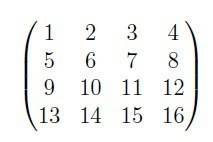
 
If each column represents a different (small) sample the sample mean would be the row matrix of column means. A similar comment would apply if each row is a sample.
If neither of those descriptions apply then more context is needed.

Is this from a multivariate problem?
 

Similar threads

  • · Replies 33 ·
2
Replies
33
Views
3K
  • · Replies 14 ·
Replies
14
Views
4K
  • · Replies 6 ·
Replies
6
Views
4K
  • · Replies 14 ·
Replies
14
Views
3K
  • · Replies 2 ·
Replies
2
Views
2K
  • · Replies 14 ·
Replies
14
Views
4K
  • · Replies 5 ·
Replies
5
Views
3K
  • · Replies 3 ·
Replies
3
Views
1K
  • · Replies 24 ·
Replies
24
Views
4K
  • · Replies 7 ·
Replies
7
Views
3K