Finding x in Radians: A Puzzling Problem for Pavadrin

  • Thread starter Thread starter pavadrin
  • Start date Start date
  • Tags Tags
    Radians
Join the discussion
Registration is free. Ask a follow-up in this thread, or start your own.
9 replies · 4K views
pavadrin
Messages
154
Reaction score
0
Hey
I have recently been studying for my upcoming exams. I am stuck on the following problem involving radians. Here is the diagram for it.
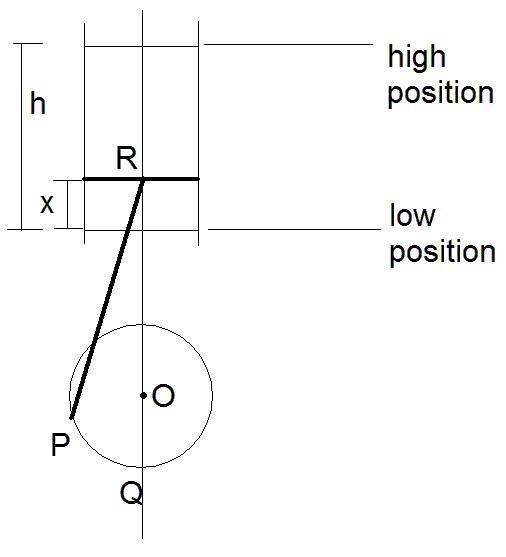
Geometrya nd trig problem.JPG

Where PQ = the radius of the circle
I need to find x in as a percentage in terms of h
My working for this problem is as follows
in a circle there is 2pi radians, therefore in half a cirlce there is pi radians, which means for that for pi radians the pistion moves for the high position to the low posotion.
I then calculated the remainder of the angle in half a circle to determine how much the piston had moved, which resulted in being 2.1416 radians.
I then calculated this as a percentage by dividing it by pi and multiply it by 100, which gave me an answer of 68% (correct to one decimal place)
Form here I took that value, 68% from 100% which gave me an answer as being 32% which I assumed as being the value for x.
However I checked the answer in the back of the book and it said 17%.
Could someone please tell me where I have gone wrong? Or if the answer in the book is wrong?
Thanks in advance,
Pavadrin
 
Physics news on Phys.org
Integral said:
I feel like there is some information missing. Could you please post the complete problem statement.
the complete problem statement is as follows:
The diagram shows how the vertical motion of a piston can be used to produce rotational motion. As the piston travels from the low position to the high position and back again the wheel will rotate. If the minor arc PQ is eqaul to the radius in length to r, the radius of the wheel, express x as a percentage of h correct to the nearest percentage
thanks
 
Last edited:
pavadrin said:
Hey
I have recently been studying for my upcoming exams. I am stuck on the following problem involving radians. Here is the diagram for it.
View attachment 6901
Where PQ = the radius of the circle
I need to find x in as a percentage in terms of h
My working for this problem is as follows
in a circle there is 2pi radians, therefore in half a cirlce there is pi radians, which means for that for pi radians the pistion moves for the high position to the low posotion.
I then calculated the remainder of the angle in half a circle to determine how much the piston had moved, which resulted in being 2.1416 radians.
I then calculated this as a percentage by dividing it by pi and multiply it by 100, which gave me an answer of 68% (correct to one decimal place)
Form here I took that value, 68% from 100% which gave me an answer as being 32% which I assumed as being the value for x.
However I checked the answer in the back of the book and it said 17%.
Could someone please tell me where I have gone wrong? Or if the answer in the book is wrong?
Thanks in advance,
Pavadrin
You're on the right track, but forgot two things. The piston didn't move 2.1416 radians straight down. Sine and cosine aren't linear functions.

You need the cosine of 2.1416 radians to find how far down you moved. That will be in proportion to the radius. The maximum up and down range varies by twice the radius (i.e. - by the diameter).
 
BobG said:
You need the cosine of 2.1416 radians to find how far down you moved. That will be in proportion to the radius. The maximum up and down range varies by twice the radius (i.e. - by the diameter).
BobG, I am not quite sure what you mean.
 
Hey
I’m really stuck on this problem. There more time I spend on it the more I get confused. I have tried another approach, where I drew triangles and substituted values for the variable r (the radius of the wheel). I looked at the diagram I had posted beforehand and noticed I had left out some detail (the distance between the top of the wheel and the low position is also equal to the radius of the wheel). I am sorry if this has caused an inconvenience in anyone’s calculation if this was also significant. The length of the arm from PR = 3r and the length of height of h = 2r. From this point onwards I have absolutely no idea where to go.
Thank you to anyone who replies
Pavadrin
 
pavadrin said:
Hey
I’m really stuck on this problem. There more time I spend on it the more I get confused. I have tried another approach, where I drew triangles and substituted values for the variable r (the radius of the wheel). I looked at the diagram I had posted beforehand and noticed I had left out some detail (the distance between the top of the wheel and the low position is also equal to the radius of the wheel). I am sorry if this has caused an inconvenience in anyone’s calculation if this was also significant. The length of the arm from PR = 3r and the length of height of h = 2r. From this point onwards I have absolutely no idea where to go.
Thank you to anyone who replies
Pavadrin

That was actually a critical piece of info. I just tried it before but since you hadn't provided that info it wasn't doable. I'll post up the solution in a bit.

EDIT : Please remember to include every piece of info in the question, no matter how insignificant it seems to you. It would help us to help you faster and with less hassle. :smile:
 
Last edited:
See the attachment and all the labels.

[tex]l\cos\theta = r\cos\alpha + r + r + x[/tex] --(1)

Also,

[tex]l = 3r[/tex] --(2)

and [tex]l\sin\theta = r\sin\alpha[/tex] --(3)

From (3),

[tex]l\cos\theta = \sqrt{l^2 - r^2\sin^2\alpha}[/tex] --(4)

Put (4) and (2) into (1) and rearrange,

[tex]x = r(\sqrt{9 - \sin^2\alpha} - \cos\alpha - 2)[/tex]

Since h = 2r,

[tex]\frac{x}{h} = \frac{1}{2}(\sqrt{9 - \sin^2\alpha} - \cos\alpha - 2)[/tex]

Now we're basically given that alpha = 1 radian (chord length PQ = radius). Therefore, x/h works out to about 16.96 % as required.
 

Attachments

  • Geometrya nd trig problem.JPG
    Geometrya nd trig problem.JPG
    19.2 KB · Views: 487
thank you so much Curious3141~!