Unveiling the Structure of Sagittarius A*: First VLBI Image at 86 GHz with ALMA

Click For Summary
SUMMARY

The discussion centers on the groundbreaking observations of Sagittarius A* (Sgr A*) at 86 GHz using the Atacama Large Millimeter/submillimeter Array (ALMA) in conjunction with the Global Millimeter VLBI Array (GMVA). Issaoun et al. (2019) achieved an angular resolution of approximately 87 microarcseconds, allowing for the first reconstruction of the unscattered source structure of Sgr A*, revealing a major axis size of 120 ± 34 microarcseconds. The findings indicate that multiple disk-dominated models align with the observational data, while refractive scattering effects are minimal at 1.3 mm with the Event Horizon Telescope. This research significantly advances the understanding of black hole dynamics and morphology.

PREREQUISITES
  • Understanding of Very Long Baseline Interferometry (VLBI)
  • Familiarity with millimeter-wave astronomy
  • Knowledge of black hole accretion dynamics
  • Experience with observational data analysis in astrophysics
NEXT STEPS
  • Research the capabilities of the Event Horizon Telescope for imaging black holes
  • Explore the implications of scattering effects in millimeter-wave observations
  • Study the methodologies used in VLBI for high-resolution imaging
  • Investigate the various models of black hole morphology and their observational constraints
USEFUL FOR

Astronomers, astrophysicists, and researchers focused on black hole studies, particularly those interested in high-resolution imaging techniques and the dynamics of supermassive black holes.

Auto-Didact
Messages
747
Reaction score
554
Issaoun et al. 2019, The Size, Shape, and Scattering of Sagittarius A* at 86 GHz: First VLBI with ALMA
Abstract said:
The Galactic Center supermassive black hole Sagittarius A* (Sgr A*) is one of the most promising targets to study the dynamics of black hole accretion and outflow via direct imaging with very long baseline interferometry (VLBI). At 3.5 mm (86 GHz), the emission from Sgr A* is resolvable with the Global Millimeter VLBI Array (GMVA). We present the first observations of Sgr A* with the phased Atacama Large Millimeter/submillimeter Array (ALMA) joining the GMVA. Our observations achieve an angular resolution of ~87{\mu}as, improving upon previous experiments by a factor of two. We reconstruct a first image of the unscattered source structure of Sgr A* at 3.5 mm, mitigating effects of interstellar scattering. The unscattered source has a major axis size of 120 ± 34{\mu}as (12 ± 3.4 Schwarzschild radii), and a symmetrical morphology (axial ratio of 1.2+0.3−0.2), which is further supported by closure phases consistent with zero within 3{\sigma}. We show that multiple disk-dominated models of Sgr A* match our observational constraints, while the two jet-dominated models considered are constrained to small viewing angles. Our long-baseline detections to ALMA also provide new constraints on the scattering of Sgr A*, and we show that refractive scattering effects are likely to be weak for images of Sgr A* at 1.3 mm with the Event Horizon Telescope. Our results provide the most stringent constraints to date for the intrinsic morphology and refractive scattering of Sgr A*, demonstrating the exceptional contribution of ALMA to millimeter VLBI.
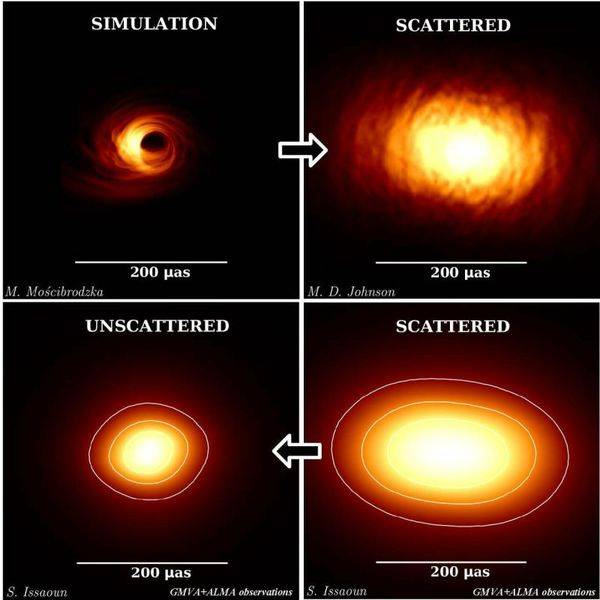
The image wasn't in the paper, nor is this an image from the Event Horizon Telescope, as I expected it would be. In either case, the image (courtesy of phys.org) can be seen here:
E6x2Ng.jpg

Top left: simulation of Sgr A* at 86 GHz. Top right: simulation with added effects of scattering. Bottom right: scattered image from the observations, how Sgr A* appears in the sky. Bottom left: the unscattered image, after removing the effects of scattering in our line of sight, revealing how Sgr A* actually looks. Credit: S. Issaoun, M. Mościbrodzka, Radboud University/ M. D. Johnson, CfA
 

Attachments

  • E6x2Ng.jpg
    E6x2Ng.jpg
    34.4 KB · Views: 771
  • Like
Likes   Reactions: BCHC, Drakkith and ohwilleke
Astronomy news on Phys.org
Not sure why my links keep dying, this is the third time now in the last few days; it only seems to occur when using the Rich Text Editor instead of typing out the BBcode.

In any case yeah, I linked to the arxiv version originally.

Having said that, is it just me or does the simulation differ quite a bit from the unscattered image?
 
The actual data doesn't have the required resolution to look as nice as the simulation. The Event Horizon telescope picture should look better - but don't expect anything as good as the simulation picture.
 

Similar threads

  • · Replies 0 ·
Replies
0
Views
2K
  • · Replies 1 ·
Replies
1
Views
3K
  • · Replies 5 ·
Replies
5
Views
2K
  • · Replies 15 ·
Replies
15
Views
6K
  • · Replies 1 ·
Replies
1
Views
2K
  • · Replies 5 ·
Replies
5
Views
751
  • · Replies 1 ·
Replies
1
Views
2K
  • · Replies 11 ·
Replies
11
Views
4K