Focal length calculation and graph Q

Click For Summary
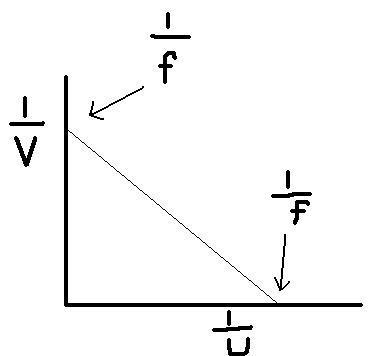
The discussion centers on the challenges of accurately determining the focal length of a converging lens using graphs of object distance (U) versus image distance (V). While plotting V against U yields a curved slope, the graph of 1/V against 1/U produces a straight line that accurately reflects the lens formula (1/U + 1/V = 1/f). The participants explain that the U and V graph does not provide a straightforward relationship to the focal length, as it lacks a simple linear correlation. The nature of lens behavior complicates the direct use of U and V for focal length calculations. Ultimately, the most reliable method involves using the reciprocal values of U and V.
_Greg_
Messages
36
Reaction score
0
Hi folks, just joined the forums :smile:
Hope you don't mind me firing a few questions now and again, i have some reports to do over the weekend which is the last of my HNC in Chemical Engineering :!)
A lot of it is basic physics which iv done in the past but its just the odd bit that catches me out.

So anyway, iv done an expeiment with a converging lens where you alter the object distance and image distance ( U & V ) to get focused images on the screen.
With these results iv plotted a graph of V against U which produces a curved slope (diagram 1)
u and v.JPG

Then i done a graph of 1/V and 1/U which produces a straight line which intercepts the x and y axis, these values being 1/f (diagram 2)
untitled.JPG

My question is

Why is the graph of U and V not useful for finding the focal length of the lens accurately?

probably an easy question but i just can't put my finger on it :shy:

cheers :smile:
 
Physics news on Phys.org
use similar triangles to proove that the formula for a lens is (1/U + 1/V = 1/f)
or u can find it anywhere on the internet. it is a very easy proof, won't take you 5 min.

therefore it is 1/U and 1/V not U and V
 
not entirly sure what you mean, triangles?
anyway, that 1/V vs 1/U graph with my experimental results is proof that the equation is true.
im just asked why the U and V graph doesn't give an accurate value for the focal length?
 
ok

if you draw your object, lens and image on a piece of paper with two of the rays you use to draw a ray diagram, you can see that there are some similar triangles on that figure. Try using similar triangles and getting two equations involving U, V and f.

then solve them simultaneously to get "1/U + 1/V = 1/f "

(if you cannot I can give you the solution but try it first :)

U and V graph cannot give you an accurate value for the focal length because the relation between the two is not related to f in any simple way.
if u play around with the equation I gave you above you might get " "[(v+U)/U]*f=V" but this won't make it any easier.

perhaps the answer to your question is that the nature of lenses does not provide us with that simple relations where you plot U versus V and get a slope or a y intercept of f
 
The book claims the answer is that all the magnitudes are the same because "the gravitational force on the penguin is the same". I'm having trouble understanding this. I thought the buoyant force was equal to the weight of the fluid displaced. Weight depends on mass which depends on density. Therefore, due to the differing densities the buoyant force will be different in each case? Is this incorrect?

Similar threads

  • · Replies 7 ·
Replies
7
Views
2K
  • · Replies 20 ·
Replies
20
Views
4K
  • · Replies 3 ·
Replies
3
Views
1K
  • · Replies 2 ·
Replies
2
Views
997
  • · Replies 3 ·
Replies
3
Views
1K
  • · Replies 1 ·
Replies
1
Views
3K
  • · Replies 12 ·
Replies
12
Views
4K
Replies
3
Views
2K
  • · Replies 3 ·
Replies
3
Views
3K
  • · Replies 7 ·
Replies
7
Views
3K