Following an example. Implies L{2du/dt+1}=2s+1. I'm Confused.

  • Context: Undergrad 
  • Thread starter Thread starter james_a
  • Start date Start date
  • Tags Tags
    Confused Example
Click For Summary
SUMMARY

The discussion centers on the confusion surrounding the Laplace transform of the expression L{2du/dt + 1} and its representation as 2s + 1. The participant questions the validity of the transformation, particularly regarding the treatment of the unit step function and the Dirac delta function. It is established that the Laplace transform of a derivative results in multiplication by 's', while the transform of a constant yields 1/s. The author’s notation and reasoning are scrutinized, leading to a deeper understanding of the transformation process.

PREREQUISITES
  • Understanding of Laplace transforms
  • Familiarity with differential equations
  • Knowledge of unit step and Dirac delta functions
  • Basic principles of control theory
NEXT STEPS
  • Study the properties of Laplace transforms in detail
  • Learn about the relationship between time-domain and frequency-domain representations
  • Explore examples of Laplace transforms involving derivatives
  • Investigate the applications of the Dirac delta function in control systems
USEFUL FOR

Students and professionals in engineering, particularly those studying control systems and signal processing, will benefit from this discussion. It is also valuable for anyone seeking to clarify concepts related to Laplace transforms and their applications in differential equations.

james_a
Messages
7
Reaction score
0
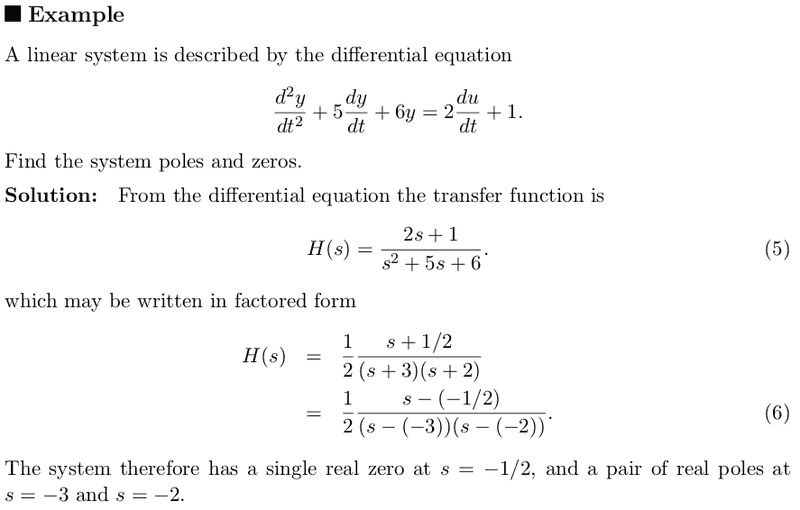
So I am reading a handout on transfer functions, and I got to this one example that doesn't seem right to me - which usually means I'm missing something.

It looks like this:
Screenshot_02092017_06_09_00_PM.png


My understanding is that the numerator in H(s) is supposed to be the laplace transform of the input for the differential equation, so N(s)=L{2du/dt+1}.

I'm not sure how the author got {2du/dt+1}=2s+1. Isn't L{1} supposed to be 1/s? And I'm not sure what to make of L{2du/dt}.

Maybe the author is using "u" to notate the unit step function, so du/dt would be the dirac delta function δ(t), and L{2δ(t)}=2 . Still, where does 2s come from? Why wouldn't they have just written 2δ(t) in the first place? And that still doesn't explain how, apparently, according to the author L{1}=1.

Any clarification is greatly appreciated.
 
Physics news on Phys.org
A derivative in the t-space gives multiplication by s in the s-space. And integration in the t-space gives division by s in the s-space.

(For proofs, see

and
 
Last edited:

Similar threads

  • · Replies 1 ·
Replies
1
Views
3K
  • · Replies 8 ·
Replies
8
Views
4K
  • · Replies 1 ·
Replies
1
Views
3K
  • · Replies 1 ·
Replies
1
Views
1K
  • · Replies 1 ·
Replies
1
Views
1K
  • · Replies 19 ·
Replies
19
Views
4K
  • · Replies 4 ·
Replies
4
Views
2K
  • · Replies 4 ·
Replies
4
Views
2K
  • · Replies 8 ·
Replies
8
Views
3K
  • · Replies 3 ·
Replies
3
Views
2K